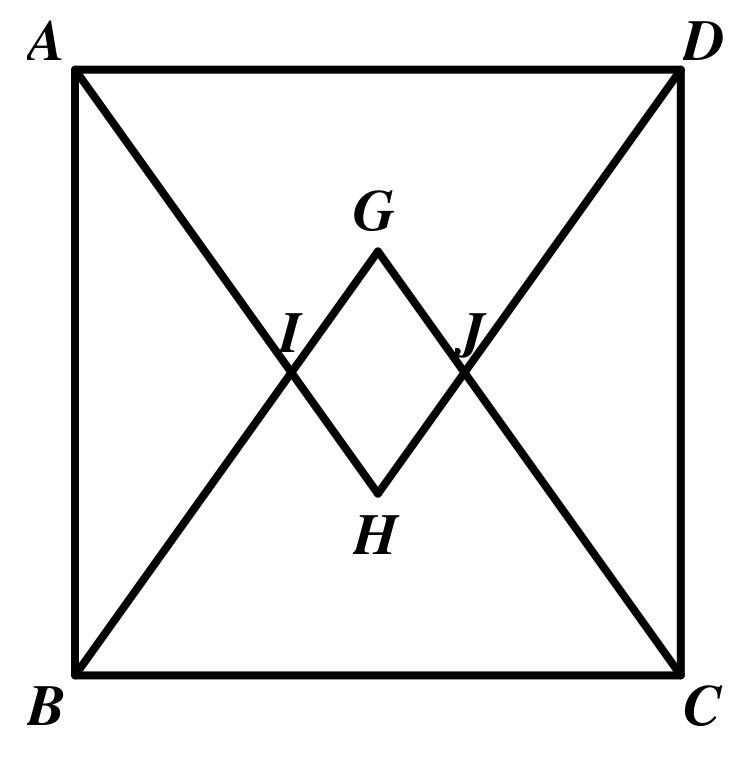
In the diagram, $ABCD$ is a square of side 6, and $AHD$ and $BCG$ are equilateral triangles inside it. Points $I$ and $J$ are the intersections shown: $I=AH\cap BG$ and $J=DH\cap CG$. Find the area of rhombus $IGJH$. Choose one option.
Find the positive integer $x$ satisfying
$$x=\sqrt{5+\sqrt{13+\sqrt{5+\sqrt{13+\cdots}}}}.$$
The radicands alternate 5 and 13 indefinitely, using non-negative square roots. Interpret the expression as the limit of its finite truncations. Enter the integer $x$.
Find $p+q+r$ for positive integers $p,q,r$ satisfying
$$\gcd(p,q)=45,\quad\gcd(q,r)=21,\quad\gcd(p,r)=3,$$
$$\operatorname{lcm}(p,q)=4725,\quad\operatorname{lcm}(q,r)=11025,$$
$$\operatorname{lcm}(p,r)=6615.$$
Here gcd means greatest common divisor and lcm means least common multiple. Enter the integer sum only.
How many times does the digit 0 appear in the list of integers from 1000 to 2021, including both endpoints? Count every occurrence, even if a number contains more than one zero. Enter the integer only.
The source asks: “Find the ordered set of 4-tuples of positive integers $[w,x,y,z]$ such that $w+x+y+z=21$.”
**Interpretation and response format:** In agreement with the source's numerical answer key, this version asks for the number of ordered quadruples, not a list of all of them. Every entry is at least 1, and changing the order may produce a different quadruple. Enter the integer count only.
A tangential quadrilateral $ABCD$ is a convex quadrilateral whose sides are tangent to a circle. Given $AD=16$, $BC=8$, and circle radius 4, find the area of the quadrilateral. Choose one option.
A number has only the digit 1 when written in base 3, but its last digit is 0 when written in base 2. What is the largest four-digit number in base 10 with this property? Enter its ordinary base-10 value, without padding it with a leading zero.
Constants $M,N$ satisfy the identity
$$\frac{52x+73}{14x^2+83x+33}=\frac{M}{7x+3}+\frac{N}{2x+11}.$$
Find $MN-M-N$. The identity holds for all real $x$ for which the denominators are nonzero.
**Domain convention:** Treat $x$ as an algebraic root, allowing complex numbers. The equation has no real root. You do not need to find the roots or perform calculations with complex numbers; use a polynomial identity. Enter the resulting number only.
An ant travels from $(7,10)$ to its anthill at $(19,25)$ and must touch the $x$-axis, where sugar is spread. What is its shortest possible travel distance? Assume an unobstructed Euclidean plane. Enter the distance in coordinate units.