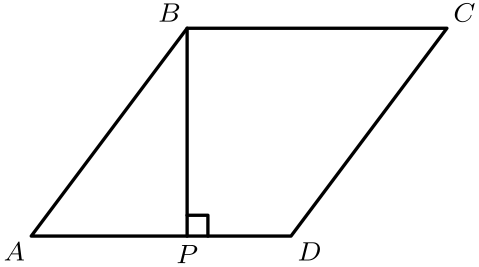
In rhombus $ABCD,$ point $P$ lies on segment $\overline{AD}$ so that $\overline{BP} \perp \overline{AD},$ $AP = 3,$ and $PD = 2.$ What is the area of $ABCD?$ (Note: the figure is not drawn to scale.)
Camila writes down five positive integers. The unique mode of these integers is $2$ greater than their median, and the median is $2$ greater than their arithmetic mean. What is the least possible value for the mode?
The sequence $a_0,$ $a_1,$ $a_2,$ $\cdots$ is a strictly increasing arithmetic sequence of positive integers such that $$
2^{a_7} = 2^{27} \cdot a_7.
$$ What is the minimum possible value of $a_2?$
Regular hexagon $ABCDEF$ has side length $2.$ Let $G$ be the midpoint of $\overline{AB},$ and let $H$ be the midpoint of $\overline{DE}.$ What is the perimeter of $GCHF?$
Kayla rolls four fair $6$-sided dice. What is the probability that at least one of the numbers Kayla rolls is greater than $4$ and at least two of the numbers she rolls are greater than $2?$
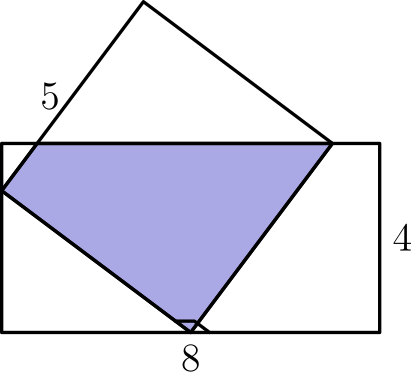
The diagram below shows a rectangle with side lengths $4$ and $8$ and a square with side length $5.$ Three vertices of the square lie on three different sides of the rectangle, as shown. What is the area of the region inside both the square and the rectangle?
How many $4 \times 4$ arrays whose entries are $0$s and $1$s are there such that the row sums (the sum of the entries in each row) are $1,$ $2,$ $3,$ and $4,$ in some order, and the column sums (the sum of the entries in each column) are also $1,$ $2,$ $3,$ and $4,$ in some order? For example, the array $$
\begin{bmatrix} 1 & 1 & 1 & 0 \\ 0 & 1 & 1 & 0 \\ 1 & 1 & 1 & 1 \\ 0 & 1 & 0 & 0 \end{bmatrix}
$$ satisfies the condition.
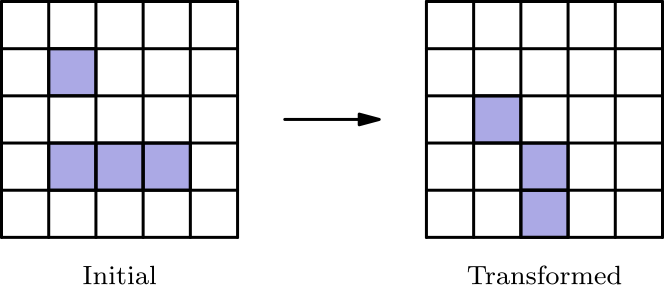
Each square in a $5 \times 5$ grid is either filled or empty, and has up to eight adjacent neighboring squares, where neighboring squares share either a side or a corner. The grid is transformed by the following rules:
Any filled square with two or three filled neighbors remains filled. Any empty square with exactly three filled neighbors becomes a filled square. All other squares remain empty or become empty.
A sample transformation is shown in the figure below.
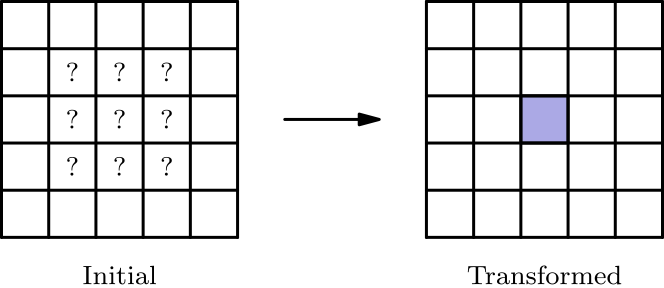
Suppose the $5 \times 5$ grid has a border of empty squares surrounding a $3 \times 3$ subgrid. How many initial configurations will lead to a transformed grid consisting of a single filled square in the center after a single transformation? (Rotations and reflections of the same configuration are considered different.)
In $\triangle ABC$ medians $\overline{AD}$ and $\overline{BE}$ intersect at $G$ and $\triangle AGE$ is equilateral. Then $\cos(C)$ can be written as $\dfrac{m\sqrt p}{n},$ where $m$ and $n$ are relatively prime positive integers and $p$ is a positive integer not divisible by the square of any prime. What is $m + n + p?$
Let $P(x)$ be a polynomial with rational coefficients such that when $P(x)$ is divided by the polynomial $x^2 + x + 1,$ the remainder is $x + 2,$ and when $P(x)$ is divided by the polynomial $x^2 + 1,$ the remainder is $2x + 1.$ There is a unique polynomial of least degree with these two properties. What is the sum of the squares of the coefficients of that polynomial?