Suppose the product $\frac{98}{100}\times\frac{97}{99}\times\frac{96}{98}\times\cdots\times\frac35\times\frac24\times\frac13$ is $\frac ab$ in simplest form, with positive integers $a,b$. Find $a+b-4000$.
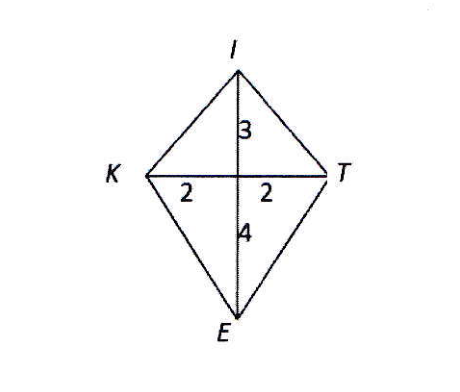
The diagonals of kite $KITE$ are perpendicular. Its perimeter is $2(\sqrt{x}+\sqrt{y})$ units. Find $x+y$.
**Convention:** $x$ and $y$ are the squares of the two different adjacent side lengths obtained from the right triangles in the figure; do not arbitrarily rewrite the radical sum. The diagonal intersection splits $KT$ into lengths 2 and 2, and $IE$ into lengths 3 and 4.
Seven unique awards are to be handed to seven exceptional students, one award per student. The probability that every award goes to an incorrect recipient is $\frac ab$ in simplest form. Find $a+b$. You are given that the corresponding probabilities for five and six awards are $\frac{11}{30}$ and $\frac{53}{144}$.
**Probability convention:** Each award has a different intended recipient, and all one-to-one assignments are equally likely. Enter the integer $a+b$.
In a three-digit number $\overline{XYZ}$, the nonzero digits $X,Y,Z$, in that order, form an arithmetic progression. If $\overline{XYZ}-\overline{ZXY}=M$, find the largest three-digit value of $M$.
The overline denotes a decimal number, not a product. Enter the integer $M$.
Determine the number of non-negative integers $M$ satisfying exactly three of the following four statements:
1. $M$ is prime.
2. $M+3$ is prime.
3. $1\lt \sqrt M\lt 8$.
4. $M+5$ has an odd number of factors.
**Answer format:** Enter the count of admissible integers, not one example of $M$. Factors mean positive integer divisors; 1 is not prime.
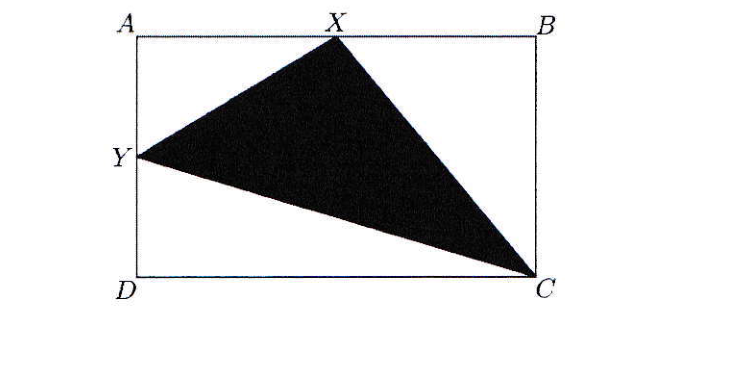
In rectangle $ABCD$, $X$ is the midpoint of $AB$ and $Y$ is the midpoint of $AD$. Find the area of triangle $XYC$, in $\mathrm{cm}^2$, if the rectangle's area is $880\mathrm{\ cm}^2$.
In a class of 50 students, 15 like Maths, 27 like English, and 13 like neither subject. How many like both Maths and English? Enter the number of students.
Find the positive integer $x$ satisfying
$$x=\sqrt{5+\sqrt{13+\sqrt{5+\sqrt{13+\cdots}}}}.$$
The radicands alternate 5 and 13 indefinitely, using non-negative square roots. Interpret the expression as the limit of its finite truncations. Enter the integer $x$.
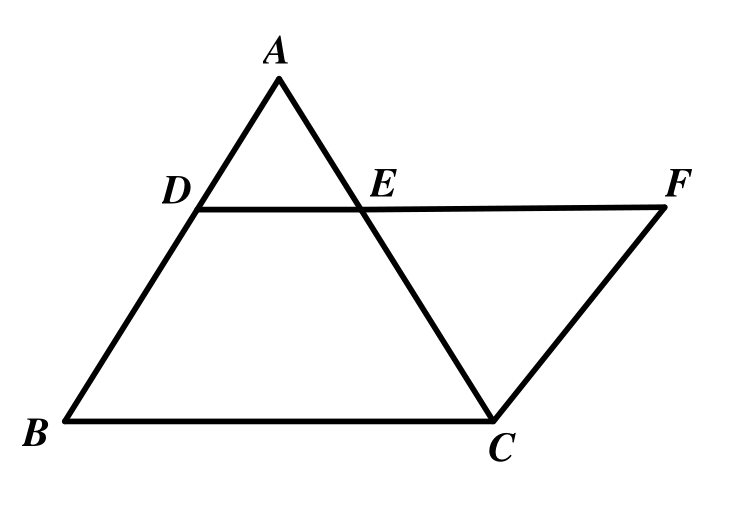
In triangle $ABC$, $D$ lies on $AB$ with $BD=3AD$. Point $E$ lies on $AC$ with $DE\parallel BC$. Point $F$ lies on the line $DE$ with $CF\parallel AB$. Find $EF$ if $BC=16$.