$E$ is the midpoint of side $BC$ of triangle $ABC$. Point $F$ lies on $AC$ and $AC=3FC$. Find the ratio of the area of quadrilateral $ABEF$ to the area of triangle $ABC$.
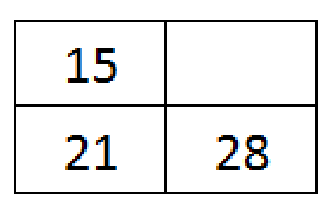
A rectangle is divided into four rectangles as shown. The areas of three parts are given in $\mathrm{cm}^2$. Find the area of the original rectangle in $\mathrm{cm}^2$.
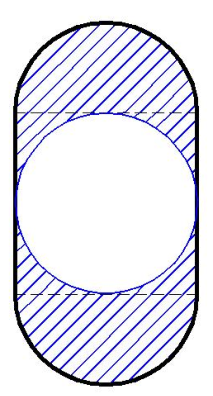
The shape is formed by placing two semicircles of diameter $2\mathrm{\ cm}$ above and below a square of side $2\mathrm{\ cm}$. A circle is inscribed in the square as shown. Find the shaded area in $\mathrm{cm}^2$.
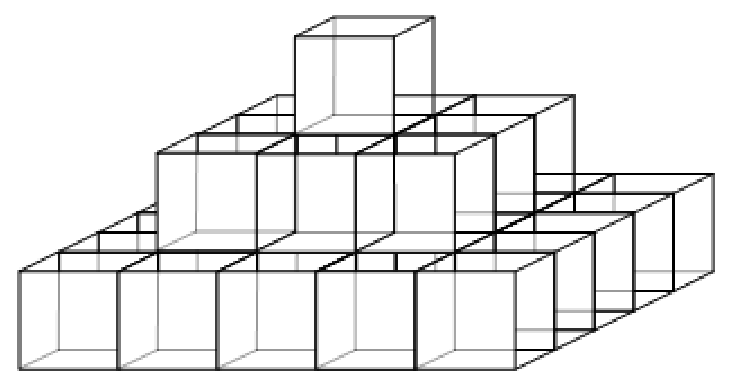
Cubes are stacked as shown. From the top down, the levels contain $1$, $3\times3$, $5\times5$, and so on cubes. There are $2010$ cubes available; every level must be complete, and some cubes may remain unused. What is the maximum number of levels?
Draw a square inside a circle of radius $1$ with all four vertices on the circle. Find the ratio of the area of the square to the area of the circle. Use $\pi=22/7$.
The areas of three faces of a rectangular box are $35$, $55$ and $77\mathrm{\ cm}^2$. Its length, width and height are integers. Find its volume in $\mathrm{cm}^3$.
The operations $\circ$ and $\blacklozenge$ are defined by the tables. For example, $2\circ3=2$ and $2\blacklozenge3=3$. Find $(1\blacklozenge2)\circ3$.
How many trailing zeros are in $$\begin{gathered}1\times5\times10\times15\times20\times25\times30\\{}\times35\times40\times45\times50\times55\times60\\{}\times65\times70\times75\times80\times85\times90\times95\end{gathered}$$?
A rod is $16$ meters long. A device divides any one piece into two equal pieces. Use the device $8$ times, leaving $9$ pieces. What is the greatest possible difference, in meters, between the longest and shortest pieces?
Rearrange the clock numbers $1,2,\ldots,12$ so that every adjacent pair sums to a triangular number. Triangular numbers are $1,3,6,10,15,21,\ldots$. If $12$ remains in its original position, which number must be opposite it?
Circles $A,B,C$ each have area $60\mathrm{\ cm}^2$. One-half of $A$, one-third of $B$, and one-quarter of $C$ are shaded, as shown. Find the total shaded area in $\mathrm{cm}^2$.
For a positive integer $n$, let $d(n)$ be its digit sum. For example, $d(123)=1+2+3=6$ and $d(7879)=7+8+7+9=31$. Find $d(d(999\,888\,777\,666\,555\,444\,333\,222\,111))$.
The numbers $1447$, $1005$, and $1231$ are four-digit numbers starting with $1$ and having exactly two identical digits. How many such numbers are there?