Six points $A,$ $B,$ $C,$ $D,$ $E,$ and $F$ lie in a straight line in that order. Suppose that $G$ is a point not on the line and that $AC = 26,$ $BD = 22,$ $CE = 31,$ $DF = 33,$ $AF = 73,$ $CG = 40,$ and $DG = 30.$ Find the area of $\triangle BGE.$
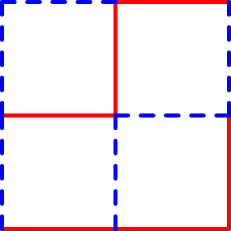
Four unit squares form a $2 \times 2$ grid. Each of the $12$ unit line segments forming the sides of the squares is colored either red or blue in such a way that each unit square has $2$ red sides and $2$ blue sides. One example is shown below (red is solid, blue is dashed). Find the number of such colorings.
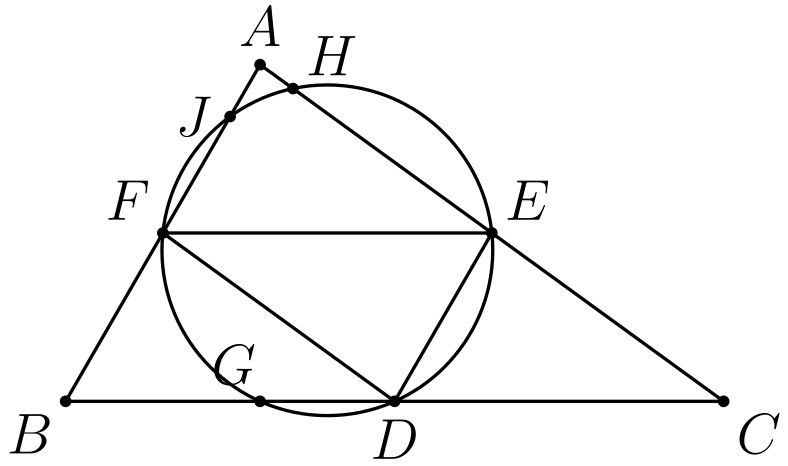
Suppose $\triangle ABC$ has angles $\angle BAC = 84^\circ,$ $\angle ABC = 60^\circ,$ and $\angle ACB = 36^\circ.$ Let $D,$ $E,$ and $F$ be the midpoints of sides $\overline{BC},$ $\overline{AC},$ and $\overline{AB},$ respectively. The circumcircle of $\triangle DEF$ intersects $\overline{BD},$ $\overline{AE},$ and $\overline{AF}$ at points $G,$ $H,$ and $J,$ respectively. The points $G,$ $D,$ $E,$ $H,$ $J,$ and $F$ divide the circumcircle of $\triangle DEF$ into six minor arcs, as shown. Find $\overset{\frown}{DE} + 2 \cdot \overset{\frown}{HJ} + 3 \cdot \overset{\frown}{FG},$ where the arcs are measured in degrees.
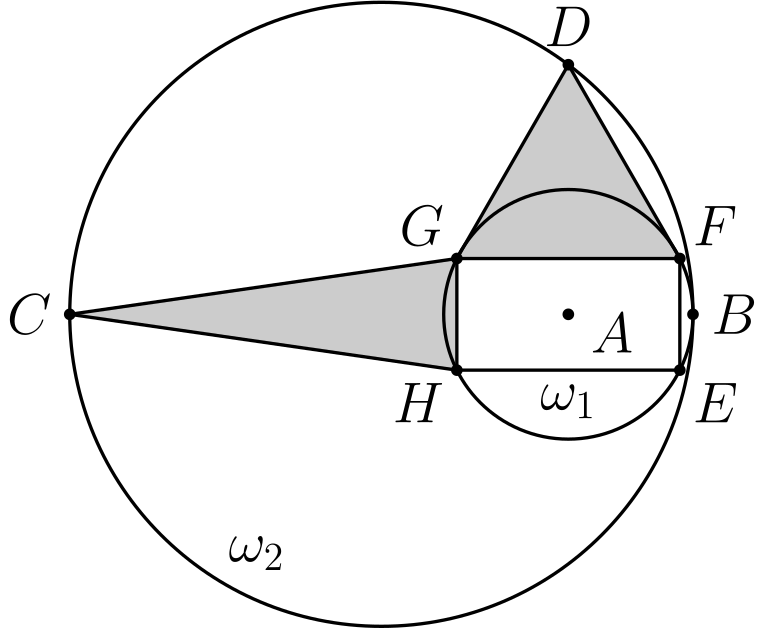
Circle $\omega_1$ with radius $6$ centered at point $A$ is internally tangent at point $B$ to circle $\omega_2$ with radius $15.$ Points $C$ and $D$ lie on $\omega_2$ such that $\overline{BC}$ is a diameter of $\omega_2$ and $\overline{BC} \perp \overline{AD}.$ The rectangle $EFGH$ is inscribed in $\omega_1$ such that $\overline{EF} \perp \overline{BC},$ $C$ is closer to $\overline{GH}$ than to $\overline{EF},$ and $D$ is closer to $\overline{FG}$ than to $\overline{EH},$ as shown. Triangles $\triangle DGF$ and $\triangle CHG$ have equal areas. The area of rectangle $EFGH$ is $\frac{m}{n},$ where $m$ and $n$ are relatively prime positive integers. Find $m + n.$
Let $A$ be the set of positive integer divisors of $2025.$ Let $B$ be a randomly selected subset of $A.$ The probability that $B$ is a nonempty set with the property that the least common multiple of its elements is $2025$ is $\frac{m}{n},$ where $m$ and $n$ are relatively prime positive integers. Find $m + n.$
From an unlimited supply of $1$-cent coins, $10$-cent coins, and $25$-cent coins, Silas wants to find a collection of coins that has a total value of $N$ cents, where $N$ is a positive integer. He uses the so-called *greedy algorithm*, successively choosing the coin of greatest value that does not cause the value of his collection to exceed $N.$ For example, to get $42$ cents, Silas will choose a $25$-cent coin, then a $10$-cent coin, then $7$ $1$-cent coins. However, this collection of $9$ coins uses more coins than necessary to get a total of $42$ cents; indeed, choosing $4$ $10$-cent coins and $2$ $1$-cent coins achieves the same total value with only $6$ coins.
In general, the greedy algorithm succeeds for a given $N$ if no other collection of $1$-cent, $10$-cent, and $25$-cent coins gives a total value of $N$ cents using strictly fewer coins than the collection given by the greedy algorithm. Find the number of values of $N$ between $1$ and $1000$ inclusive for which the greedy algorithm succeeds.
There are $n$ values of $x$ in the interval $0 \lt x \lt 2\pi$ where $f(x) = \sin(7\pi \cdot \sin(5x)) = 0.$ For $t$ of these $n$ values of $x,$ the graph of $y = f(x)$ is tangent to the $x$-axis. Find $n + t.$
Sixteen chairs are arranged in a row. Eight people each select a chair in which to sit so that no person sits next to two other people. Let $N$ be the number of subsets of $16$ chairs that could be selected. Find the remainder when $N$ is divided by $1000.$
Let $S$ be the set of vertices of a regular $24$-gon. Find the number of ways to draw $12$ segments of equal lengths so that each vertex in $S$ is an endpoint of exactly one of the $12$ segments.
Let $A_1A_2 \ldots A_{11}$ be an $11$-sided non-convex simple polygon with the following properties:
• For every integer $2 \le i \le 10,$ the area of $\triangle A_iA_1A_{i+1}$ is $1.$
• For every integer $2 \le i \le 10,$ $\cos(\angle A_iA_1A_{i+1}) = \frac{12}{13}.$
• The perimeter of the $11$-gon $A_1A_2 \ldots A_{11}$ is equal to $20.$
Then $A_1A_2 + A_1A_{11}$ can be expressed as $\frac{m\sqrt{n} - p}{q}$ where $m,$ $n,$ $p,$ and $q$ are positive integers, $n$ is not divisible by the square of any prime, and no prime divides all of $m,$ $p,$ and $q.$ Find $m + n + p + q.$
Let the sequence of rationals $x_1,$ $x_2,$ $\ldots$ be defined such that $x_1 = \frac{25}{11}$ and $$
x_{k+1} = \frac{1}{3}\left(x_k + \frac{1}{x_k} - 1\right)
$$ for all $k \ge 1.$ Then $x_{2025}$ can be expressed as $\frac{m}{n}$ for relatively prime positive integers $m$ and $n.$ Find the remainder when $m + n$ is divided by $1000.$
Let $\triangle ABC$ be a right triangle with $\angle A = 90^\circ$ and $BC = 38.$ There exist points $K$ and $L$ inside the triangle such that $$
\begin{gathered} AK = AL = BK \\ = CL = KL = 14. \end{gathered}
$$ The area of the quadrilateral $BKLC$ can be expressed as $n\sqrt{3}$ for some positive integer $n.$ Find $n.$
There are exactly three positive real numbers $k$ such that the function $$
\begin{aligned} f(x) &= \frac{(x - 18)(x - 72)}{x} \\ &\quad {}\cdot (x - 98)(x - k) \end{aligned}
$$ defined over the positive real numbers achieves its minimum value at exactly two positive real numbers $x.$ Find the sum of these three values of $k.$