The roots of the quadratic equation $x^2-7mx+5n=0$ are $m$ and $n$, where $m\ne0$ and $n\ne0$. Find a quadratic equation whose roots are $\frac mn$ and $\frac nm$.
Suppose that $\sin x=\frac{12}{13}$ and $\cos y=-\frac45$, where $0^\circ\le x\le90^\circ$ and $90^\circ\le y\le180^\circ$. Find the value of $\cos(x+y)$.
The coordinates of the vertices of a triangle $\triangle ABC$ are $A(6,0)$, $B(0,8)$ and $C(x,y)$ such that $x^2-16x+y^2-12y+91=0$. Find the largest possible value of the area of the triangle $\triangle ABC$.
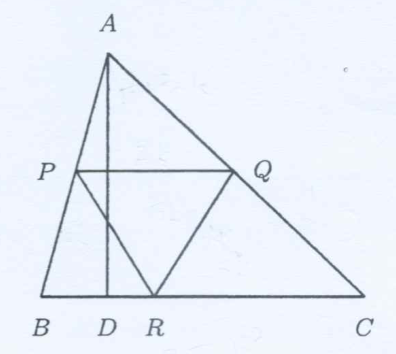
In the figure below, $AD$ is perpendicular to $BC$, $PQ$ is parallel to $BC$, and the triangle $\triangle PQR$ is an equilateral triangle whose area (in meter$^2$) is equal to the length of $AD$ (in meter). Find the smallest possible value of the length of $BC$.
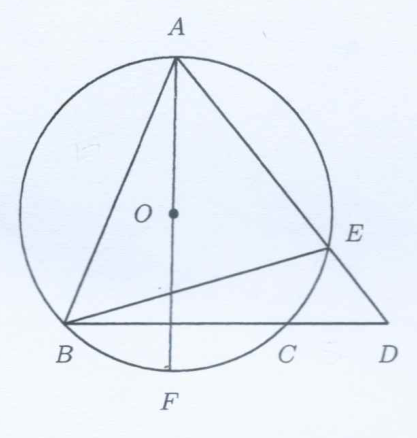
In the figure below, the chord $AF$ passes through the origin $O$ of the circle, and is perpendicular to the chord $BC$. It is given that $AB=17$ cm, $CD=5$ cm. Suppose $\frac{BE}{ED}=\frac mn$, where $m$ and $n$ are positive integers which are relatively prime. What is the value of $m+n$?
Let $P(x)$ be the polynomial that results from the expansion of the following expression: $$(2x^3+3x^2+x)^5\left(\frac x6+\frac12\right)^5.$$ Find the sum of the coefficients of $x^{2k+1}$, where $k=0,1,2,3,\ldots,9$.
Find the value of the following expression: $$\frac{2(1^2+2^2+3^2+\cdots+49^2+50^2)+(1\times2)+(2\times3)+(3\times4)+\cdots+(48\times49)+(49\times50)}{100}.$$
Find the maximum possible value of $x+y+z$ where $x,y,z$ are integers satisfying the following system of equations: $$x^2z+y^2z+8xy=200,\qquad 2x^2+2y^2+xyz=50.$$
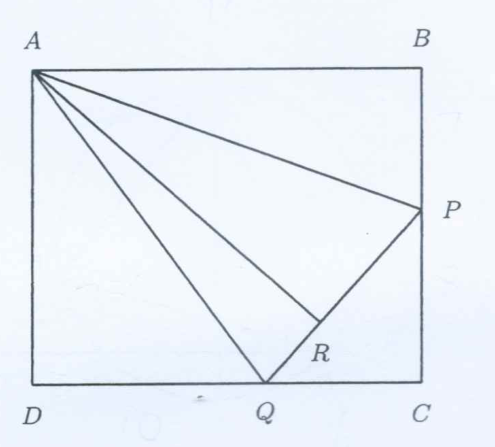
The figure below shows a rectangle $ABCD$ with $AB=16$ cm and $BC=15$ cm. Let $P$ be a point on the side $BC$ such that $BP=7$ cm, and let $Q$ be a point on the side $CD$ such that $CQ=6$ cm. Find the length of $AR$ (in cm), where $R$ is the foot of the perpendicular from $A$ to $PQ$.
A sequence $x_0,x_1,x_2,x_3,\ldots$ of integers satisfies the following conditions: $x_0=1$, and for any positive integer $n\ge1$, $|x_n-1|=|x_{n-1}+2|$. Find the maximum possible value of $2019-(x_1+x_2+\cdots+x_{2018})$.