Skip to content / Đến nội dung
ThichHocToan.com

SMO 2006 Senior Round 1

Question 1

Let $p=2^{3009}$, $q=3^{2006}$ and $r=5^{1003}$. Which of the following statements is true?
  1. $p\lt q\lt r$
  2. $p\lt r\lt q$
  3. $q\lt p\lt r$
  4. $r\lt p\lt q$
  5. $q\lt r\lt p$

Question 2

Which of the following numbers is the largest?
  1. $30^{20}$
  2. $10^{30}$
  3. $30^{10}+20^{20}$
  4. $(30+10)^{20}$
  5. $(30\times20)^{10}$

Question 3

What is the last digit of $2^2+20^{20}+200^{200}+2006^{2006}$?
  1. $2$
  2. $4$
  3. $6$
  4. $8$
  5. $0$

Question 4

Let $x$ be a number such that $x+\dfrac1x=4$. Find $x^3+\dfrac1{x^3}$.
  1. $48$
  2. $50$
  3. $52$
  4. $54$
  5. None of the above

Question 5

Consider the two curves $y=2x^3+6x+1$ and $y=-\dfrac3{x^2}$ in the Cartesian plane. Find the number of distinct points at which these two curves intersect.
  1. $1$
  2. $2$
  3. $3$
  4. $0$
  5. $5$

Question 6

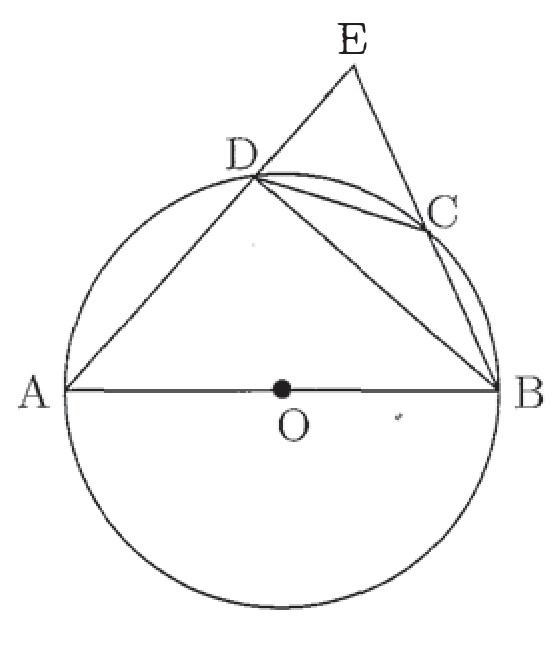
In the following figure, $AB$ is the diameter of a circle with centre $O$. It is given that $AB=4$ cm, $BC=3$ cm, and $\angle ABD=\angle DBE$. Suppose the area of quadrilateral $ABCD$ is $x$ cm$^2$ and the area of $\triangle DCE$ is $y$ cm$^2$. Find the ratio $x/y$.

Question illustration
  1. $7$
  2. $8$
  3. $4$
  4. $5$
  5. $6$

Question 7

Five students $A,B,C,D,E$ form a team to take part in a $5$-leg relay competition. If $A$ cannot run the first leg and $D$ cannot run the last leg, how many ways can we arrange them to run the relay?
  1. $74$
  2. $76$
  3. $78$
  4. $80$
  5. $82$

Question 8

There are $n$ balls in a box, numbered $1,2,3,\ldots,n$. One ball is removed, and the sum of the numbers on the remaining balls is $5048$. If the removed ball has number $m$, find $m$.
  1. $1$
  2. $2$
  3. $3$
  4. $4$
  5. $5$

Question 9

Suppose $a,b,c$ are real numbers such that $a+b+c=0$ and $abc=-100$. Let $x=\dfrac1a+\dfrac1b+\dfrac1c$. Which statement is true?
  1. $x\gt 0$
  2. $x=0$
  3. $-1\lt x\lt 0$
  4. $-100\lt x\lt -1$
  5. $x\lt -100$

Question 10

Let $a,b$ be positive real numbers such that
$$\frac1a-\frac1b-\frac1{a+b}=0.$$
Find $\left(\dfrac ba+\dfrac ab\right)^2$.
  1. $4$
  2. $5$
  3. $6$
  4. $7$
  5. $8$

Question 12

Find the smallest natural number $n$ satisfying $2006^{1003}\lt n^{2006}$.

Question 13

Find the smallest integer greater than $(1+\sqrt2)^3$.

Question 14

Find the number of pairs of positive integers $(x,y)$ satisfying $20x+6y=2006$.

Question 15

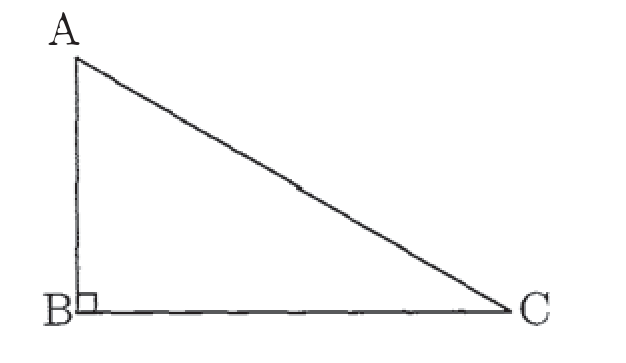
$\triangle ABC$ is right-angled with $\angle ABC=90^\circ$. A circle $C_1$ is drawn with $AB$ as diameter, and another circle $C_2$ with $BC$ as diameter. The circles meet at $B$ and $P$. If $AB=5$ cm, $BC=12$ cm, and $BP=x$ cm, find $2400/x$.

Question illustration

Question 16

Evaluate
$$\frac1{\log_2(12\sqrt5)}+\frac1{\log_3(12\sqrt5)}+\frac1{\log_4(12\sqrt5)}+\frac1{\log_5(12\sqrt5)}+\frac1{\log_6(12\sqrt5)}.$$

Question 17

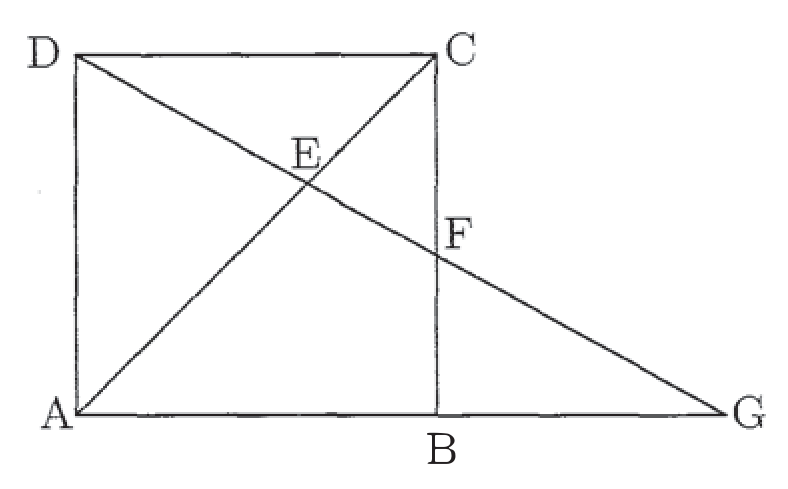
In the diagram below, $ABCD$ is a square. The points $A,B,G$ are collinear. Segments $AC$ and $DG$ intersect at $E$, and segments $DG$ and $BC$ intersect at $F$. Suppose $DE=15$ cm, $EF=9$ cm, and $FG=x$ cm. Find $x$.

Question illustration

Question 18

Find the sum of the coefficients of $(4x^2-4x+3)^4(4+3x-3x^2)^2$.

Question 19

Different positive $3$-digit integers are formed from the five digits $1,2,3,5,7$, and repetitions of digits are allowed. Examples include $352,577,111$. Find the sum of all the distinct positive $3$-digit integers formed in this way.