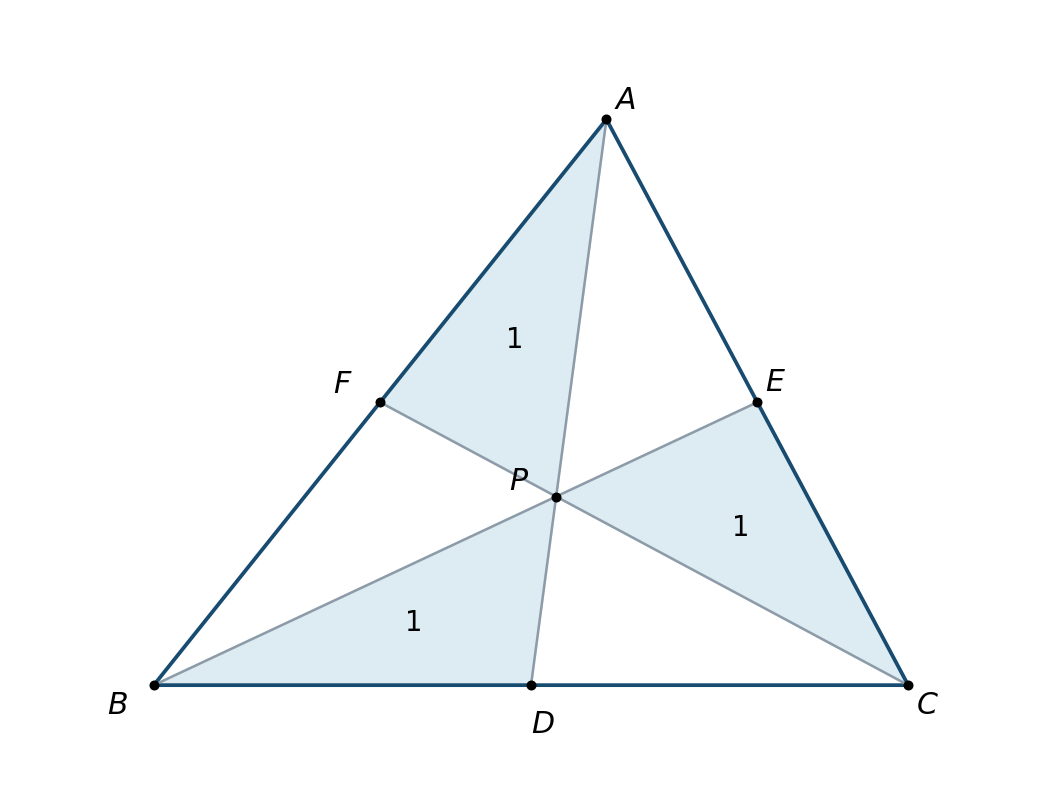
Let $P$ be a point inside triangle $ABC$. Let $D,E,F$ be the intersections of line $AP$ with side $BC$, line $BP$ with side $CA$, and line $CP$ with side $AB$, respectively. Prove that the area of triangle $ABC$ is 6 if each of triangles $PFA,PDB,PEC$ has area 1.
Each cell of a $2012\times2012$ square grid contains a real number in $[0,1]$. Split the grid into two nonempty rectangles of cells by a line parallel to a horizontal or vertical side. Suppose that for every such split, at least one resulting rectangle has sum at most 1. Determine the maximum possible sum of all entries.
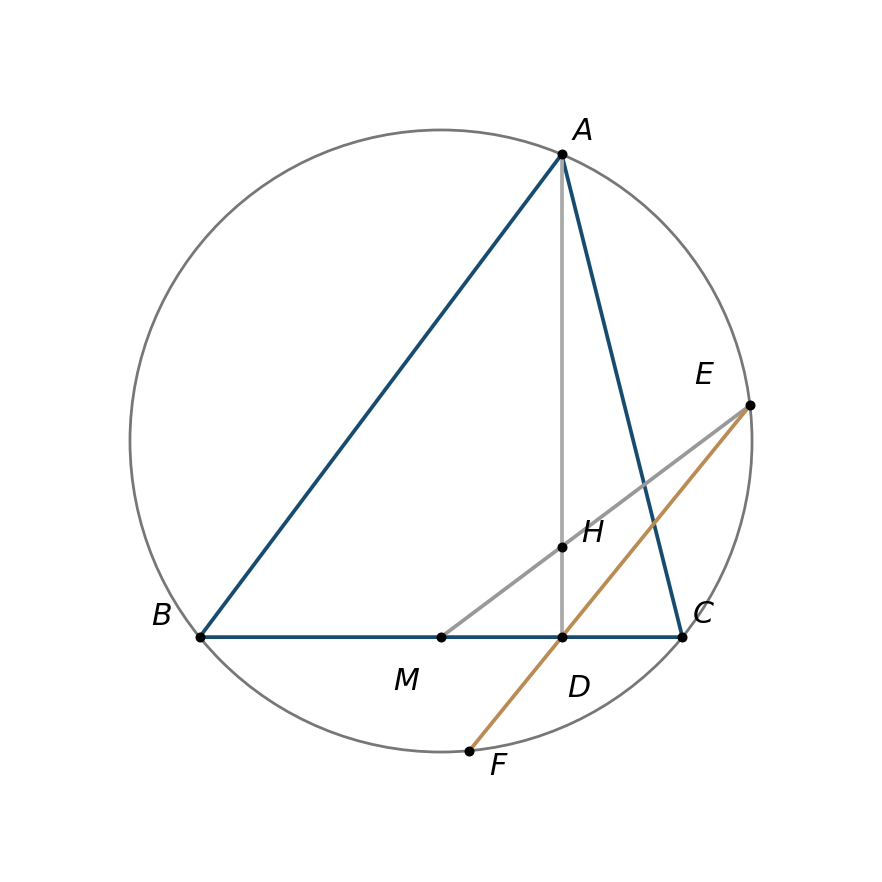
Let $ABC$ be an acute triangle. Let $D$ be the foot of the perpendicular from $A$ to $BC$, $M$ the midpoint of $BC$, and $H$ the orthocenter. Let $E$ be the intersection of the circumcircle $\Gamma$ of $ABC$ with ray $MH$, and $F\ne E$ the other intersection of line $ED$ with $\Gamma$. Prove
$$\frac{BF}{CF}=\frac{AB}{AC},$$
where $XY$ denotes the length of segment $XY$.
Let $n\ge2$ be an integer. Prove that if real numbers $a_1,\ldots,a_n$ satisfy $a_1^2+\cdots+a_n^2=n$, then
$$\sum_{1\le i\lt j\le n}\frac1{n-a_i a_j}\le\frac n2.$$