The equation $x^3-9x^2+11x-1=0$ has the non-negative real roots $p$, $q$ and $r$. If $s=\sqrt p+\sqrt q+\sqrt r$, what is the value of $|s^4-18s^2-8s|$?
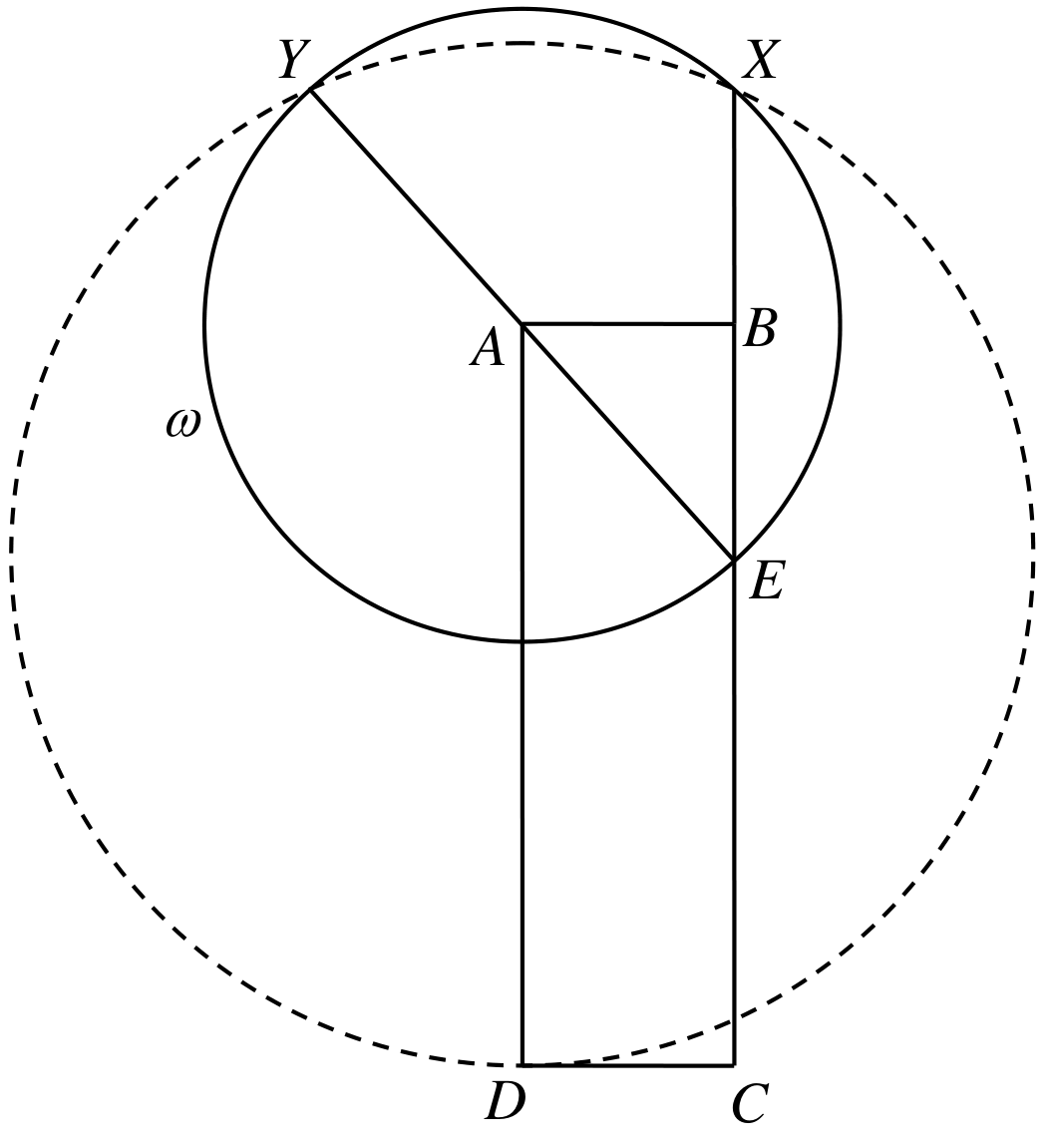
Let $ABCD$ be a rectangle, $E$ is a point on the line segment $BC$. The circle $\omega$ has center $A$ and passes through $E$. Extension lines $EB$ and $AE$ meet $\omega$ at $X$ and $Y$, respectively, as shown in the diagram below. Prove that $DC$ is tangent to the circle passing through $Y$, $X$ and $D$.
Paper instruction: Give a full solution, subject to the example-or-proof instructions in the question.
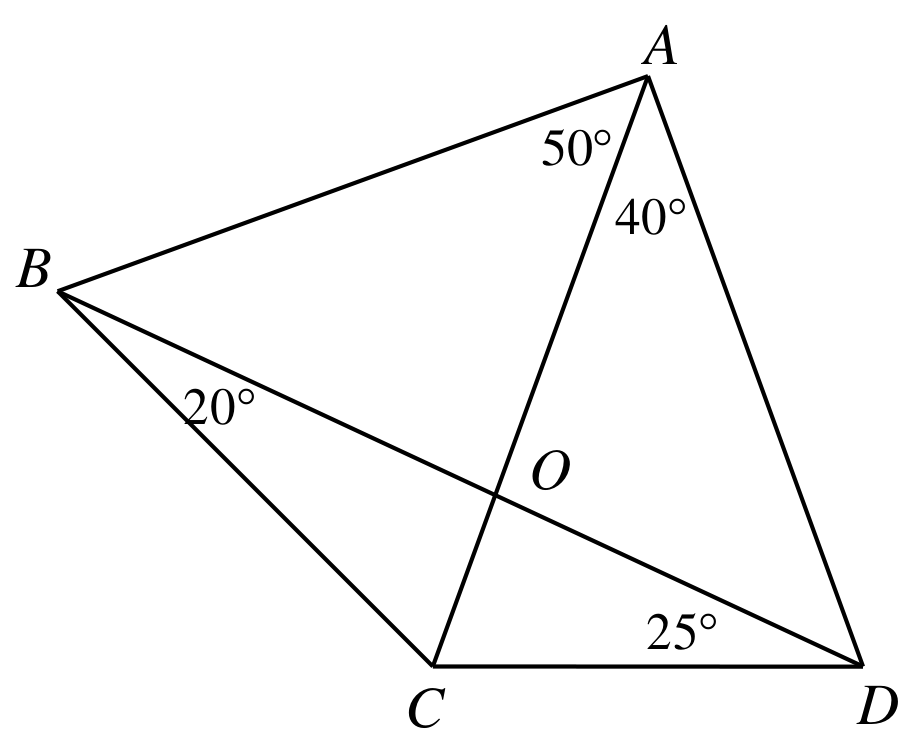
The convex quadrilateral $ABCD$ has $\angle CAD=40^\circ$, $\angle BAC=50^\circ$, $\angle CBD=20^\circ$ and $\angle CDB=25^\circ$, as shown in the diagram below. If $O$ is the intersection of $AC$ and $BD$, what is the measure, in degrees, of $\angle AOB$?
Dinko placed some marbles into one hundred black bags, which are numbered from 1 to 100. Each time, you are allowed to ask Dinko about the parity of the total number of all the marbles in any 15 distinct bags and Dinko will give you the correct answer. What is the least number of times you need to ask Dinko, in order to determine the parity of the number of the marbles in bag 1 correctly? Show an example and prove your answer.
Paper instruction: Give a full solution, subject to the example-or-proof instructions in the question.
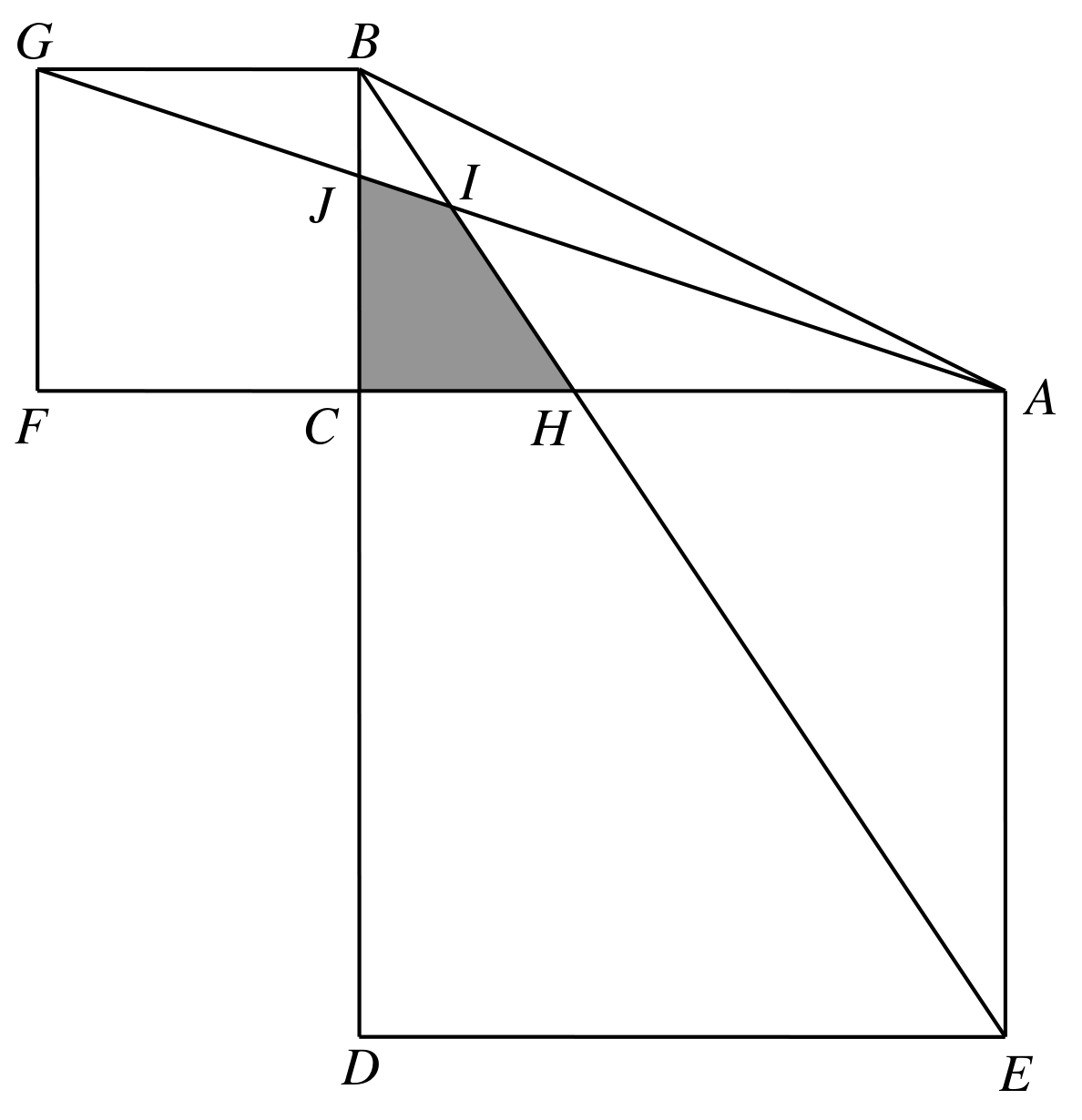
Let $ABC$ be a triangle with $\angle C=90^\circ$, $AC=28$ cm and $BC=14$ cm. Squares $ACDE$ and $BCFG$ are constructed outside the triangle $ABC$. Let $BE$ intersect $AC$ and $AG$ at $H$ and $I$, respectively. $AG$ intersects $BC$ at $J$, as shown in the diagram below. What is the area, in $\mathrm{cm}^2$, of quadrilateral $CHIJ$?
There exists an infinite arithmetic progression satisfying the following properties:
- Each term of the progression is a positive integer.
- The common difference of the progression is $d$.
- No term of the progression appears in the Fibonacci sequence.
What is the smallest positive integer $d$ for which this is possible?
(The Fibonacci sequence is defined as $F_1=1$, $F_2=1$, $F_{n+2}=F_n+F_{n+1}$ for $n\ge1$.)
Paper instruction: Give a full solution, subject to the example-or-proof instructions in the question.
A perfect square $N$ is called a “BIMC number” if there exist three positive integers $a$, $b$ and $c$, where $a\lt b\lt c$, such that
$$N=(b-a)(c-a)(c-b)=ab+ac+bc.$$
For example, $230400$ is a BIMC number since $230400=480\times480$ and
$$230400=(288-224)(324-224)(324-288)$$
$$=224\times288+224\times324+288\times324.$$
What is the smallest BIMC number?
Tim wants to place 1600 points inside a unit square such that there is at least one point inside every rectangle of area $\frac1{200}$ and with sides parallel to those of the square. Is it possible to do it? If your answer is yes, please give an example and show that it works. If your answer is no, please prove it is impossible.
Paper instruction: Give a full solution, subject to the example-or-proof instructions in the question.
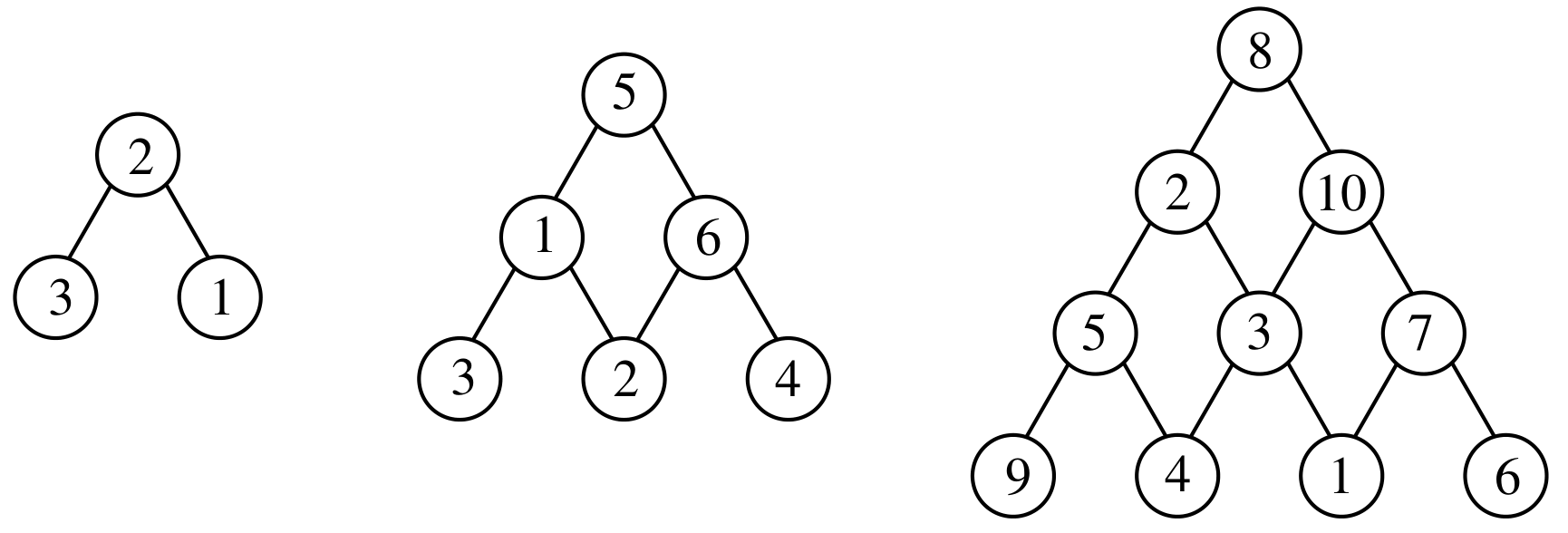
A triangular arrangement of numbers is called a smart triangle of order $n$ if one can arrange all the positive integers from $1$ to $\frac{n(n+1)}2$ in a triangular structure such that, apart from the bottom row of $n$ numbers, each number in a subsequent row above it is the absolute difference or the sum of the two numbers immediately below it.
The triangular structures represented below, from left to right, are some examples of smart triangles of order 2, 3 and 4, respectively.
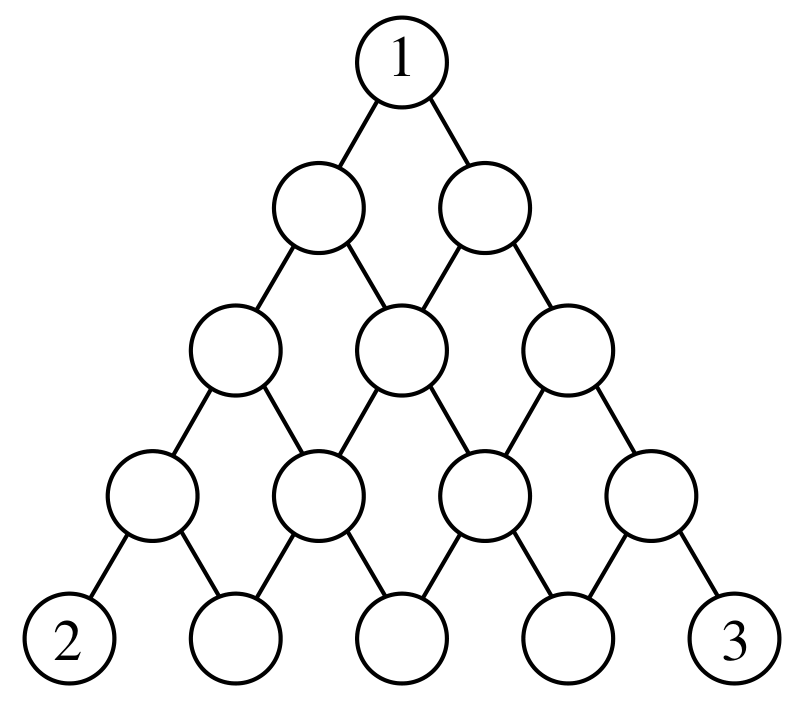
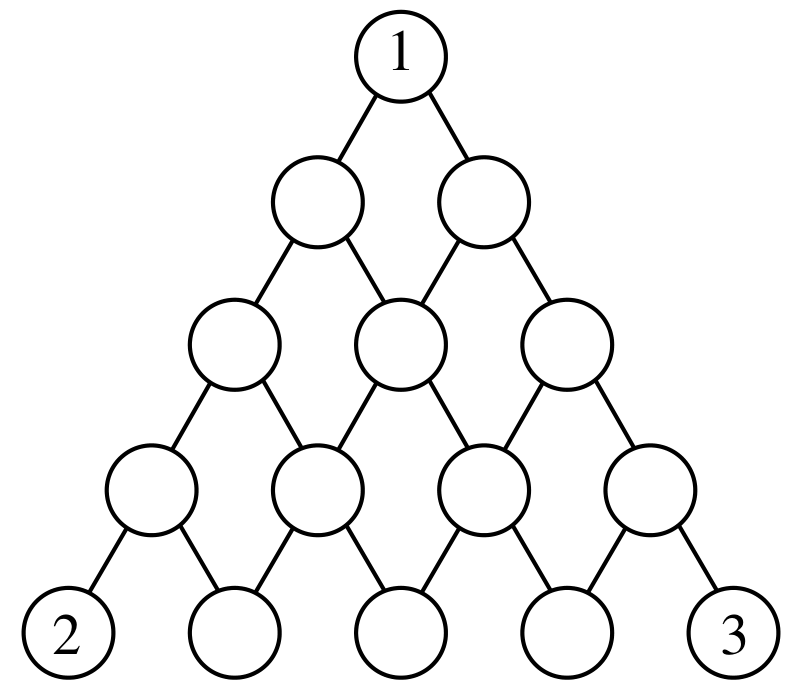
(a) Does there exist a smart triangle of order 5, with the numbers 1, 2 and 3 in the vertices, as shown in the diagram below? If your answer is yes, please give an example. If your answer is no, please prove it is impossible. (10 marks)
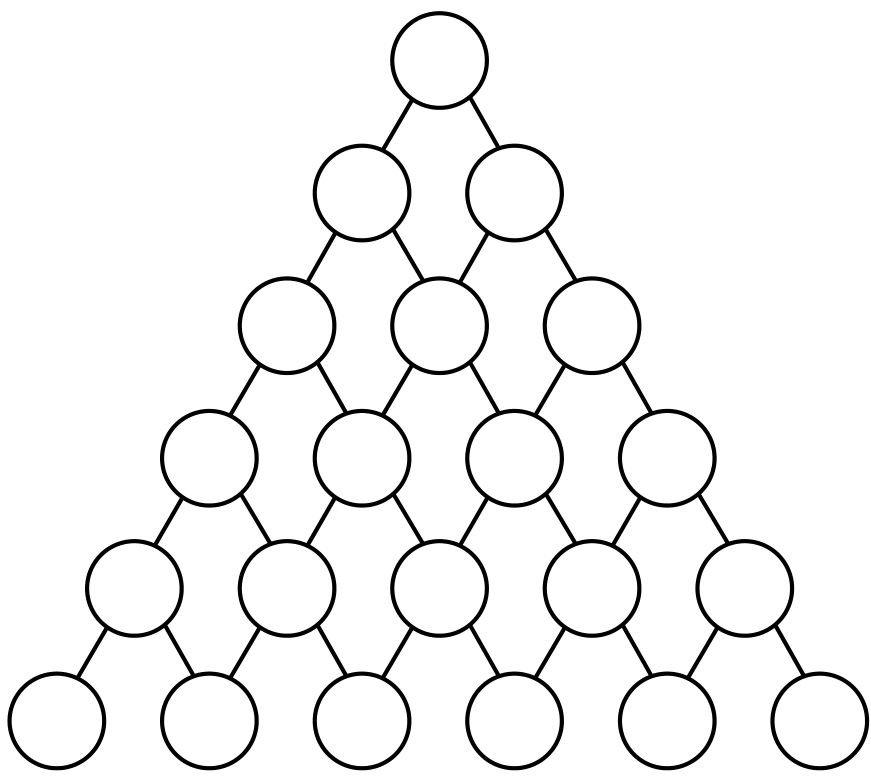
(b) Does there exist a smart triangle of order 6? If your answer is yes, please give an example. If your answer is no, please prove it is impossible. (30 marks)
Original response sheet (continued on the next source page):
(a) My answer is yes and the example is shown on the right. / My answer is no and the proof is:
(b) My answer is yes and the example is shown on the right. / My answer is no and the proof is:
Paper instruction: Give a full solution, subject to the example-or-proof instructions in the question.