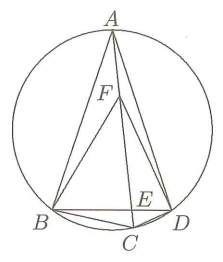
The fraction $p/q$ is in lowest terms and has decimal expansion $0.ababab\ldots$. Digits $a,b$ may coincide but cannot both be zero. How many different numerators $p$ are possible?
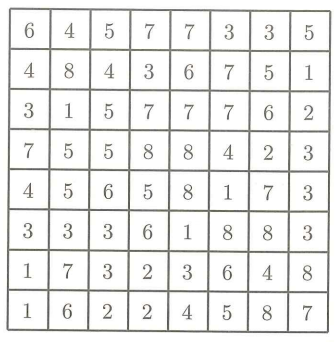
Cover as few cells as possible in the shown $8\times8$ number table so no equal uncovered numbers share a row or column. Two cells sharing an edge cannot both be covered.
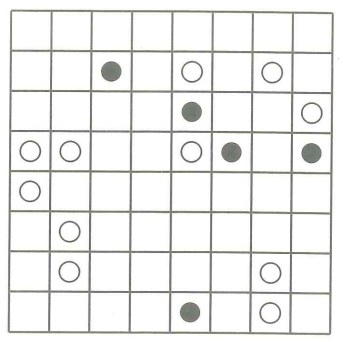
Draw one closed, non-self-intersecting path through edge-adjacent cells of the shown $8\times8$ board. It must visit every circled cell, but need not visit all cells. At every black circle it turns, but at neither the previous nor the next cell may it turn. At every white circle it continues straight, but must turn at the previous or next cell, or both.
Consider boxes with integer dimensions $1\le a\le b\le c\le5$. One box fits inside another exactly when all three corresponding dimensions do not exceed the other dimensions. What is the greatest number of boxes one can choose with none fitting inside another?
Initially one and four are on a blackboard. At each move choose numbers $a,b$ on it and add $c=ab+a+b$. Find the smallest number at least $2008$ that can appear.
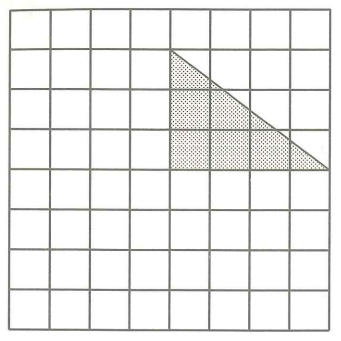
The shaded triangle in the grid has side lengths three, four and five. Find all ways of extending one side to a new point so the resulting triangle has two equal sides.
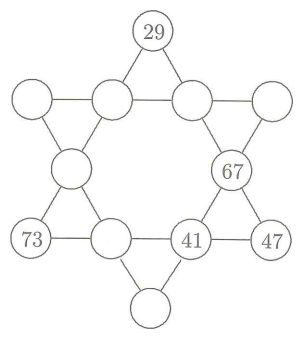
The six-pointed magic star has twelve circles containing prime numbers. The four primes on every line have equal sum. Five primes are given, including the largest and smallest of all twelve. Fill the remaining circles.
Nine identical-looking coins have weights $a$, seven copies of $b$, and $c$, where $a\lt b\lt c$. Using a beam balance at most four times, decide whether $a+c\lt 2b$, $a+c=2b$, or $a+c\gt 2b$.