A teacher wants the largest possible circle inside a triangle with sides $2,2,2x$, for real $x\gt 0$. Alex proposes $x=1$; Brian proposes $x=\sqrt2$; Colin says both are wrong. Who is right?
A triangle can be cut into two isosceles triangles. One original angle is $36^\circ$. Determine all possible values, in degrees, of the original triangle’s largest angle.
Five tetrominoes each consist of four unit squares joined edge to edge. Combine the L-shaped piece with each of the other four shown pieces to form a shape with a reflection axis.
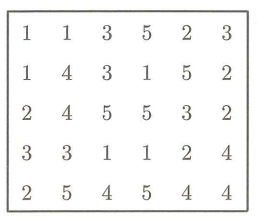
Fifteen dominoes, labelled $11,12,13,14,15,22,23,24,25,33,34,35,44,45,55$, fill the shown $5\times6$ rectangle. Each domino consists of two numbered squares sharing an edge. Their individual boundaries have been erased. Reconstruct them.
Alice and Betty alternately enter zero or one in any blank square of an $n\times n$ board, Alice first. Once full, Betty wins if every row has even sum; otherwise Alice wins. (a) Who has a winning strategy for $n=2006$? (b) Answer for every positive integer $n$.
Delete from the positive integers all multiples of four and all numbers one more than a multiple of four. Let $S_n$ be the sum of the first $n$ remaining terms. Compute $$\lfloor\sqrt{S_1}\rfloor+\lfloor\sqrt{S_2}\rfloor+\cdots+\lfloor\sqrt{S_{2006}}\rfloor,$$ where the floor is the greatest integer not exceeding its argument.
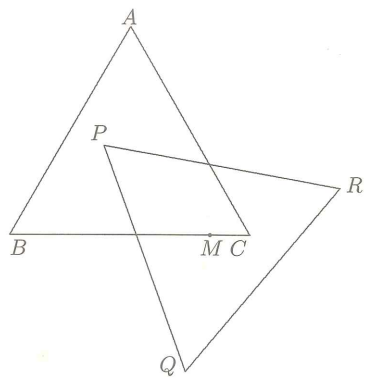
$ABC,PQR$ are equilateral triangles, each of area one square cm. The centre $M$ of $PQR$ lies on the perimeter of $ABC$. Find the minimum intersection area in square cm.