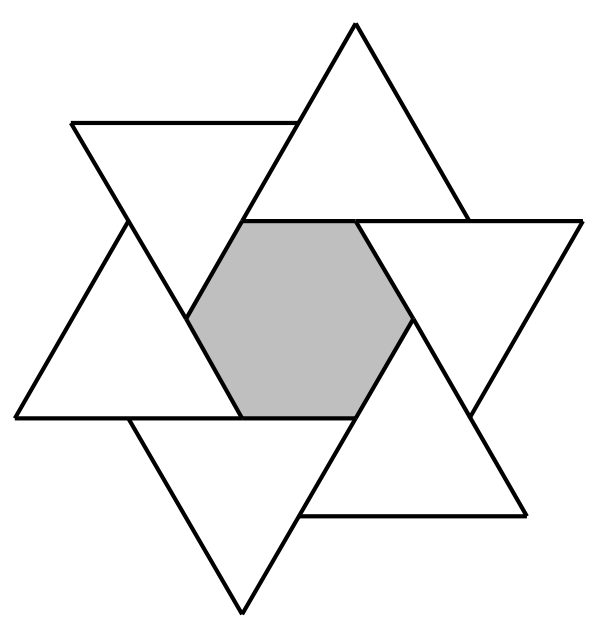
The diagram on the right is composed of six identical equilateral triangles and one regular hexagon, where the ratio of the side length of the equilateral triangle to the side length of the regular hexagon is $2:1$. If the area of the whole diagram is $45$ cm$^2$, then what is the area, in cm$^2$, of the regular hexagon?
At a stationery store, the unit cost, in dollars, of one notebook is an integer. The cost of buying nine identical notebooks is more than $1100$ but less than $1200$ dollars, while the cost of buying thirteen identical notebooks is more than $1500$ but less than $1600$ dollars. What is the cost, in dollars, of one notebook?
The average score obtained by a class of $100$ students in an exam is $79$. If the average score obtained by all the girls in the class is $75$, while the average score obtained by all the boys is the same as the number of boys in the class, then what is the total number of girls in the class?
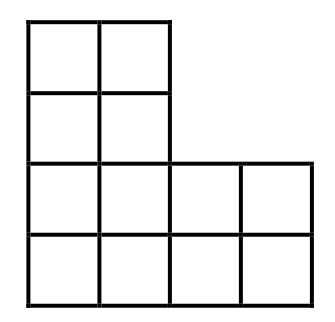
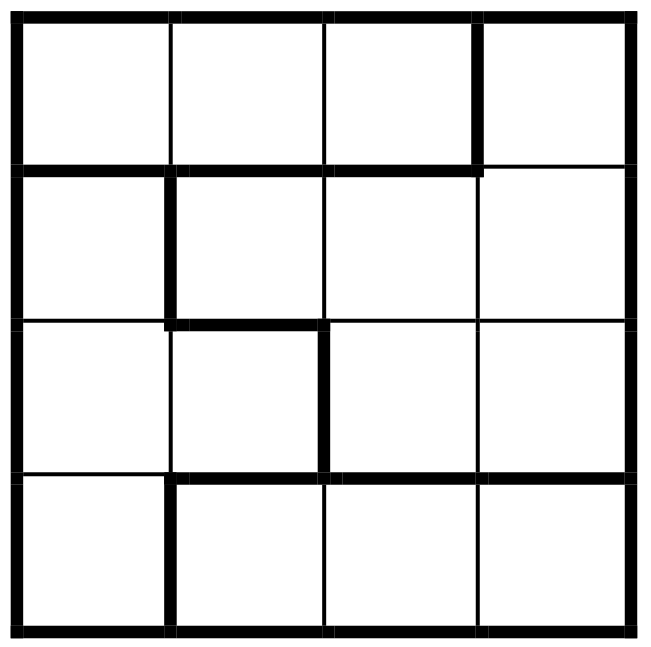
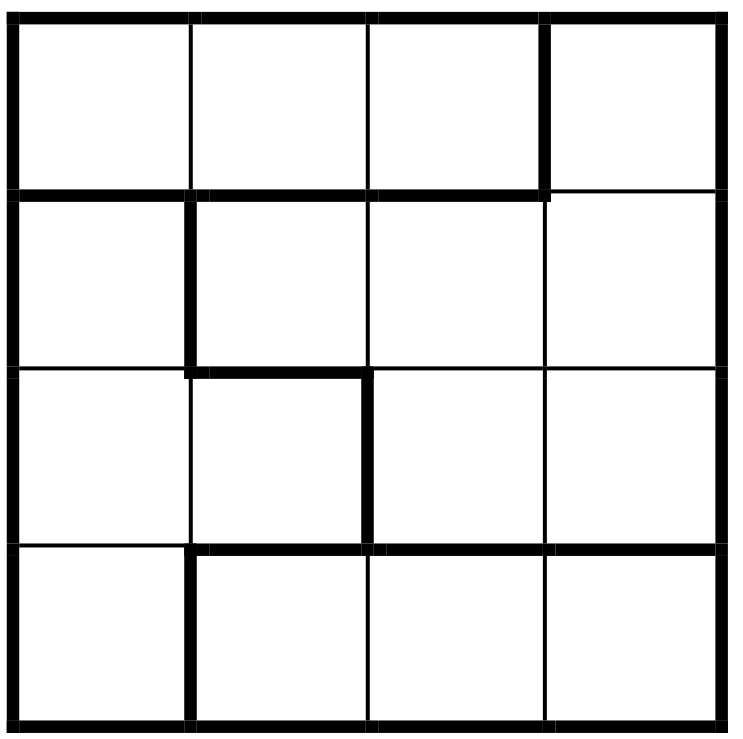
The diagram shows an “L-shaped” figure which is made up by $1\times1$ unit squares. Kitty cuts the figure along the grid lines to make two pieces. She then uses these pieces to form a $2\times6$ rectangle, where the pieces are allowed to be rotated or flipped. What is the minimum positive difference between the areas, in unit squares, of the two pieces?
There are eight big volcanoes and six small volcanoes in Indonesia. Big volcanoes erupt every three years and small volcanoes erupt every two years. If there were $30$ eruptions in the last five years, then how many volcanoes will erupt this year?
In a Mathematics contest, the scores of $10$ students, which are all positive integers, are shown in the table below, except for Grace’s score.
| Student | Score |
|---|---:|
| Alice | 23 |
| Bob | 6 |
| Carla | 14 |
| David | 13 |
| Eric | 23 |
| Freya | 9 |
| Grace | ? |
| Helen | 12 |
| Ivory | 29 |
| Jordan | 19 |
The committee remembers that the difference between the average of the six highest scores and the average of the six lowest scores is $12$. What is the sum of all the possible scores of Grace?
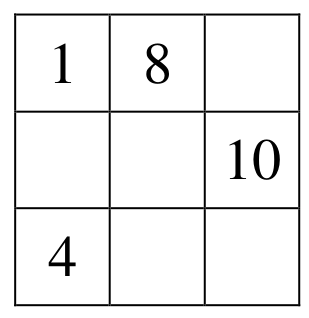
In the following $3\times3$ board, some cells are already filled in with positive integers:
Our goal is to write a positive integer in each of the remaining empty cells in such a way that the following conditions are met:
- All nine integers written on the board must be different from each other.
- The sum of the four integers in any $2\times2$ square is always the same.
Find the smallest possible value for the sum of the nine integers on the board.
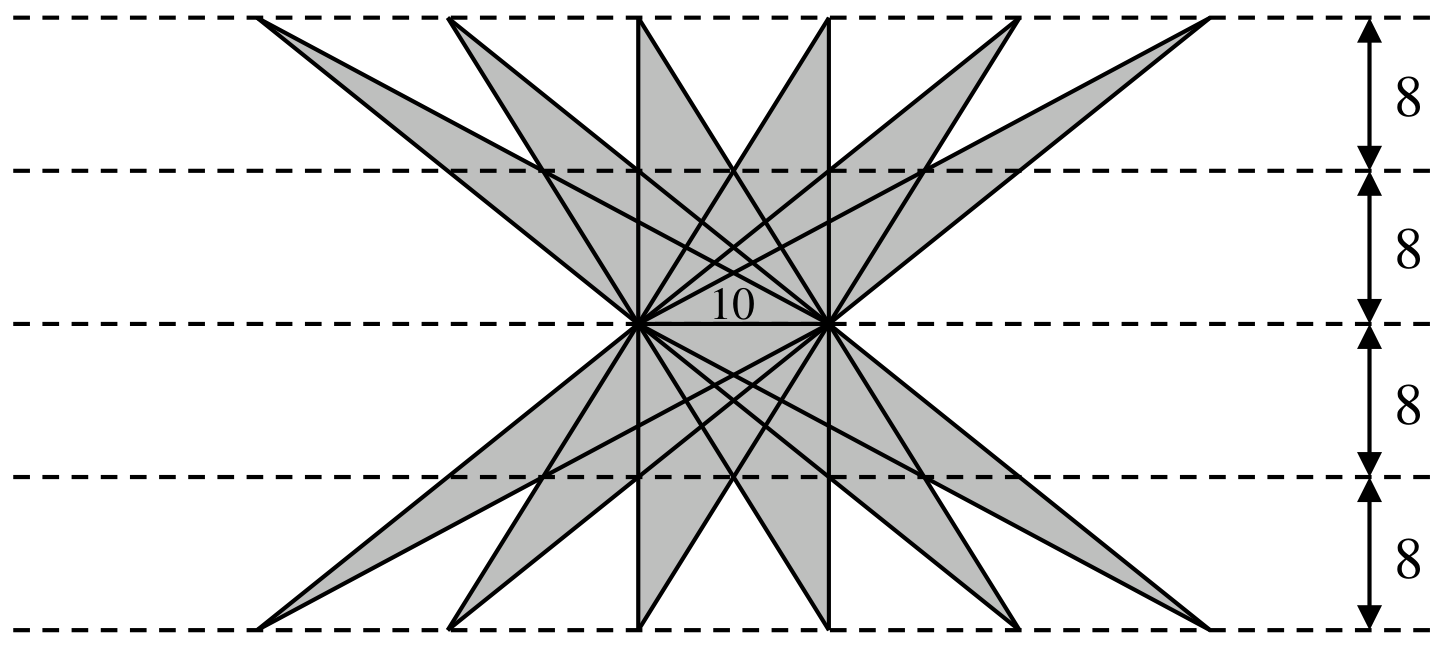
There are five parallel horizontal dashed lines and the distance between two adjacent dashed lines is $8$ cm, as shown on the diagram below. If the length of the segment on the middle dashed line is $10$ cm, what is the area, in cm$^2$, of the shaded region?
Captain Crook and five members of his team are seated at a round table, sharing $99$ coins. If at least three members of the five team members have more coins than each of his two neighbors, then what is the maximum number of coins that Captain Crook can have?
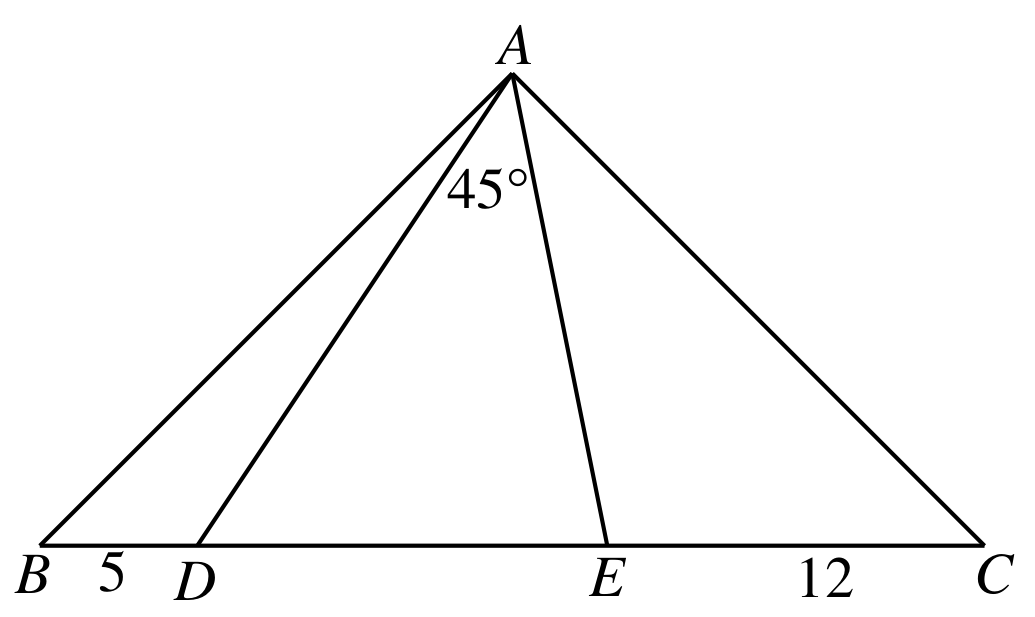
In the diagram below, $ABC$ is a triangle where $AB=AC$ and $\angle BAC=90^\circ$. Points $D$ and $E$ are on $BC$ such that $\angle DAE=45^\circ$. If $BD=5$ cm and $EC=12$ cm, then what is the area, in cm$^2$, of triangle $ABC$?
We want to remove some numbers from the following set:
$$\{1,2,3,4,5,6,7,8,9,10,11,12,13,14,15\}$$
such that the product of the remaining numbers is a multiple of each of the numbers from $1,2,3,\ldots,14,15$. At most how many numbers can we remove?
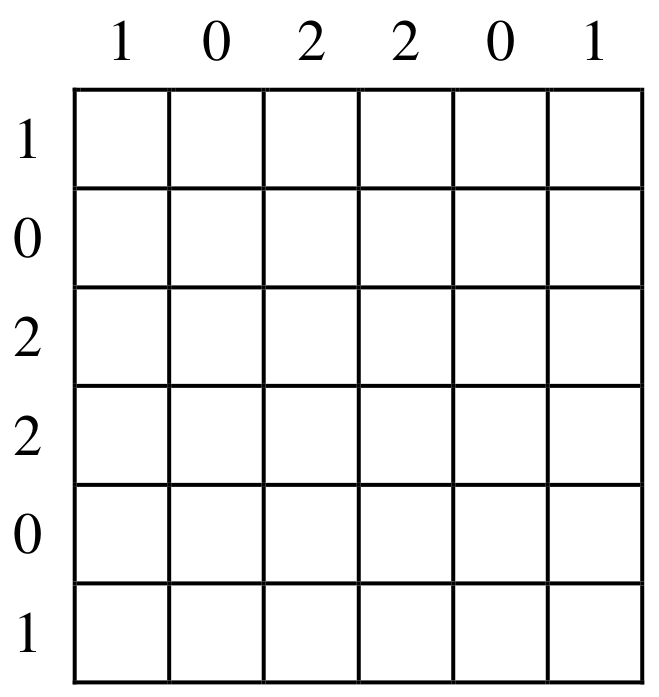
We wish to place some stars into the unit cells of the given $6\times6$ table shown below such that the number written at the top of each column equals the total number of stars in that column, while the number written to the left of each row equals the total number of stars in that row. In how many different ways can the stars be placed? (Note: Each cell can contain at most one star.)
On New Year’s Eve, a group of kids gathered together to play a simple math game. The first kid writes $2022$ on a blackboard. The second kid and every kid thereafter replaces the number written by the previous kid with the product of the digits of that number plus $12$. What number does the $59$th kid write?
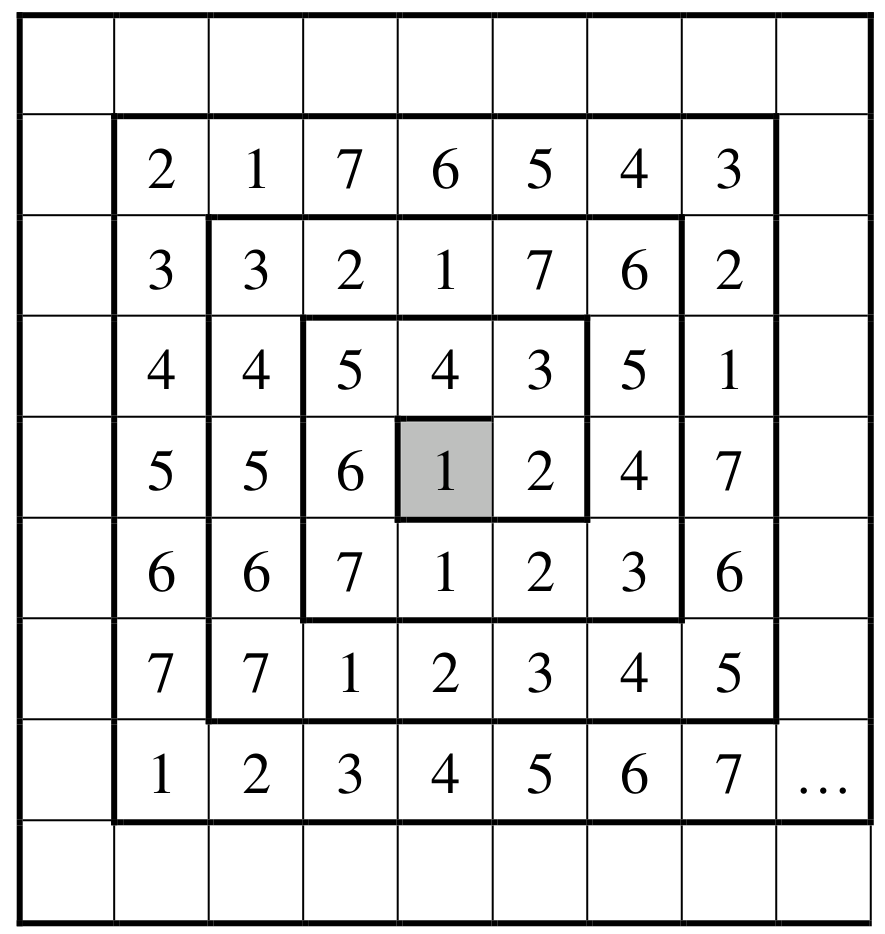
Fill up the infinite grid with the numbers $1,2,3,4,5,6,7,1,2,3,4,5,6,7,1,2,3,4,5,\ldots$ (numbers from $1$ to $7$, repeatedly) in a counterclockwise spiral-like manner starting at the shaded cell as shown in the diagram below. Which number is written in the cell that is located $2022$ cells below the shaded cell?
Select any positive integer $n$ and write down the integers from $0$ to $n$, inclusive, in some order with no spaces.
What is the minimum value of $n$ for which the resulting string can have the same value when read forwards and backwards? What is the resulting string?
A four-digit positive integer is called “good” if it consists of two pairs of same digits in some order but not all four digits are the same. For example, the numbers $2211$, $2424$ and $7007$ are good, while $5555$ and $3111$ are not. Find the total number of “good” four-digit positive integers which are divisible by $7$ or $101$, but not divisible by both.