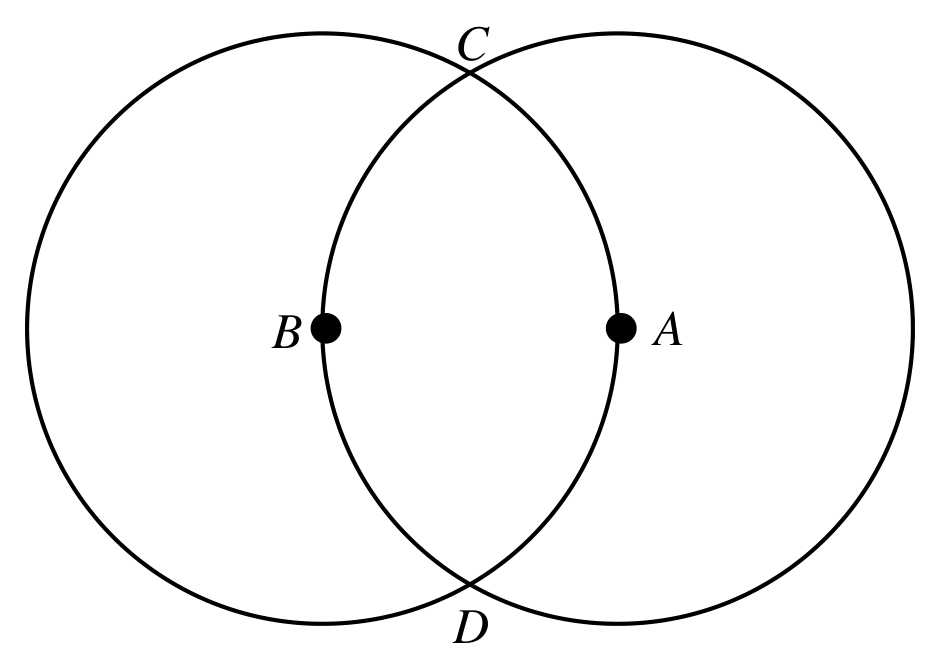
In the figure below, there are two intersecting circles of the same size, with centres $A$ and $B$, such that each circle’s centre lies on the other circle’s circumference. What is the ratio of the length of the arc $CBD$ to the circumference of one circle?
Each of three students $A$, $B$ and $C$ has a calculator and starts doing some operations at the same time. Student $A$ starts from $1509$ and adds $3$ at each step, student $B$ starts from $2019$ and subtracts $7$ at each step, while student $C$ starts from the number $X$ and adds $1$ at the first step, adds $2$ at the second step, adds $3$ at the third step and so on. If after $N$ steps the three students end up with the same result, then find the number $X$.
The city government surveyed all of the grade $5$ and $6$ students to determine the popularity of riding a scooter and skateboarding. Of the grade $5$ students, $9\%$ answered that they like riding a scooter and $14\%$ answered that they like skateboarding. Of the grade $6$ students, $11\%$ answered that they like riding a scooter and $7\%$ answered that they like skateboarding. When combining the grade $5$ and $6$ students, the number of students that like riding a scooter is the same as the number of students that like skateboarding. If the total number of grade $5$ and $6$ students in the city is $59400$ and no student likes both riding a scooter and skateboarding, determine the number of grade $6$ students in the city.
The average of three positive integers is $2019$. If one of the numbers is replaced by $3$, then the average of these $3$ positive integers becomes $673$. What is the original number replaced by $3$?
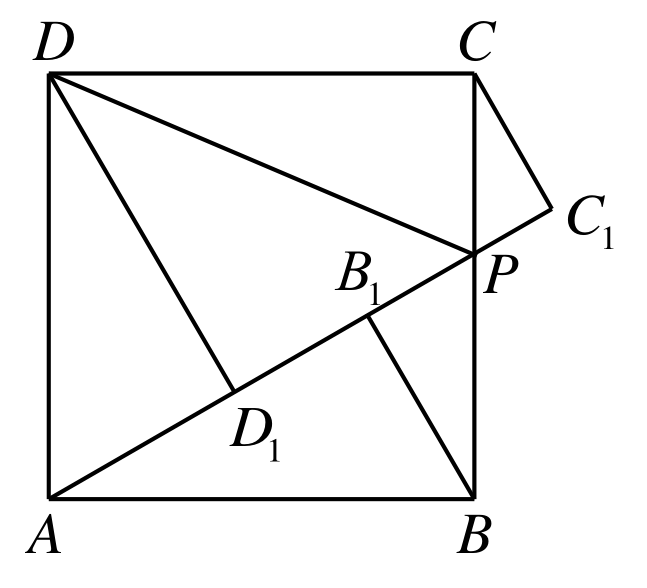
The figure below shows a square $ABCD$, where point $P$ lies on $BC$ and $AP=4$ cm. Let $BB_1$, $CC_1$ and $DD_1$ be the perpendiculars from the points $B$, $C$ and $D$ to the line $AP$ respectively. If $BB_1+CC_1+DD_1=6$ cm, find the area, in $\mathrm{cm}^2$, of triangle $APD$.
Nine baskets contain the following number of eggs: $4$, $5$, $7$, $8$, $12$, $13$, $14$, $23$ and $24$. Anyone who wants to buy eggs must buy all the eggs in a basket. Kitty and Philip bought four baskets each. If Kitty got three times as many eggs as Philip, then how many eggs are there in the remaining basket?
Divide the numbers $1$ through $9$ into three groups of three and compute the product of the three numbers in each group such that the largest product is as small as possible. What is this largest product?
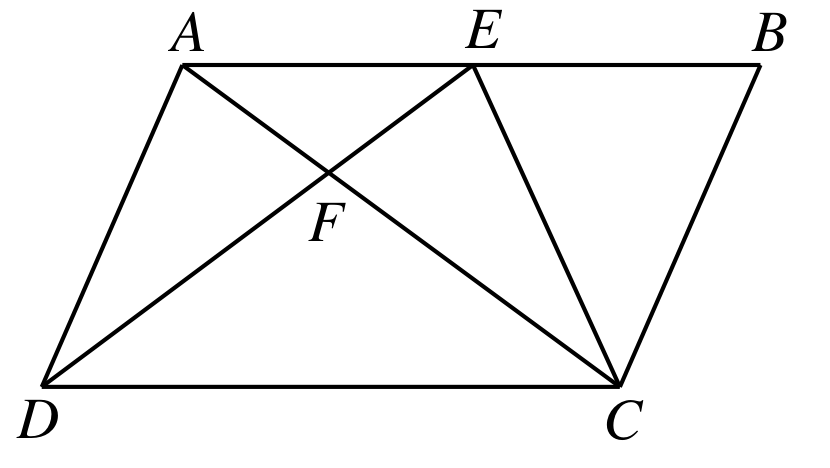
Let $ABCD$ be a parallelogram and point $E$ be the midpoint of $AB$, as shown in the figure below. If the area of the triangle $CDF$ is $2692\ \mathrm{cm}^2$, then find the area, in $\mathrm{cm}^2$, of the triangle $BCE$.
The side lengths of a triangle are consecutive positive integers, in cm. One of its medians is perpendicular to one of its angle bisectors. What is the perimeter, in cm, of this triangle?
Consider all the words obtained as permutations of the letters $\{D,U,R,B,A,N\}$. All these words are written in a row, arranged in alphabetical order, starting from $\mathrm{ABDNRU}$, and ending with $\mathrm{URNDBA}$. What is the position of the word $\mathrm{DURBAN}$ in this sequence?
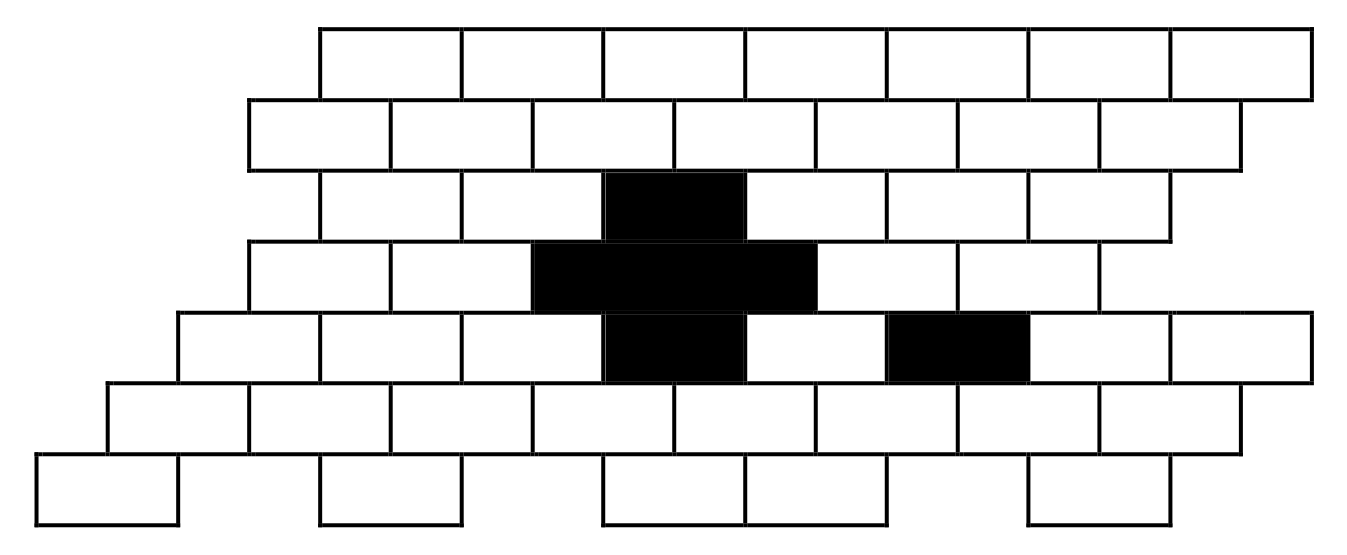
The figure below illustrates a $7$-row brick wall with $2$ holes (shaded in black). We want to choose a brick in each row such that any two bricks chosen in any adjacent rows are connected (two bricks are connected if they share at least a portion of their sides). In how many different ways can we choose the $7$ bricks?
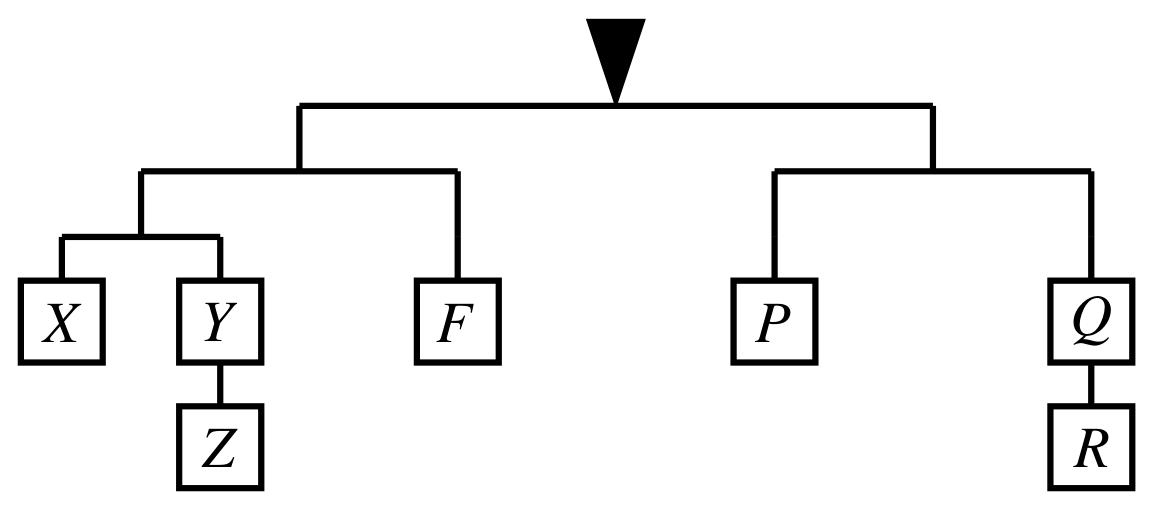
In the figure below, the balance is in equilibrium and each of the weights is an integer greater than zero grams. If the sum of all weights is the largest possible integer not greater than $2019$ grams, find the largest possible value, in gram, of $X$.
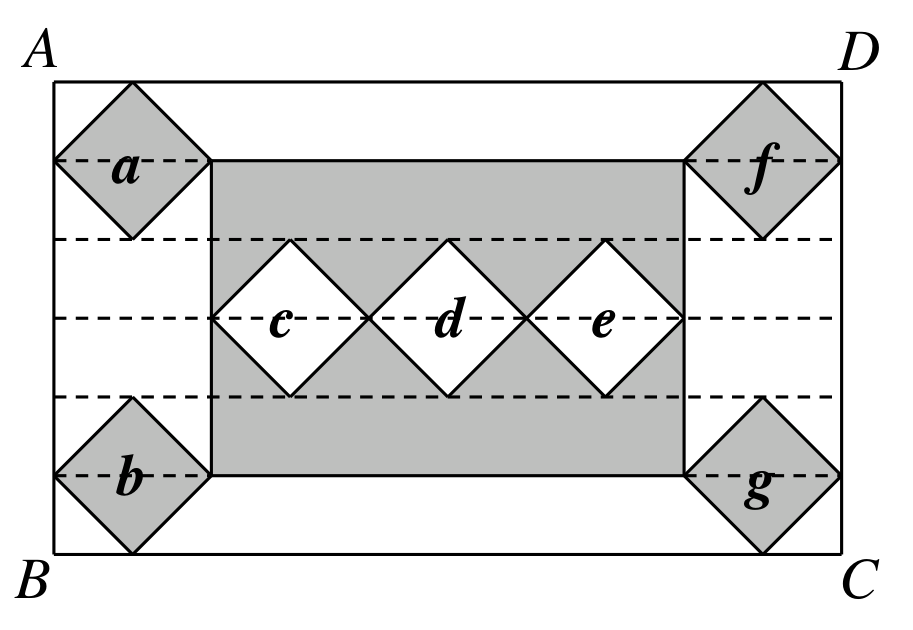
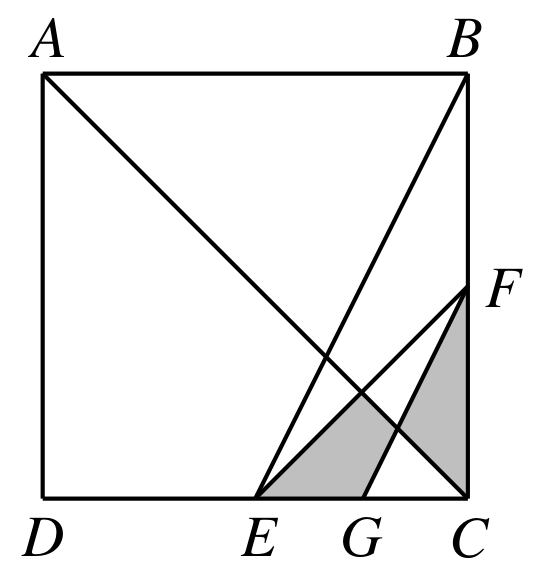
In the figure below, $ABCD$ is a square and points $E$, $G$ and $F$ are the midpoints of $CD$, $CE$ and $BC$ respectively. What is the ratio of the total area of the shaded regions to the area of $ABCD$?
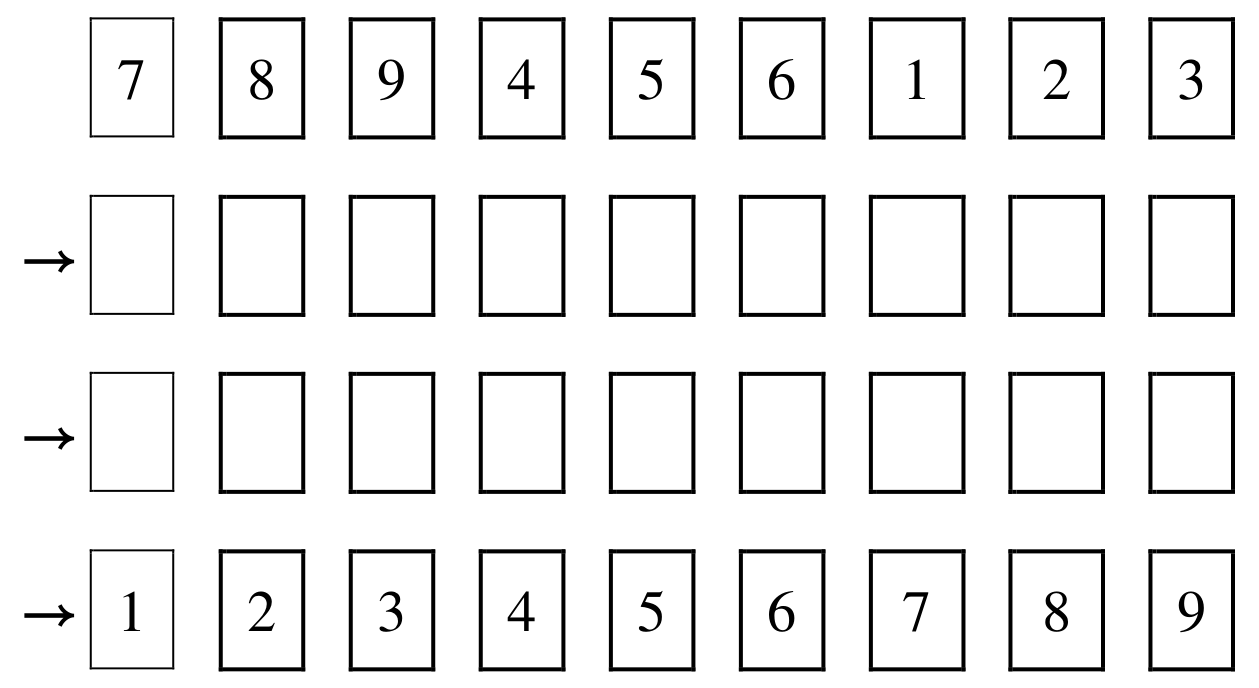
There are nine cards that are arranged in a sequence $7,8,9,4,5,6,1,2,3$ in this order as shown below. On each turn, we may remove any number of consecutive cards, reverse their order and put them back anywhere in the row. After three turns the cards are in the sequence $1,2,3,4,5,6,7,8,9$. What are the three turns? Show your steps.
Peter and Jack went to a store to buy some pens. In the store, they are selling different pen packs such that each pack has exactly $1,2,4,8,16,\ldots$ pens. For example, if Peter wants to buy $14$ pens, then he needs to buy packs with $8$, $4$ and $2$ pens. It is known that Peter bought $n$ pens and Jack bought $n+1$ pens, where $n\le2019$. If Peter and Jack bought the minimum number of packs of pens and Peter has $4$ packs more than Jack, then find the number of different values of $n$.
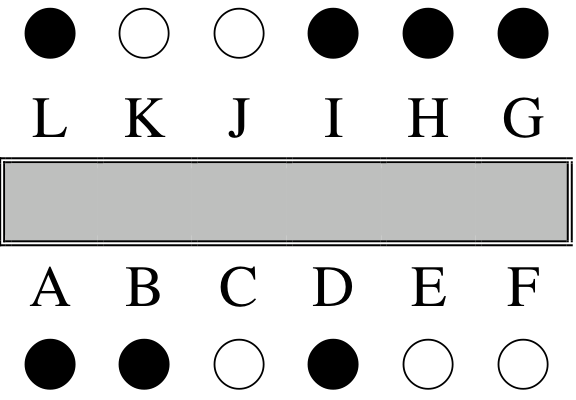
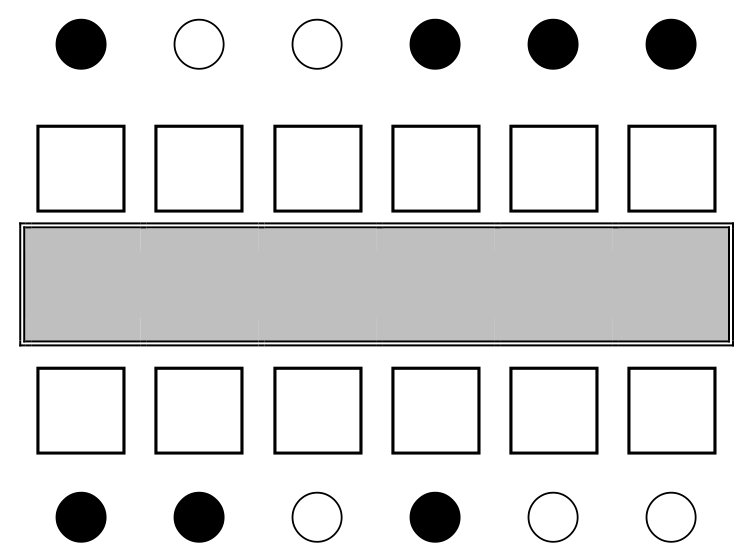
Twelve children, $A,B,C,D,E,F,G,H,I,J,K,L$, sit at a long table with chairs on each side, forming six opposite pairs. Six of them are boys and the other six are girls. The party host stipulates two rules. First, each boy must have a girl on the seat opposite him. Second, if a girl is not in a seat at either end of the table, then there must be a boy on each side of her. However, not every child observed these rules. In the diagram below, those children observing the rules are represented by white circles and those not observing the rules are represented by black circles. Since neither rule applies to a girl sitting on a seat at either end, such a girl may be represented by a white circle or a black circle. What is the gender of each child, represent a girl as “g”, a boy as “b”?
Original response template:
Answer entry: give the twelve letters in the order $A,B,C,D,E,F,G,H,I,J,K,L$.