$ABCDE$ is a regular pentagon of side length 1 m. There are 5, 15, 14, 9 and 17 students at the vertices $A$, $B$, $C$, $D$ and $E$ respectively. The teacher wants the same number of students at each vertex, so some of the students have to walk to other vertices. They may only walk along the sides. What is the minimum total length, in m, the students have to walk?
$A$, $B$ and $C$ run a 200-m race in constant speeds. When $A$ finishes the race, $B$ is 40 m behind $A$ and $C$ is 10 m behind $B$. When $B$ finishes, $C$ still has to run another 2 seconds. How many seconds does $B$ still have to run when $A$ finishes?
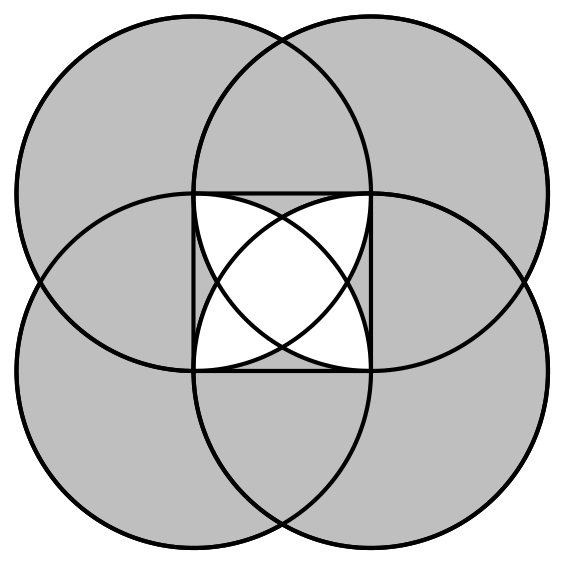
With each vertex of a 1 cm by 1 cm square as centre, circles of radius 1 cm are drawn, as shown in the diagram below. How much larger, in $\mathrm{cm}^2$, is the area of the shaded region than the area of a circle of radius 1 cm? (Take $\pi=3.14$)
In a basketball game, a foul shot is worth 1 point, a field shot is worth 2 points and a long-range shot is worth 3 points. Stephen makes 8 foul shots and 14 others. If he had made twice as many field shots and half as many long-range shots, he would have scored 7 extra points. How many points has Stephen actually scored?
John’s running speed is twice his walking speed. Both are constant. On his way to school one day, John walks for twice as long as he runs, and the trip takes 30 minutes. The next day, he runs for twice as long as he walks. How many minutes does the same trip take on the second day?
Jimmy has some peanuts. On the first day, he eats 13 peanuts in the morning and one tenth of the rest in the afternoon. On the second day, he eats 16 peanuts in the morning and one tenth of the rest in the afternoon. If he has eaten the same number of peanuts on both days, how many peanuts will he have left?
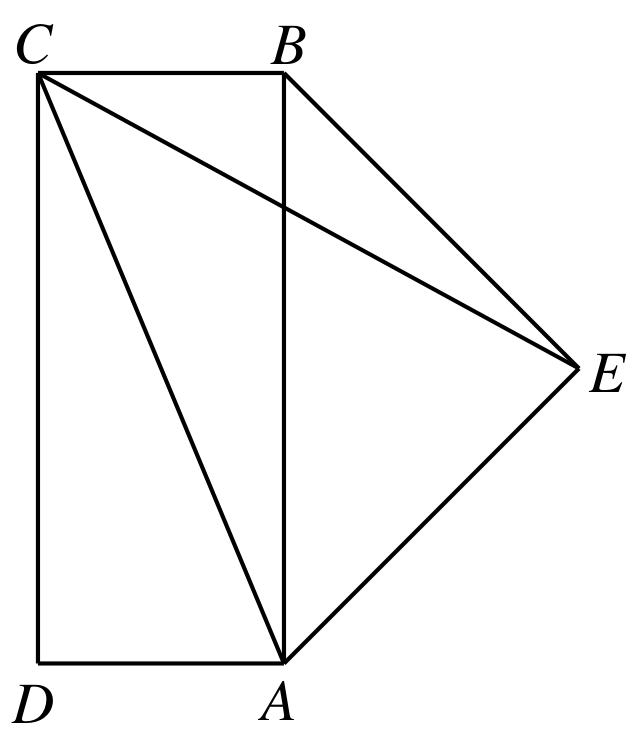
$ABCD$ is the rectangle where $AB=12$ cm and $BC=5$ cm. $E$ is a point on the opposite side of $AB$ to $C$, as shown in the diagram below. If $AE=BE$ and the area of triangle $AEB$ is 36 $\mathrm{cm}^2$, find the area, in $\mathrm{cm}^2$, of triangle $AEC$.
Anna starts writing down all the prime numbers in order, $235711\ldots$. She stops after she has written down ten prime numbers. She now removes 7 of the digits, and treats what is left as a 9-digit number. What is the maximum value of this number?
Three two-digit numbers are such that the sum of any two is formed of the same digits as the third number but in reverse order. Find the sum of all three numbers.
The sum of two four-digit numbers is a five-digit number. If each of these three numbers reads the same in both directions, how many different four-digit numbers can appear in such an addition?
When 2016 is divided by 3, 5 and 11, the respective remainders are 0, 1 and 3. Find the smallest number with the same properties that can be made from the digits 2, 0, 1 and 6, using each at most once.
Each student writes down six positive integers, not necessarily distinct, such that their product is less than or equal to their sum, and their sum is less than or equal to 12. If no two students write down the same six numbers, at most how many students are there?
Choose nine different ones of 1, 2, 3, 4, 5, 6, 7, 8, 9 and 10. Use each of them exactly once to form three equations, using each of addition, subtraction, multiplication and division at most once. What is the smallest number that we can leave out?
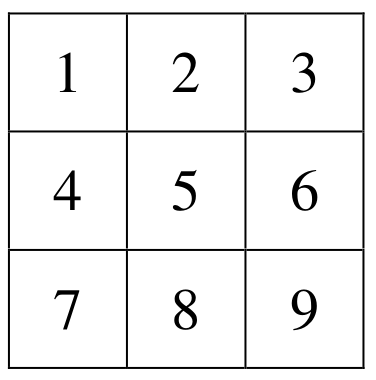
The squares of a 3 by 3 table are labelled $1,2,\ldots,9$ as shown. In how many ways can we shade five of the squares so that no row or column is completely shaded?
Submission guidance: Give a full solution, as required for this even-numbered problem by the examination cover.
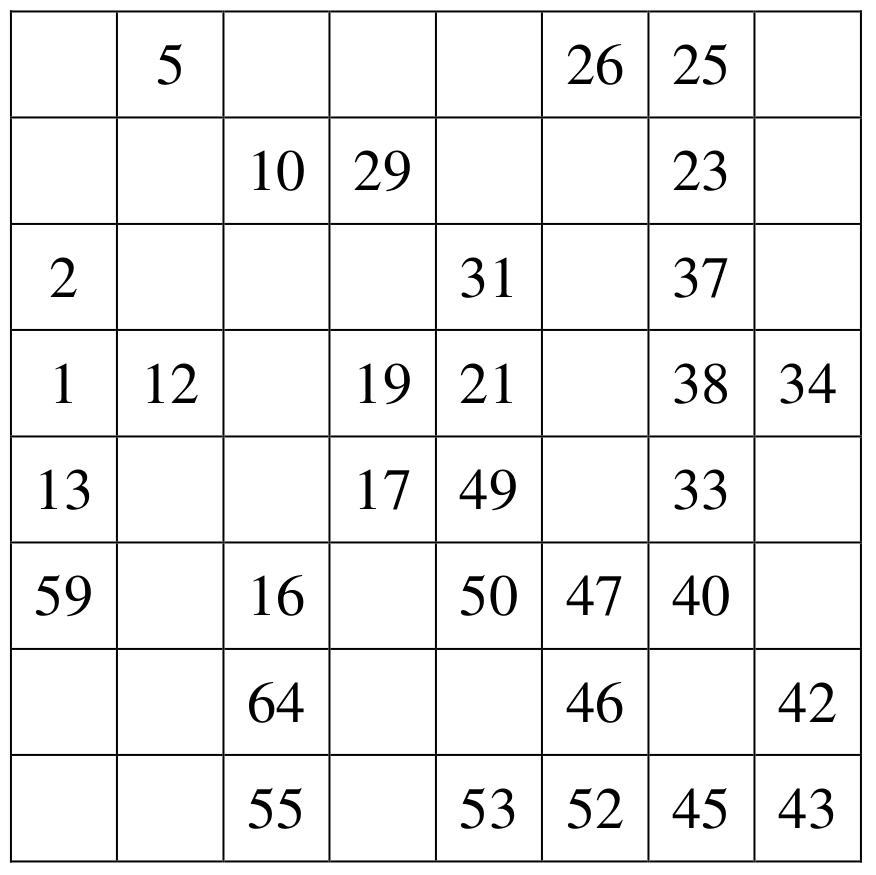
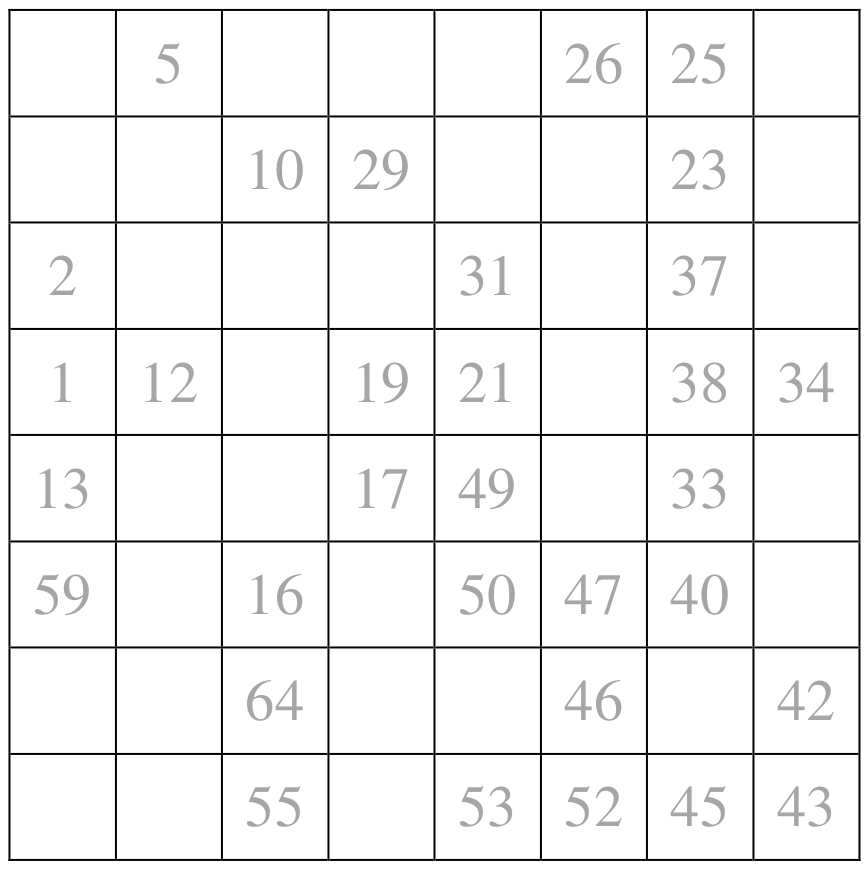
The diagram shows an 8 by 8 board. An ant visits each of the 64 squares once and only once. It crawls from one to another of two squares sharing at least one corner. The order in which the squares are visited is marked with numbers, starting from 1 and ending at 64. Some of the marked numbers have been erased. Restore these erased numbers.
Original answer template:
Submission guidance: Supply the completed grid only; the source does not require a written proof for this odd-numbered problem. It is represented as a manually graded grid response, with all-or-nothing credit.
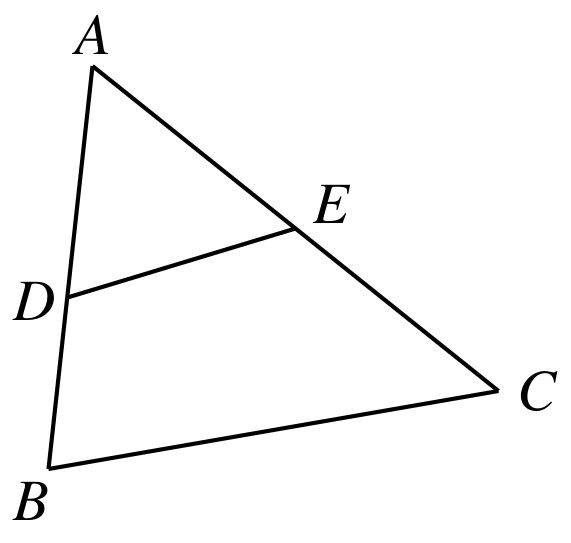
In triangle $ABC$, $AB=7$ cm and $AC=9$ cm. $D$ is a point on $AB$ such that $BD=3$ cm. $E$ is a point on $AC$ such that the area of the quadrilateral $BCED$ is $\frac57$ of the area of triangle $ABC$. Find the length, in cm, of $CE$.
Submission guidance: Give a full solution, as required by the examination cover.
How many positive integers less than 100 are there such that the product of all positive divisors of such a number is equal to the square of the number?