Neglecting air resistance, a projectile fired from a gun follows a parabola in the vertical plane through the barrel axis. Take the gun's ground position as $O$, the horizontal line as $Ox$ and the vertical line as $Oy$. Its trajectory is
$$y=-\frac{g}{2v_0^2\cos^2\alpha}x^2+x\tan\alpha,$$
where $\alpha$ is the barrel's angle with the ground, $g$ is gravitational acceleration, and $v_0$ is the initial speed.
(a) For which angle does the projectile travel farthest?
(b) For which angles does it hit a point with coordinates $X\ge0$, $Y\ge0$? What region of space consists of reachable points?
In a plane $(P)$, two fixed lines $a,b$ and two variable lines $x,y$ are given. During their motion $x,y$ remain parallel and pass respectively through two points $A,B$ lying on “line $A$” [as printed]; $x$ meets $b$ at $C$, and $y$ meets $b$ at $D$. Through the intersection $M$ of $AB$ and $CD$, draw the line parallel to $x$, meeting $a$ at $L$ and $b$ at $N$.
(a) What can be said about $L,M,N$? Prove it and determine the locus of $M$.
(b) Let a second plane $P'$ not parallel to $P$ and a point $O$ outside both planes be given. The planes $Oa,Ob,Ox,Oy$ may intersect $P'$ or be parallel to it; when they intersect it, denote their intersections by $a',b',x',y'$ respectively. Thus there is a corresponding locus problem in $P'$ for the intersection $M'$ of “line $M$” [as printed] with $P'$. State that locus problem.
(c) In which positions of $x,y$ are $x',y'$ parallel, and in which positions are $A'D',B'C'$ parallel?
Editorial transcription note: The three quoted constructions are retained as printed. The solution explains the literal defect and separately studies a proposed correction; this is not a silently corrected official statement.
Let $x,y,z$ be nonnegative numbers satisfying
$$x+by\le36,\qquad 2x+3z\le72,$$
where $b$ is a given positive number. Prove that the largest possible value of $x+y+z$ is $\max\{36,\ 24+36/b\}$.
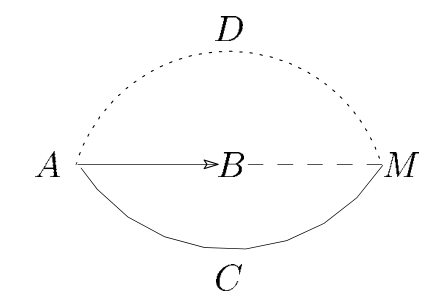
Application. Goods are to be transported from $A$ to $M$ in three ways:
(a) by motor vehicle along $ACM$;
(b) by boat along $ADM$;
(c) by motor vehicle from $A$ to $B$, then by boat from $B$ to $M$.
There are 9 motor vehicles and 45 boats available. Each vehicle on $AB$ carries an average of four tons per day from $A$ to $B$; on $ACM$ it carries 2 tons per day from $A$ to $M$. Each boat on $BM$ carries $8/15$ ton per day from $A$ to $M$ [the route and endpoints are as printed]. How should transport be organized (tons per day by each of the three ways) to maximize total tonnage? How should it be organized if each vehicle on $ACM$ guarantees less than $4/3$ per day [the unit is omitted in this final phrase]?
Editorial note: The source gives no separate boat capacity on $ADM$ and its boat sentence has inconsistent endpoints. Its final phrase says less than $4/3$, not unambiguously equal to $4/3$; the solution distinguishes these cases. Keep this issue in mind when interpreting the application; no missing capacity is silently supplied.