If three times the larger of two numbers is four times the smaller and the difference between the numbers is $8,$ then the larger of the two numbers is
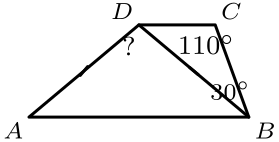
In trapezoid $ABCD,$ sides $AB$ and $CD$ are parallel, and diagonal $BD$ and side $AD$ have equal length. If $\angle DCB=110^\circ$ and $\angle CBD=30^\circ,$ then $\angle ADB=$
The lines $L$ and $K$ are symmetric to each other with respect to the line $y=x.$ If the equation of line $L$ is $y=ax+b$ with $a\ne0$ and $b\ne0,$ then the equation of $K$ is $y=$
If $p,$ $q,$ and $M$ are positive numbers and $q\lt100,$ then the number obtained by increasing $M$ by $p\%$ and decreasing the result by $q\%$ exceeds $M$ if and only if
Suppose that at the end of any year, a unit of money has lost $10\%$ of the value it had at the beginning of that year. Find the smallest integer $n$ such that after $n$ years the unit of money will have lost at least $90\%$ of its value. (To the nearest thousandth $\log_{10}3$ is $0.477.$)
In a geometric sequence of real numbers, the sum of the first two terms is $7,$ and the sum of the first six terms is $91.$ The sum of the first four terms is
The function $f$ is not defined for $x=0,$ but, for all nonzero real numbers $x,$ $$
f(x)+2f\left(\frac1x\right)=3x.
$$ The equation $f(x)=f(-x)$ is satisfied by
exactly one real number
exactly two real numbers
no real numbers
infinitely many, but not all, nonzero real numbers
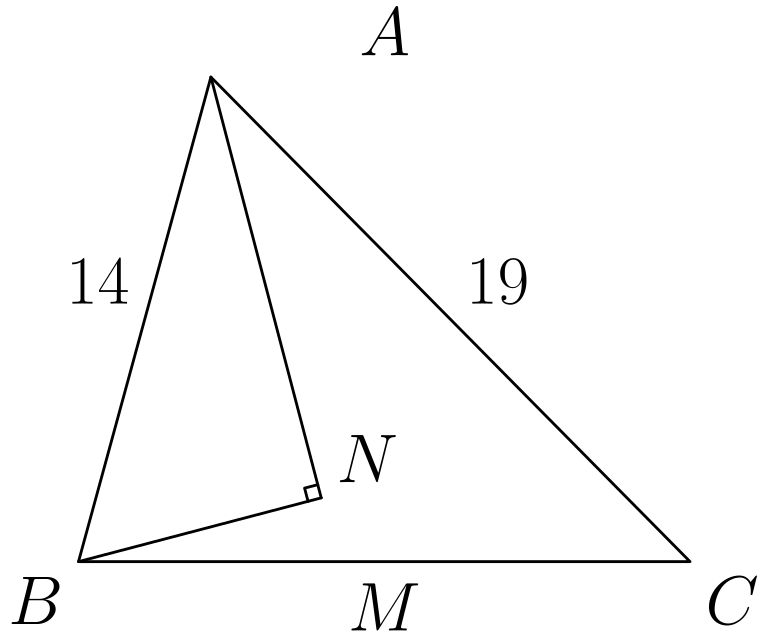
In $\triangle ABC,$ $M$ is the midpoint of side $BC,$ $AN$ bisects $\angle BAC,$ $BN\perp AN,$ and $\theta$ is the measure of $\angle BAC.$ If sides $AB$ and $AC$ have lengths $14$ and $19,$ respectively, then length $MN$ equals
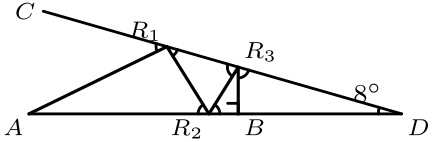
A ray of light originates from point $A$ and travels in a plane, being reflected $n$ times between lines $AD$ and $CD,$ before striking a point $B$ (which may be on $AD$ or $CD$) perpendicularly and retracing its path to $A.$ (At each point of reflection the light makes two equal angles as indicated in the adjoining figure. The figure shows the light path for $n=3.$) If $\angle CDA=8^\circ,$ what is the largest value $n$ can have?