A man has $\$2.73$ in pennies, nickels, dimes, quarters and half dollars. If he has an equal number of coins of each kind, then the total number of coins he has is
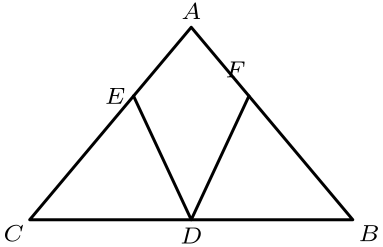
In triangle $ABC,$ $AB=AC$ and $\angle A=80^\circ.$ If points $D,$ $E$ and $F$ lie on sides $BC,$ $AC$ and $AB,$ respectively, and $CE=CD$ and $BF=BD,$ then $\angle EDF$ equals
The set of all points $P$ such that the sum of the (undirected) distances from $P$ to two fixed points $A$ and $B$ equals the distance between $A$ and $B$ is
the line segment from $A$ to $B$
the line passing through $A$ and $B$
the perpendicular bisector of the line segment from $A$ to
$B$
For every triple $(a,b,c)$ of nonzero real numbers, form the number $$
\frac a{|a|}+\frac b{|b|}+\frac c{|c|}+\frac{abc}{|abc|}.
$$ The set of all numbers formed is
For each real number $x,$ let $[x]$ be the largest integer not exceeding $x$ (i.e., the integer $n$ such that $n\le x\lt n+1$). Which of the following statements is (are) true?
$\mathrm{I}.$ $[x+1]=[x]+1$ for all $x$
$\mathrm{II}.$ $[x+y]=[x]+[y]$ for all $x$ and $y$
Al’s age is $16$ more than the sum of Bob’s age and Carl’s age, and the square of Al’s age is $1632$ more than the square of the sum of Bob’s age and Carl’s age. The sum of the ages of Al, Bob and Carl is
If $a_1,$ $a_2,$ $a_3,$ $\ldots$ is a sequence of positive numbers such that $a_{n+2}=a_na_{n+1}$ for all positive integers $n,$ then the sequence $a_1,$ $a_2,$ $a_3,$ $\ldots$ is a geometric progression
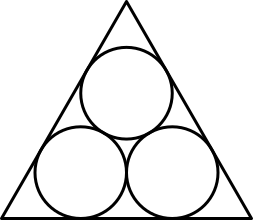
Each of the three circles in the adjoining figure is externally tangent to the other two, and each side of the triangle is tangent to two of the circles. If each circle has radius three, then the perimeter of the triangle is
If $i^2=-1,$ then the sum $$
\begin{aligned} &\cos45^\circ+i\cos135^\circ+\cdots\\ &\quad+i^n\cos(45+90n)^\circ+\cdots\\ &\quad+i^{40}\cos3645^\circ \end{aligned}
$$ equals
Three fair dice are tossed at random (i.e., all faces have the same probability of coming up). What is the probability that the three numbers turned up can be arranged to form an arithmetic progression with common difference one?
Let $E$ be the point of intersection of the diagonals of convex quadrilateral $ABCD,$ and let $P,$ $Q,$ $R$ and $S$ be the centers of the circles circumscribing triangles $ABE,$ $BCE,$ $CDE$ and $ADE,$ respectively. Then
$PQRS$ is a parallelogram
$PQRS$ is a parallelogram if and only if $ABCD$ is a
rhombus
$PQRS$ is a parallelogram if and only if $ABCD$ is a
rectangle
$PQRS$ is a parallelogram if and only if $ABCD$ is a
parallelogram
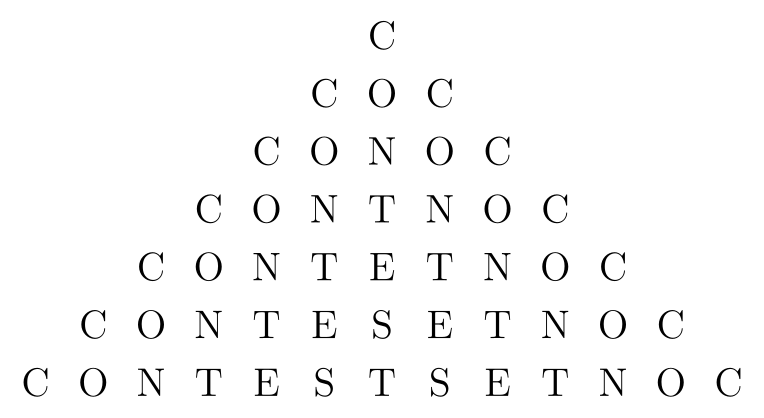
For how many paths consisting of a sequence of horizontal and/or vertical line segments, with each segment connecting a pair of adjacent letters in the diagram below, is the word CONTEST spelled out as the path is traversed from beginning to end?