A real-valued function $f$ is defined on all real numbers such that $f(x)\le x$ for all real numbers $x$ and $f(x+y)\le f(x)+f(y)$ for all real numbers $x$ and $y$. What is the numerical value of $f(20)+f(25)$?
Alex and Boris drive at different constant speeds. At a certain moment in the morning of one day, Alex started to drive from town A to town B along a road, while Boris started to drive from town B to town A along the same road. After they met at 11:00 AM, Alex continued to drive and arrived at town B at 3:00 PM while Boris continued to drive and arrived at town A at 8:00 PM. At what time did they start to drive on that day?
There exist some perfect squares where its last four digits (from the right) are all equal to a certain digit $a$. For example, $100^2=10000$. How many different possible values of digit $a$ are there?
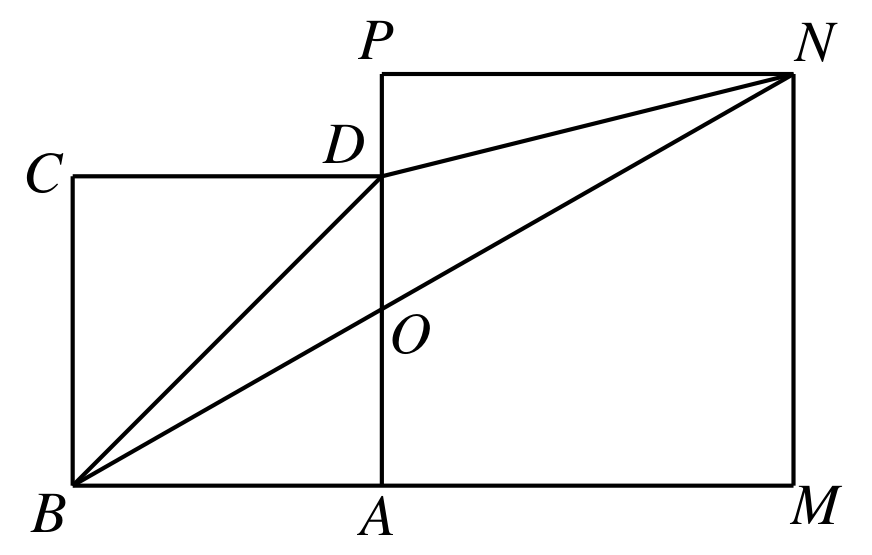
As shown in the diagram below, squares $ABCD$ and $APNM$ are placed side by side, without overlapping. The side length of square $ABCD$ is less than the side length of square $APNM$ and $O$ is the intersection of $BN$ and $AD$.
Only one statement from options (A)–(E) is ALWAYS true. Which one is it?
The areas of triangles $BCD$ and $DON$ are equal.
The area of triangle $BDN$ is less than the area of triangle $BCD$.
The area of triangle $BCD$ is larger than the area of triangle $DPN$.
The area of triangle $BOA$ is less than the area of triangle $DON$.
A two-digit number is said to be good if it is equal to the sum of squares of each of its digits minus the product of its digits. For example, $48$ is a good number since $48=4^2+8^2-4\times8$. What is the sum of all the good numbers, including $48$?
A three-digit number is said to be interesting if it satisfies both the conditions below:
- All digits of this number are non-zero.
- After removing any one of the digits and adding the removed digit to the remaining two-digit number, the resulting number is always divisible by $8$.
For example, $195$ is interesting: removing $1$ gives $1+95=96$; removing $9$ gives $15+9=24$; removing $5$ gives $19+5=24$. All are divisible by $8$. How many interesting three-digit numbers are there in total?
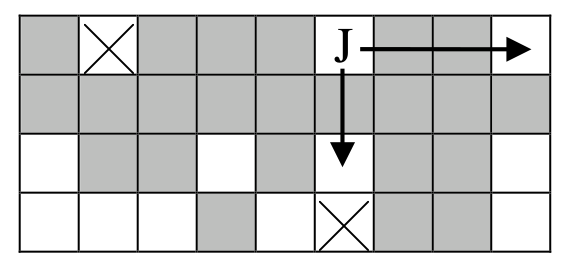
In a computer game, a maze is illustrated as a grid, where some cells are painted in grey. The grey cells indicate where traps have been placed and the white cells indicate safe cells. A jumping man named Jay is standing on a white cell, which is indicated as “J”. Jay may jump from one white cell to another white cell. However, he may only jump horizontally or vertically at most 3 cells. He can jump over a sequence of grey cells, but he cannot jump over another white cell (and he cannot land on a grey cell).
For example, as shown below, if Jay stands on “J”, he may jump three cells to the right or two cells down, but he cannot jump four cells to the left or three cells down. To get to any other white cell, he would need additional jumps.
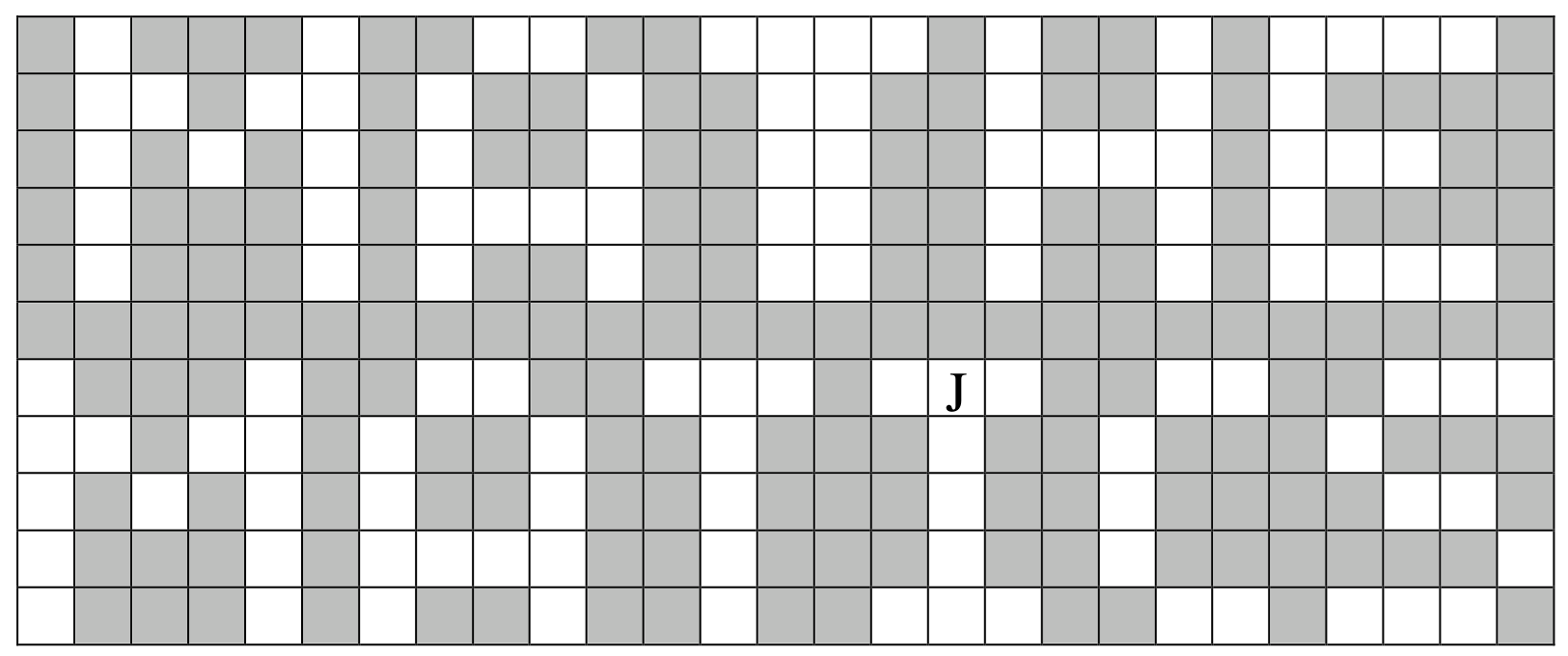
In the following maze, Jay begins on “J”. What is the minimum number of jumps he needs to do to be sure that any other white cell can be reached when jumping from this starting position?
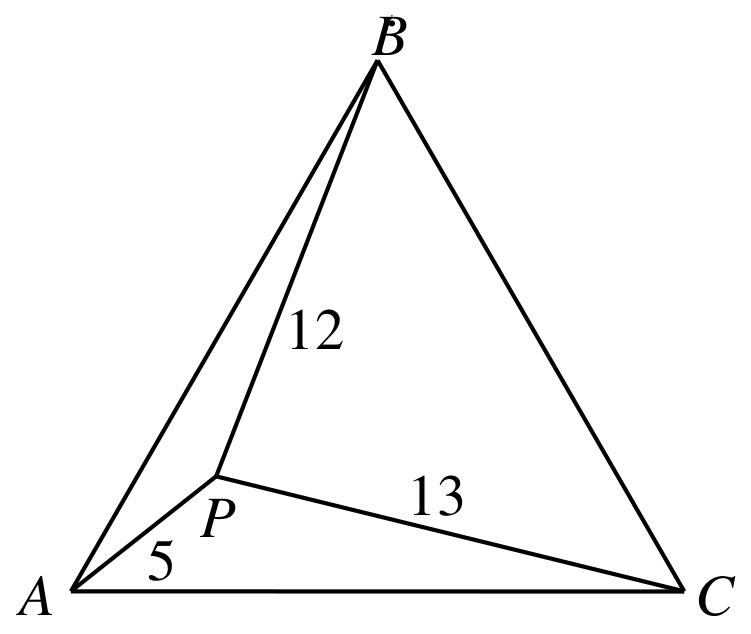
In equilateral triangle $ABC$, let $P$ be a point inside the triangle such that $PA=5$ cm, $PB=12$ cm and $PC=13$ cm, as shown below. What is the measure, in degrees, of $\angle APB$?
There are $18$ cards. Each card is labelled with exactly one positive integer from $\{1,2,3,4,5,6,7,8,9\}$, with exactly two cards of each label. Amy randomly selects two cards at the same time and tells Brandon only the product of their numbers. Brandon wins if he can determine the two numbers in one try without guessing. What is the probability $\frac{q}{p}$, where $p,q$ are relatively prime, that Brandon wins?
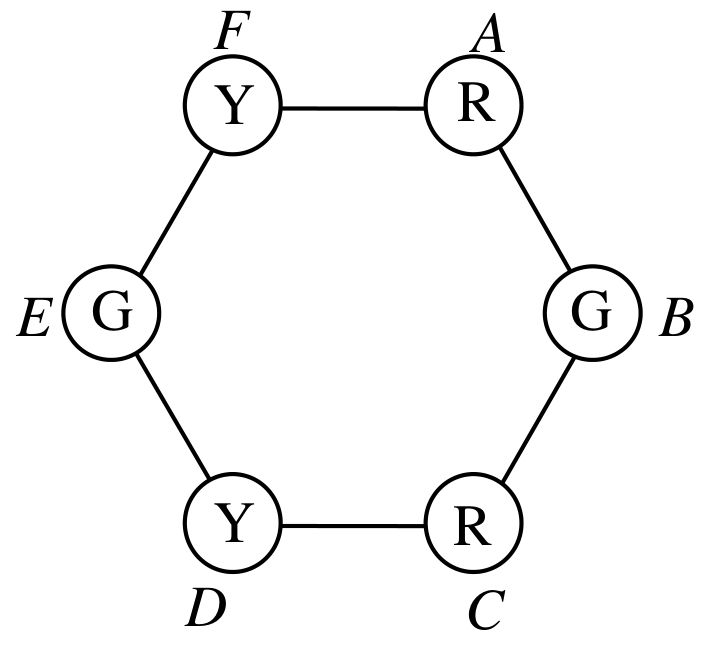
In how many ways can we paint each of the six vertices of hexagon $ABCDEF$ using one of the three colours red, green and yellow, such that no two adjacent vertices have the same colour? One colouring is shown below, where R means red, G means green and Y means yellow.
In a ball pit, there are sufficiently many balls of four colours: red, blue, yellow and green. Now, 2025 persons will each take turns, one at a time, to take out four balls from the ball pit. What is the minimum number of persons that will have exactly the same set of colours and same number of balls of each colour? Provide the tightest bound.
In a store, each cup costs 21 dollars, each bowl costs 24 dollars and each stockpot costs 168 dollars. One day, some cups, bowls and stockpots were sold for a total of 2025 dollars such that at least one of each of these three products was sold. How many different possible sales states were there for these three products on that day?
A recurring decimal is a decimal representation of a number whose digits are periodic in nature, meaning that, after some places, the same sequence of digits repeats continuously. For example, $\frac{1234}{9999}=0.12341234\ldots=0.\overline{1234}$. To calculate the sum of all the digits of a recurring decimal, aside from summing all the digits directly, there is another method as follows:
(a) It is known that the recurring decimal of $\frac1{17}$ is $16$ digits long, which you can assume to be true. To find the sum of all the digits of the recurring decimal of $\frac1{17}$, suppose $\frac1{17}=\frac{A}{10^{16}-1}$, where positive integer $A$ is the repetend. Since the period is $16$, $10^{16}-1$ is divisible by $17$ but $10^k-1$ is not divisible by $17$ for $1\le k<16$. Notice that $17$ is prime; by Fermat’s Little Theorem, $10^{16}\equiv1\pmod{17}$. Thus $10^{16/2}=10^8\equiv\pm1\pmod{17}$. Write the subsequent proof to show that the answer is $72$. (5 marks)
(b) It is known that the recurring decimal of $\frac1{179}$ is $178$ digits long, which you can assume to be true. What is the sum of all the digits of the recurring decimal of $\frac1{179}$? Use a similar method to part (a). (15 marks)
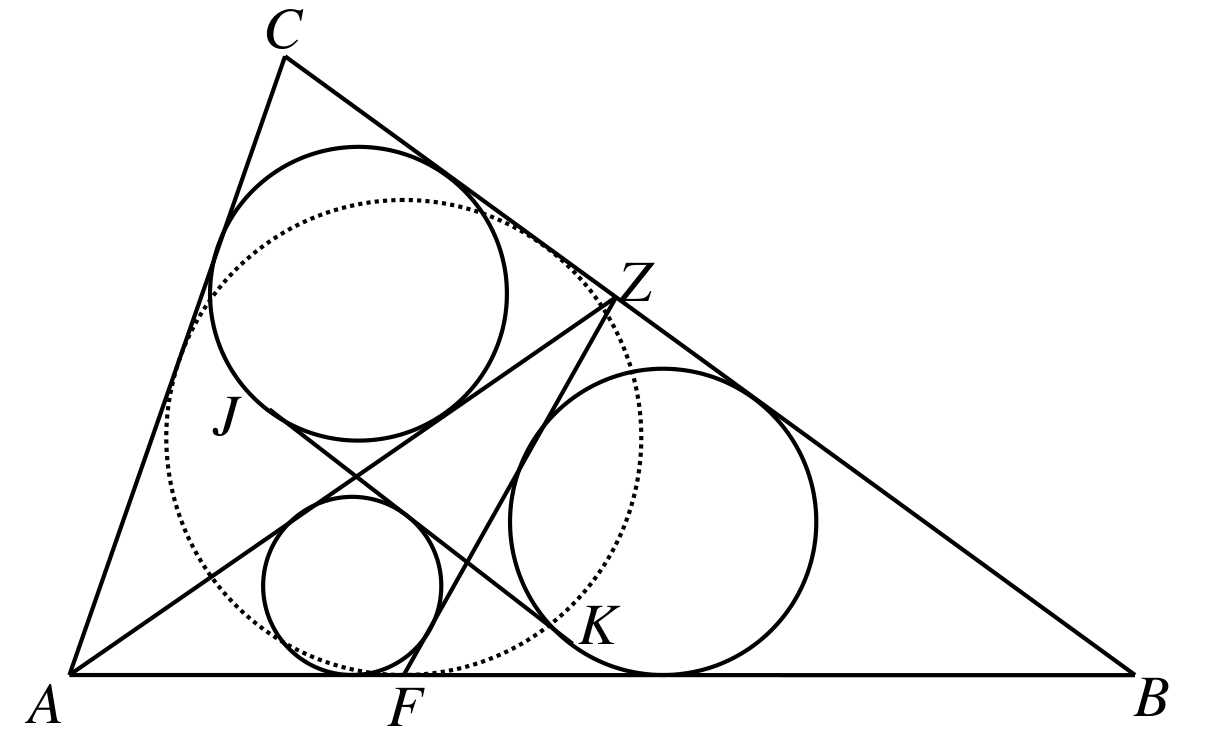
Let $F$ be the point of tangency of the incircle of triangle $ABC$ with $AB$, and let $Z$ be an arbitrary point strictly between $B$ and $C$, as shown below. Let $K$ and $J$ be the points on the incircles of triangles $BFZ$ and $CAZ$, respectively, such that $KJ$ is the other exterior common tangent to these two circles. Prove that $KJ$ is also a tangent of the incircle of triangle $AFZ$.