Consider the sum of the three tables below. The first represents $n$ lines, the first with $n$ numbers equal to $n$, the second with $n-1$ numbers equal to $n-1$ And so on. In the second, we have a similar distribution of numbers, but in columns instead of rows. On the third, we have these numbers diagonals, the first diagonal has a number $1$, the second two numbers equal to $2$, the third three numbers equal to $3$ And so on.
The result of the sum of the three tables will be a table with the same number of numbers and with each position being the result of the sum of the corresponding positions in the three tables. For example, in the upper left corner, we will have the number $n+n+1=2n+1$.
a) One way to check how many numbers there are in each table is to turn one upside down and join with another to form a rectangle with $n$ rows and twice as many numbers in a table. Knowing this, how many numbers are there in a table?
b) How many times does each number appear? $k$ in all three tables?
c) For each position, line $i$ and column $j$, Determine the numbers written on it in the three tables and in the result table.
d) Using the information in the previous items, check that
$$
1^{2}+2^{2}+3^{2}+\ldots+(n-1)^{2}+n^{2}=\frac{1}{6} n(n+1)(2 n+1)
$$
Two tangents are drawn from a point $A$ to a center circle $O$, touching it in $B$ and $C$. Let $H$ be the orthocenter of the triangle $ABC$, knowing that $\angle BAC = 40^\circ$, find the value of the angle $\angle HCO$.
A lucky number is one whose sum of its digits is divisible by $7$. For example, $7$, $25$ and $849$ are lucky numbers. The smallest pair of lucky numbers is $7$ and $16$.
a. Find eight consecutive numbers, of which two are lucky numbers.
b. Find $12$ consecutive numbers, such that none are lucky.
c. Shows that any sequence of $13$ consecutive numbers contains at least one lucky number.
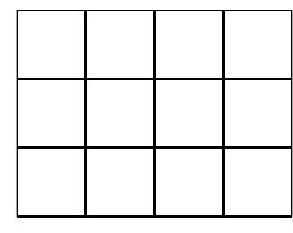
On the following board, we must place all the numbers, since $1$ up until $25$, following the following rules: - In each queue, the $5$ Numbers placed should form a strictly increasing sequence when read from left to right. - In each column, the $5$ Numbers placed should form a strictly increasing sequence when read from top to bottom.
The main diagonal of the board is the diagonal painted on the chart.
a) Show that after placing the numbers, the smallest number placed on the main diagonal is always greater than or equal to $5$, and the largest number placed on the main diagonal is greater than or equal to $15$.
b) Place the numbers on the board so that on the main diagonal we find the numbers $5, 9, 12, 14$ e $15$.
c) Show that it is impossible to put the numbers so that the sum on the main diagonal is less than $55$.
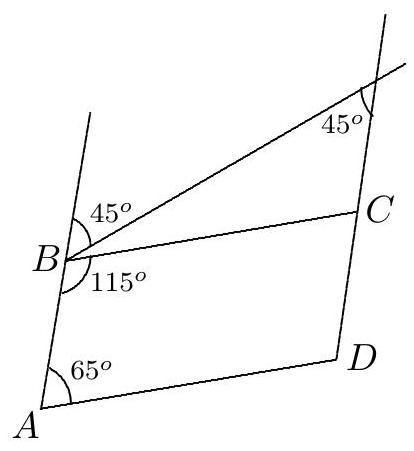
The figure illustrates a regular 9-sided polygon. The measure of the side of the polygon is $a$, the measurement of the smallest diagonal is $b$ and the measurement of the largest diagonal is $d$. Figure 58.1
a) Determine the measure of angle $B\hat{A}E$.
b) Show that $d = a + b$. Figure 58.2
Two players face off in a dice combat game. The striker will launch three dice and the defender, two. The attacker will defeat the defender in only one dice if, and only if the following two conditions are satisfied: i) the attacker's highest die is greater than the defender's highest die. ii) the second highest data of the attacker is greater than the second largest die for the defender (we agree that the "second largest data" can be equal to the highest data, if two or more data tie at the highest value). Considering that all the data is honest with the equiprobable results, calculate the probability that the attacker will win with the defender getting in his data:
a) 2 Cinco;
b) 1 Five and 1 four.
Consecutive Products - Divide the numbers $2$, $3$, $5$, $7$, $11$, $13$ e $17$ In two groups in such a way that, by multiplying all the numbers of one group and all of the other, we find consecutive numbers.
The collar - a necklace is composed of large pearls and small pearls, totaling less than 500 pearls. i. If we replace $70\%$ of large pearls with small pearls, the weight of the necklace decreases from $60\%$. II. If we replace $60\%$ of small pearls with large pearls, the weight of the necklace increases from $70\%$. How many pearls does the necklace have?
Three cars depart from a city $A$ at the same time and travel a closed path consisting of three line segments $AB$, $BC$ and $CA$. The speeds of the first car on these segments are 12, 10 and 15 kilometers per hour, respectively. The speeds of the second car are 15, 15 and 10 kilometers per hour, respectively. Finally, the speeds of the third car are 10, 20 and 12 kilometers per hour, respectively. Find the value of angle $\angle ABC$, knowing that all three cars end in the city $A$ at the same time.
A checkered - the squared rectangle in the figure is made of 31 segments of $0{,}5~\mathrm{cm}$, and comprises 12 squares. Rosa drew on a rectangular sheet of $21~\mathrm{cm}$ by $29{,}7~\mathrm{cm}$ checkered with squares of side $0{,}5~\mathrm{cm}$, a large checkered rectangle made with 1997 segments. How many squares does this rectangle have?
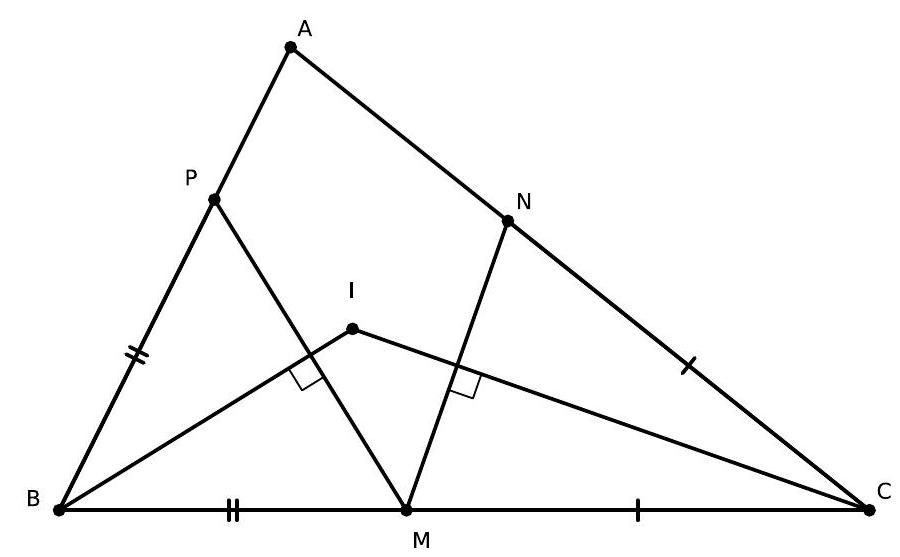
Points $M$, $N$ and $P$ are chosen on the sides $BC$, $CA$ and $AB$ of triangle $ABC$ so that $BM = BP$ and $CM = CN$. The lowered perpendicular from $B$ to $MP$ and the lowered perpendicular of $C$ to $MN$ intersect $I$. Prove that the angles $\angle IPA$ and $\angle INC$ are congruent.
For the school's birthday party, Ana, Pedro, Miriam and Fábio took 90 sweets together. Their teacher observed that: - If Ana had taken 2 more sweets; - If Pedro had taken 2 fewer sweets; - If Miriam had taken twice as much; - if Fábio had taken half; The 4 friends would have all taken the same number of sweets. How many sweets did each of the friends take?
In a certain country there are 21 cities and the government intends to build $n$ roads (all two-way), each road connects exactly 2 of the country's cities. What is the smallest value of $n$ so that, regardless of how the roads are built, it is possible to travel between any 2 cities (passing, possibly, through intermediate cities)?

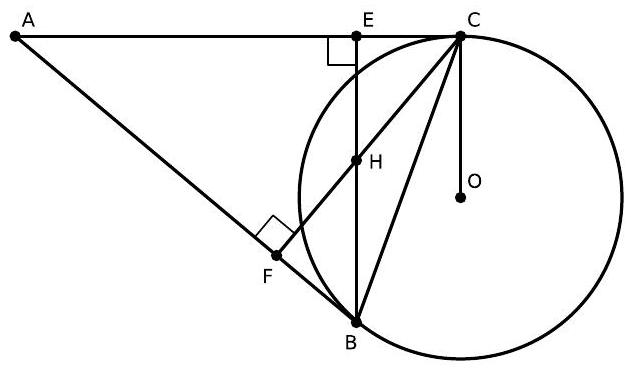
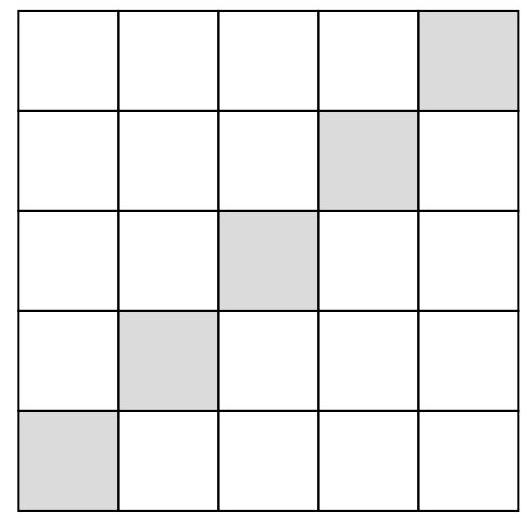
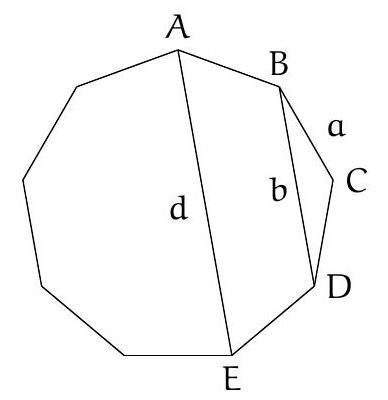 Figure 58.1