Let $p$ be the answer to this question. If a point is chosen uniformly at random from the square bounded by $x=0$, $x=1$, $y=0$, and $y=1$, what is the probability that at least one of its coordinates is greater than $p$?
Find at least one integer $a$ such that for the polynomial $P(x) = x^5 + a x$ the statement
“if $n \mid P(k) - P(l)$ then $n \mid k - l$, for all $k, l \in \mathbb{Z}$”
holds only for finitely many positive integers $n$, including $n = 95$.
Each side and each diagonal of a convex $n$-gon is colored in one of $k$ colors. It is known that there doesn't exist a closed monochrome broken line whose vertices are also the vertices of the given $n$-gon. Determine the largest possible value of $n$. (Russia 1990)
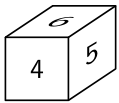
There are 8 identical dice. The numbers $4$, $5$, $6$ are written on three faces of the dice, as shown in the figure, and the remaining faces carry the numbers $1$, $2$, $3$ so that the sum of the numbers written on each pair of opposite faces is $7$.
a) Show that using these dice, it is possible to form a $2 \times 2 \times 2$ cube so that every two faces that touch each other carry the same number.
b) Is it possible to do this in such a way that only numbers $4$, $5$, $6$ occur on the outer surface of the resulting cube?
Let $ABCD$ be a quadrilateral inscribed in a circle with center $O$. Let $\Delta_1,\Delta_2$ be the images of line $AB$ under reflections in the internal bisectors of $\angle CAD,\angle CBD$, respectively. Let $P$ be the intersection of $\Delta_1,\Delta_2$. Prove that $OP$ and $CD$ are perpendicular.
The numbers $0$, $1$, and $2$ are written in the vertices of a triangle. One step involves increasing two of the three numbers by $m$ or decreasing one of the three numbers by $n$. Is it possible that after some steps there are numbers $1$, $2$, and $3$ (in an arbitrary order) written in the vertices if
a) $m = 3$, $n = 6$;
b) $m = 4\frac{1}{2}$, $n = 6$?
In the plane there are 2011 pairwise distinct points colored either blue or red.
a. Suppose that for every blue point the disk centered at that point with radius 1 contains exactly two red points. What is the largest possible number of blue points?
b. Suppose that for every blue point the circle centered at that point with radius 1 contains exactly two red points. What is the largest possible number of blue points?
In a rectangle $ABCD$ we have $|AB| = a$ and $|BC| = b$, where $a \ge b$. Let $E$ be a point in the interior of side $AB$ such that there is exactly one possibility to choose points $F, G, H$ on the sides $BC, CD, DA$, respectively, in such a way that $EFGH$ is a rectangle, too. Find the ratio of the areas of rectangles $EFGH$ and $ABCD$.
Rachel and Brian are playing a game in a grid with 1 row of 2011 squares. Initially, there is one white checker in each of the first two squares from the left, and one black checker in the third square from the left. At each stage, Rachel can choose to either run or fight. If Rachel runs, she moves the black checker 1 unit to the right, and Brian moves each of the white checkers one unit to the right. If Rachel chooses to fight, she pushes the checker immediately to the left of the black checker 1 unit to the left, the black checker is moved 1 unit to the right, and Brian places a new white checker in the cell immediately to the left of the black one. The game ends when the black checker reaches the last cell. How many different final configurations are possible?
Prove that none of the integers that contain one $2$, one $1$, and all the rest zeros, can be expressed as a sum of two perfect squares or as a sum of two perfect cubes.
Let $n \ge 3$ be an integer. Determine the minimum number of points one has to mark inside a convex $n$-gon in order for the interior of any triangle with the vertices at vertices of the $n$-gon to contain at least one of the marked points.
Let $a$, $b$, and $c$ be positive real numbers. Determine the largest total number of real roots that the following three polynomials may have among them: $a x^{2} + b x + c$, $b x^{2} + c x + a$, and $c x^{2} + a x + b$.
The size of the angle $ABC$, expressed in degrees, in a right triangle $ABC$ is an integer. It is known that for some positive integer $n$, one can choose points $K_0 = A$, $K_2, \dots, K_{2n}$ on the hypotenuse $AB$ and points $K_1 = C$, $K_3, \dots, K_{2n+1} = B$ on the leg $CB$ in such a way that each triangle $K_{i-1}K_iK_{i+1}$ with $i = 1, \dots, 2n$ is isosceles with base $K_{i-1}K_{i+1}$. Find all possible values of the size of angle $ABC$.
Let $ABC$ be a triangle with area $1$. Let points $D$ and $E$ lie on $AB$ and $AC$, respectively, such that $DE$ is parallel to $BC$ and $DE / BC = 1/3$. If $F$ is the reflection of $A$ across $DE$, find the area of triangle $FBC$.
Nathaniel and Obediah play a game in which they take turns rolling a fair six-sided die and keep a running tally of the sum of the results of all rolls made. A player wins if, after he rolls, the number on the running tally is a multiple of $7$. Play continues until either player wins, or else indefinitely. If Nathaniel goes first, determine the probability that he ends up winning.
Let $P_1, P_2, \dots, P_{2n}$ be a permutation of the vertices of a regular $2n$-gon. Prove that every closed polygonal line that consists of segments
$$
\overline{P_1P_2}, \overline{P_2P_3}, \dots, \overline{P_{2n-1}P_{2n}}, \overline{P_{2n}P_1}
$$
contains at least one pair of parallel segments.