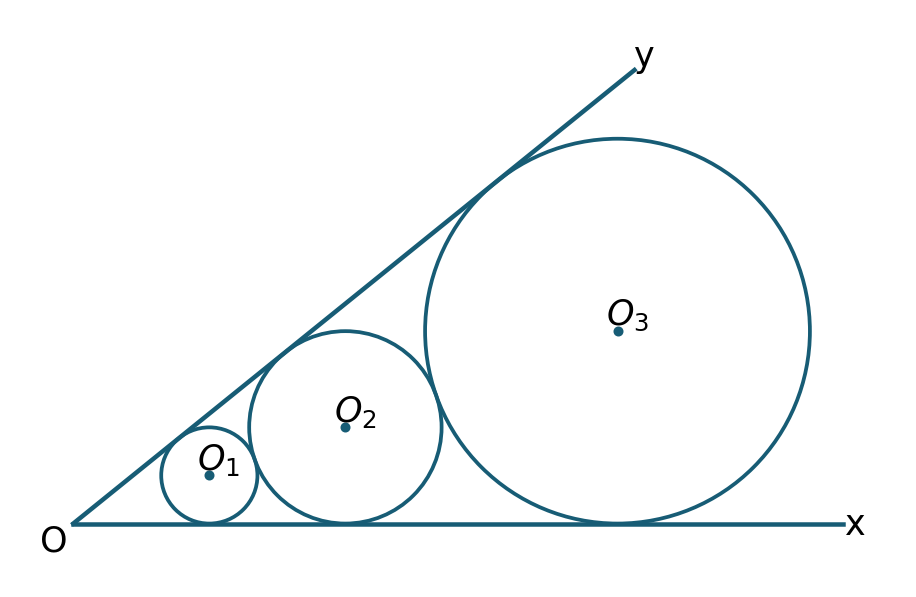
A sequence of circles $(O_1;r_1),(O_2;r_2),(O_3;r_3),\ldots$ is tangent to both sides of angle $xOy$, with consecutive circles externally tangent as shown. Given $r_1=1$ and $r_2=2$, find $r_{2020}$.
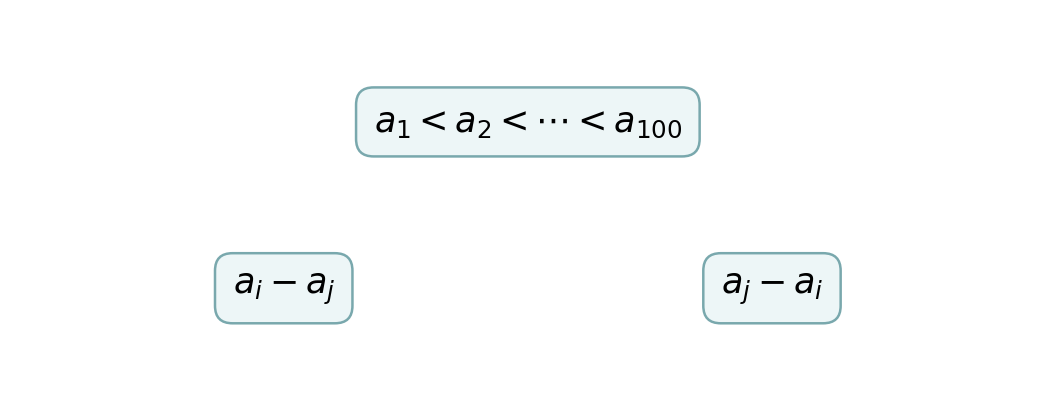
Let $X=\{a_1,a_2,\ldots,a_{100}\}$ be a set of 100 real numbers. Define $D=\{a_i-a_j\mid a_i,a_j\in X,\ i\ne j\}$. What is the smallest possible number of elements of $D$?
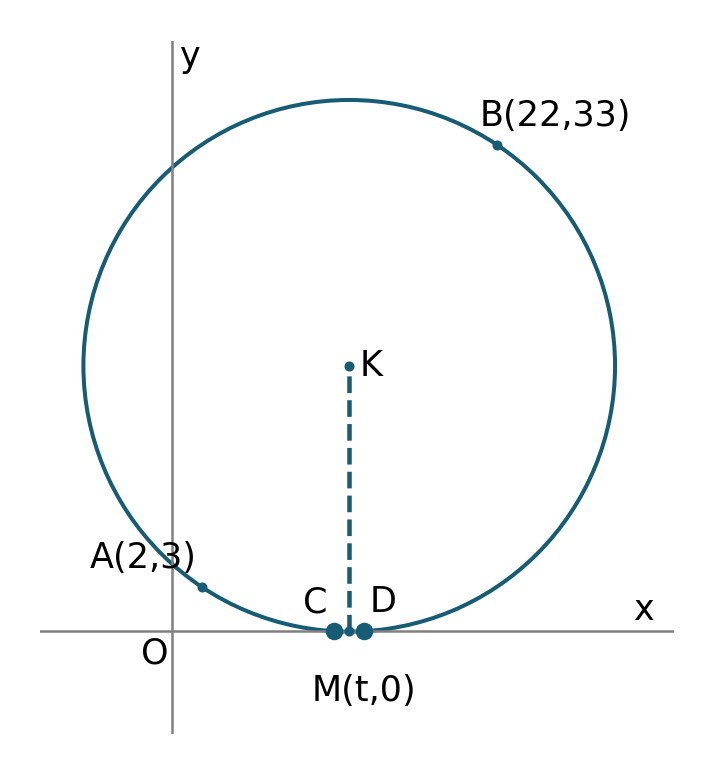
In the coordinate plane $Oxy$, a circle with centre $K$ passes through $A(2,3)$ and $B(22,33)$. It meets the $x$-axis at $C,D$, both with positive $x$-coordinates, and $CD=2$. The midpoint of $CD$ is $M(t,0)$. Find $t$.
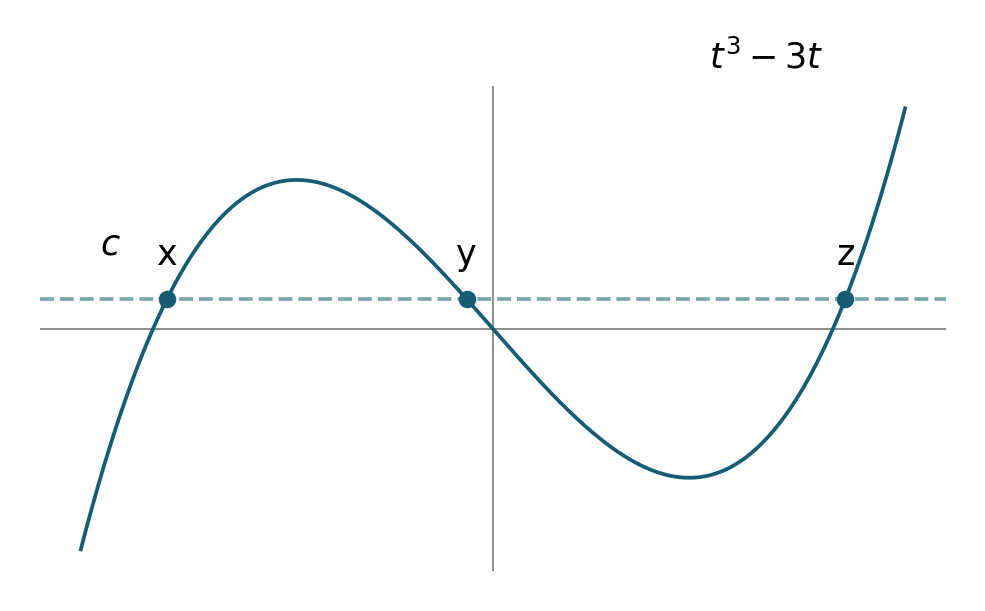
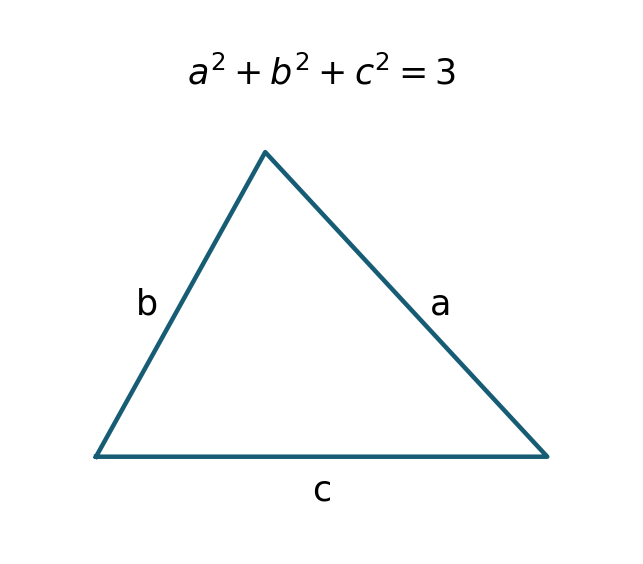
Positive real numbers $a,b,c$ satisfy $a^2+b^2+c^2=3$. Find the smallest real number $k$ such that whenever $\min\{a+b,b+c,c+a\}>k$, the numbers $a,b,c$ are the side lengths of a triangle.
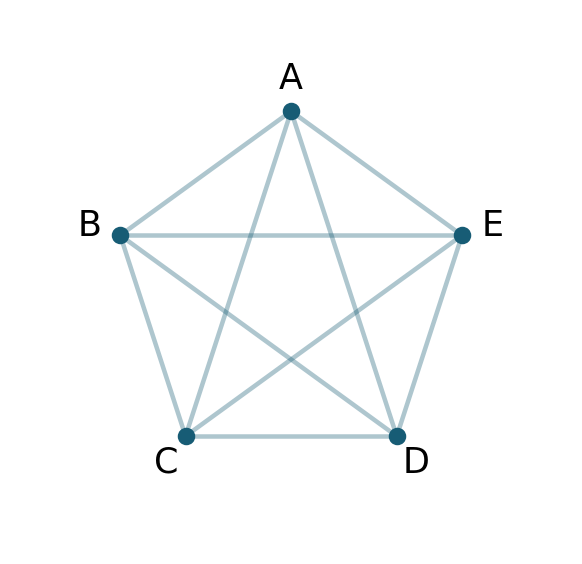
Five teams play in a single round-robin football tournament: any two teams play each other once. A win earns 3 points, a loss 0 points, and a draw 1 point for each team. After some matches, all five teams have positive, pairwise distinct scores. What is the smallest possible number of matches already played?
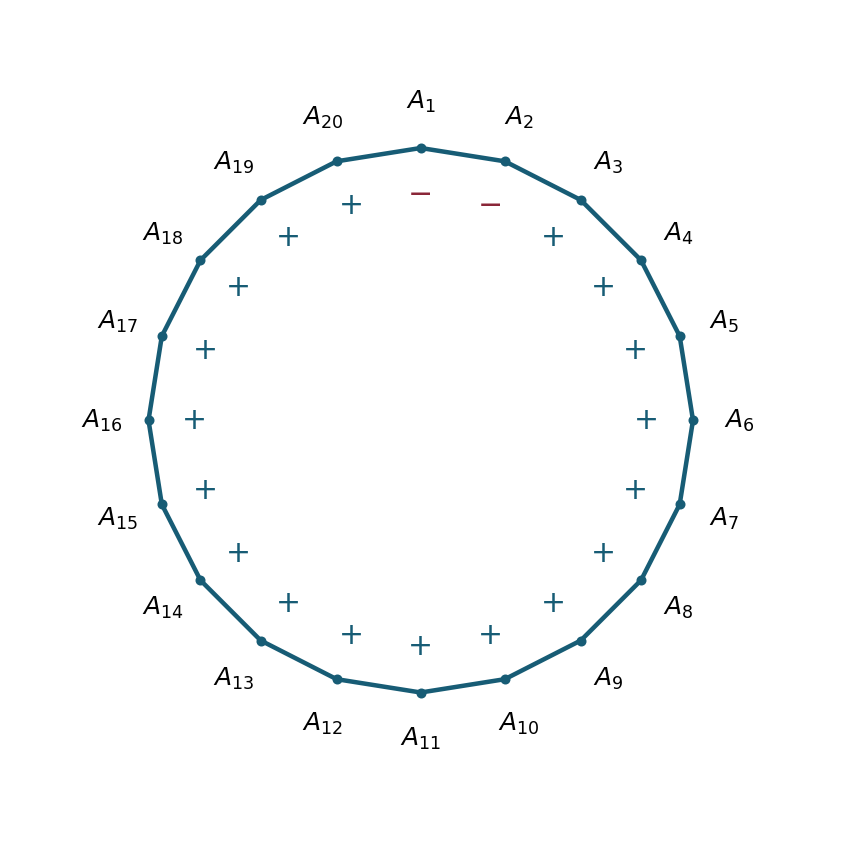
A regular polygon has 20 vertices $A_1,A_2,\ldots,A_{20}$ in cyclic order. Initially $A_1,A_2$ carry minus signs and all other vertices carry plus signs. In one move, reverse the signs at five consecutive vertices, changing minus to plus and plus to minus; consecutive vertices are counted cyclically. Can a sequence of moves leave minus signs exactly at $A_3,A_4$ and plus signs at all the other vertices? Why?
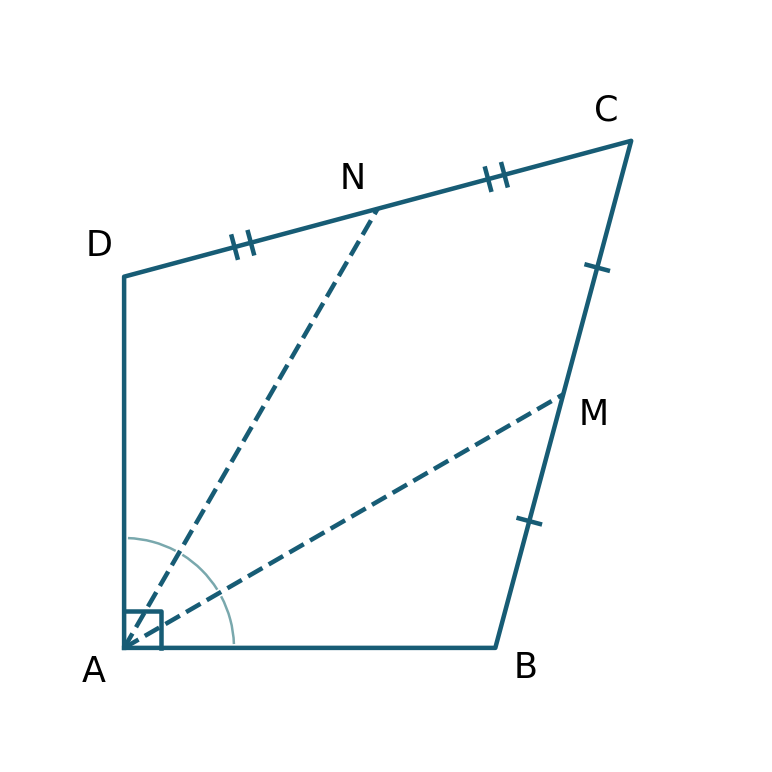
Let $ABCD$ be a convex quadrilateral with $\angle DAB=90^\circ$. Let $M,N$ be the respective midpoints of $BC,CD$, and suppose $\angle DAN=\angle NAM=\angle MAB$. Prove that $\angle DCB=60^\circ$.
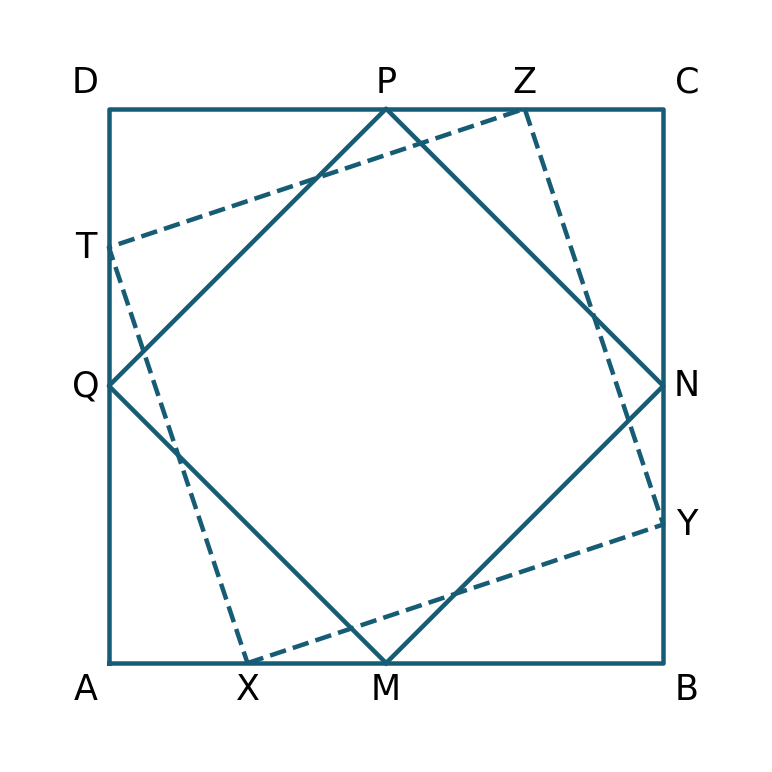
Square $ABCD$ has side $AB=4$ cm. Points $M,N,P,Q$ are the respective midpoints of $AB,BC,CD,DA$. Points $X,Y,Z,T$ are the respective midpoints of $AM,BN,CP,DQ$. Find the area of the intersection of squares $MNPQ$ and $XYZT$.
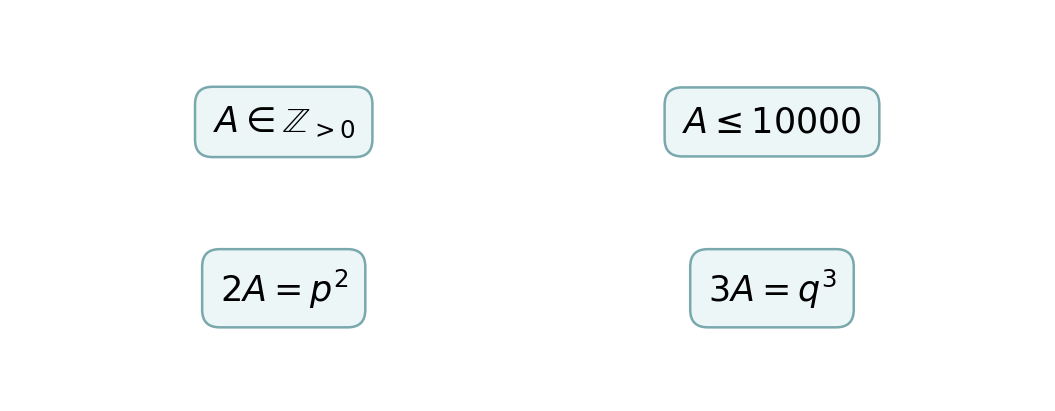
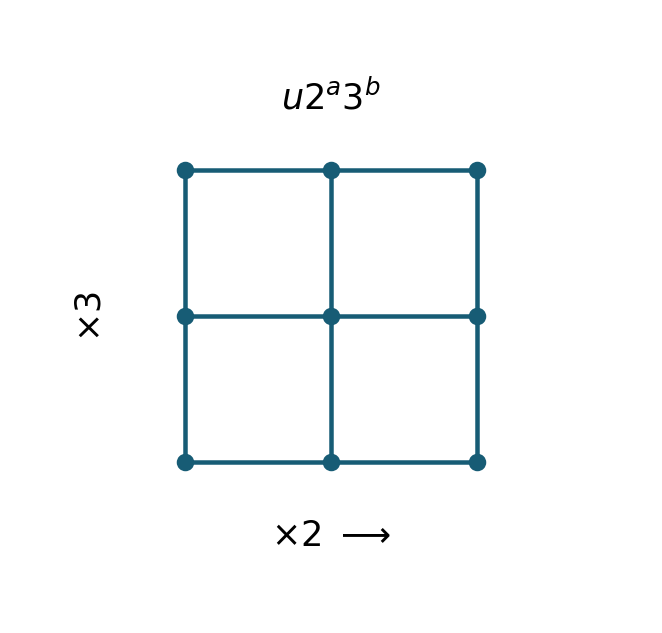
A positive integer $A$ is called beautiful if $2A$ is a perfect square and $3A$ is a perfect cube. Let $S$ be the set of all beautiful integers $A\le10000$. How many elements does $S$ have?
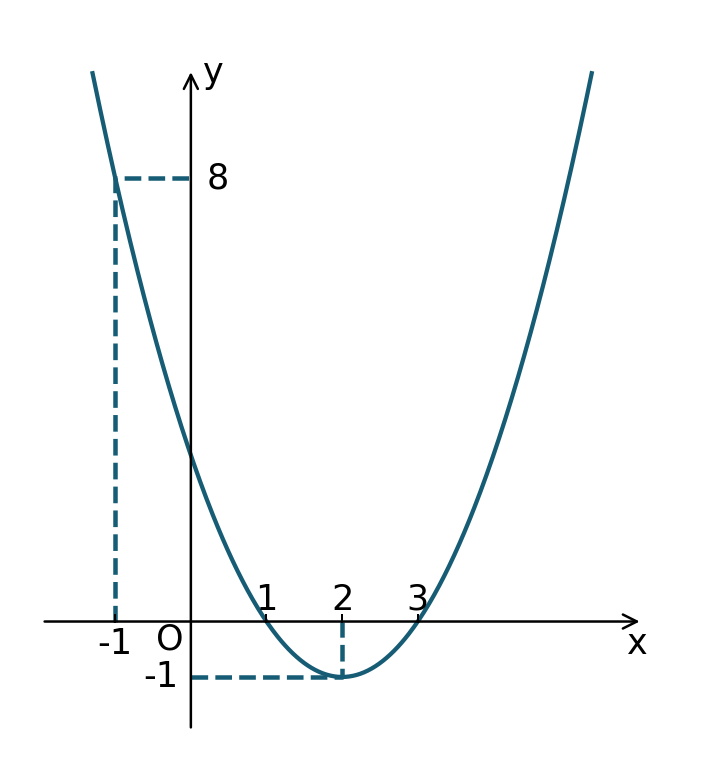
The graph of the quadratic function $y=f(x)$ is the parabola shown. Find the greatest integer $m$ such that $f(f(f(x)))=m$ has exactly eight distinct real solutions.
Given 100 distinct positive integers, call an unordered pair a nice pair if the larger number divided by the smaller is 2 or 3. What is the greatest possible number of nice pairs? A number may belong to more than one pair.