Skip to content / Đến nội dung
ThichHocToan.com

AMO 2021 – Junior College (Grades 11–12)

Question 1

Find $\sin^2 10^\circ+\sin^2 20^\circ+\sin^2 30^\circ+\sin^2 40^\circ+\sin^2 50^\circ+\sin^2 60^\circ+\sin^2 70^\circ+\sin^2 80^\circ$. The five choices below correspond, in order, to choices 1–5 in the original.

Question illustration
  1. $1$
  2. $2$
  3. $3$
  4. $4$
  5. $5$

Question 2

If $f(x)=x^3(a\cdot2^x-2^{-x})$ is even, find $a$.

Question illustration
  1. $1$
  2. $2$
  3. $3$
  4. $4$
  5. $5$

Question 3

Acute angles $\alpha,\beta$ satisfy $2\tan\alpha+3\sin\beta=7$ and $\tan\alpha-6\sin\beta=1$. Find $\sin\alpha$.

Question illustration
  1. $\frac13$
  2. $\frac{3\sqrt{10}}{10}$
  3. $\frac{3\sqrt7}{7}$
  4. $\frac{5\sqrt5}{5}$
  5. $\frac{10}{9}$

Question 4

A geometric sequence $(a_n)$ satisfies $a_5a_6=4$. Find $\log_2a_1+\cdots+\log_2a_{10}$. As required by the displayed logarithms, all ten terms are positive.

Question illustration
  1. $2$
  2. $4$
  3. $5$
  4. $8$
  5. $10$

Question 5

The polynomial $x^4-3x^3+5x^2+ax+b$ is divisible by $x^2-2x+1$. Find $ab$.

Question illustration
  1. $-10$
  2. $-5$
  3. $-2$
  4. $5$
  5. $10$

Question 6

In the expansion of $(\sqrt[3]x+\sqrt x)^{50}$, how many terms have integer exponents of $x$?

Question illustration
  1. $2$
  2. $4$
  3. $6$
  4. $9$
  5. $10$

Question 7

In an arithmetic sequence $(A_n)$, the sum $S_{2m-1}$ of its first $2m-1$ terms equals $19$, and $A_{m-1}+A_{m+1}-A_m^2=1$. Find $m$.

Question illustration
  1. $25$
  2. $20$
  3. $15$
  4. $10$
  5. $5$

Question 8

How many ordered pairs of integers $(x,y)$ satisfy $x^{2022}+y^2=2y$?

Question illustration
  1. $1$
  2. $2$
  3. $3$
  4. $4$
  5. $5$

Question 9

Given $\log_a b+\log_b a=3$ and $a>b>1$, find $\log_a b-\log_b a$.

Question illustration
  1. $-\sqrt5$
  2. $-\sqrt3$
  3. $\frac12$
  4. $\sqrt3$
  5. $\sqrt5$

Question 10

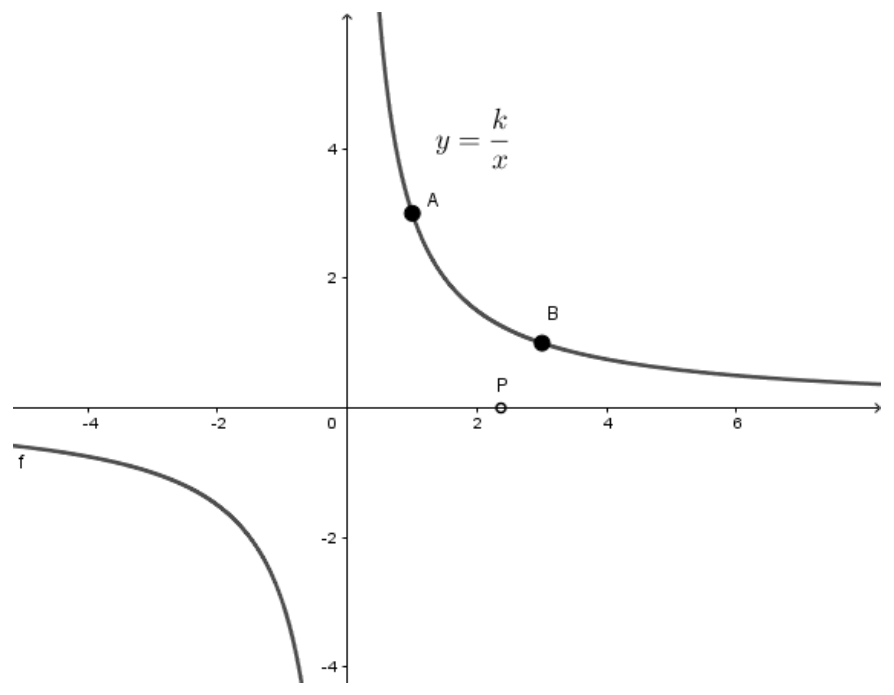
$A(1,3)$ and $B(3,m)$ lie on $y=k/x$. Find the $x$-coordinate of a point $P$ on the $x$-axis minimizing $PA+PB$.

Question illustration
  1. $\frac12$
  2. $1$
  3. $\frac32$
  4. $2$
  5. $\frac52$

Question 11

If $x^2/2+y^2/3=4$, find the greatest value of $x+y$.

Question illustration
  1. $2\sqrt3$
  2. $4$
  3. $2\sqrt5$
  4. $2\sqrt6$
  5. $2\sqrt7$

Question 12

Given $\sqrt[3]{5+x}+\sqrt[3]{5-x}=1$, find $x^2$.

Question illustration
  1. $13$
  2. $27$
  3. $39$
  4. $52$
  5. $65$

Question 13

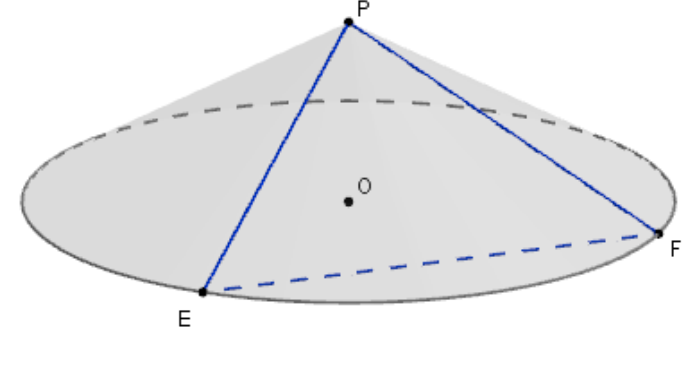
A circular cone has vertex $P$, base radius $\sqrt3$ inches, and height $1$ inch. Points $E,F$ lie on the base circle. Find the largest possible area of $\triangle PEF$, in square inches.

Question illustration
  1. $\frac12$
  2. $2$
  3. $4$
  4. $2\sqrt3$
  5. $4\sqrt3$

Question 14

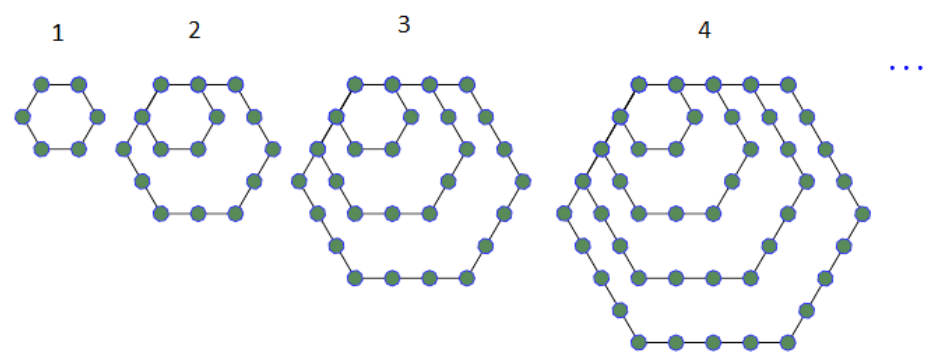
Continue the hexagonal dot pattern shown. How many dots are in the 99th shape?

Question illustration
  1. $18900$
  2. $19900$
  3. $20301$
  4. $20706$
  5. $16110$

Question 15

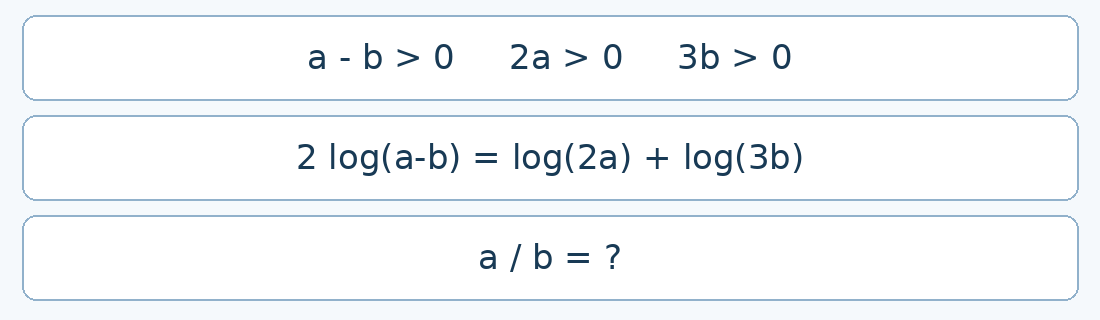
All logarithms are defined and $2\log(a-b)=\log(2a)+\log(3b)$. Find $a/b$.

Question illustration
  1. $2-\sqrt3$
  2. $4-\sqrt{15}$
  3. $4-\sqrt5$
  4. $2+\sqrt3$
  5. $4+\sqrt{15}$

Question 16

Find $80M^2$, where $M=\dfrac{\sqrt{3+\sqrt5}+\sqrt{3-\sqrt5}}{\sqrt{5-2\sqrt6}-\sqrt{5+2\sqrt6}}$.

Question illustration

Question 17

For every nonzero real $x$, $2f(x)+f(1/x)=2$. Find $30f(x)$.

Question illustration

Question 18

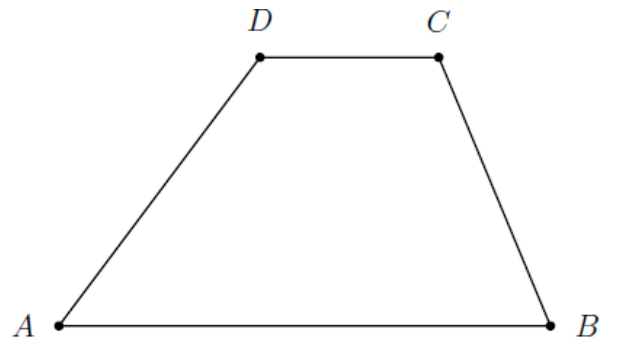
In trapezoid $ABCD$, $CD\parallel AB$, $AD=15$ cm, $AB=22$ cm, $BC=13$ cm, and $CD=8$ cm. Find its area in square centimetres.

Question illustration

Question 19

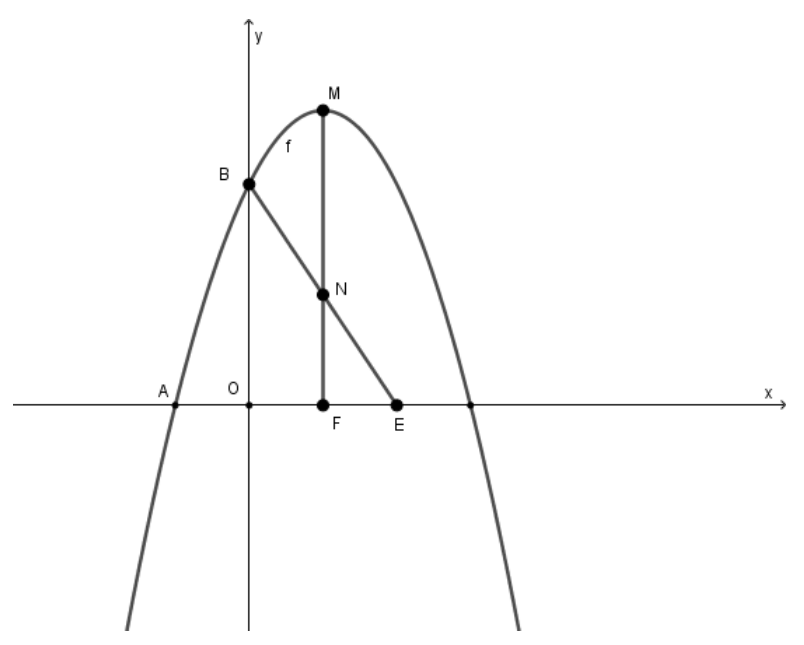
The parabola $y=-x^2+2x+3$ meets the axes at $A$ and $B$ as shown. Point $E$ is on the positive $x$-axis. The vertical line through the midpoint of $OE$ meets $BE$ at $N$ and the parabola at $M$, with $MN=5/2$. The sum of all possible positive $x$-coordinates of $E$ is $a+b\sqrt c$, in simplified form with integers $a,b$ and square-free positive integer $c$. Find $abc$.

Question illustration

Question 20

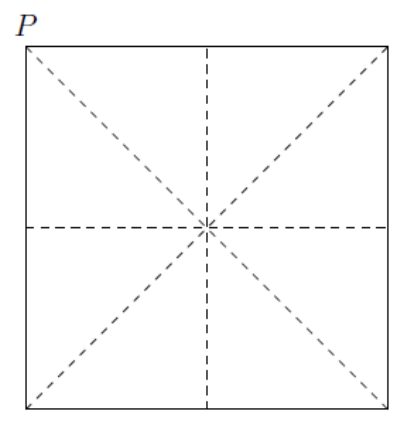
A square has seven nonidentity symmetries: four reflections and rotations through $90^\circ,180^\circ,270^\circ$. Starting at vertex $P$, perform four independent, uniformly random choices from these seven symmetries, successively. The probability that the four resulting positions are all four vertices is $k/7^4$. Find $k$. Clarification: this version counts the positions after moves 1, 2, 3, 4, not the initial position. The original wording does not specify this distinction; the solution explains both readings.

Question illustration