SEAMO self-study edition 2027; not an official 2027 paper. Original source years are retained. 25 questions, 90 minutes; Q1–10: 3 points, Q11–20: 4 points, Q21–25: 6 points, total 100. Original response types and all subparts are preserved. Verified is an editorial convention; source defects, necessary assumptions and unresolved mathematical uncertainty are disclosed.
Given that $abcd$ is nonzero, $c,d$ are roots of $x^2+ax+b=0$, and $a,b$ are roots of $x^2+cx+d=0$, which expression equals $(a+b+c+d)^2$?
Two teams A and B each have 7 players in a table-tennis tournament. A losing player is eliminated; the winner stays to face the next opposing player. Play stops as soon as every player on one team has been eliminated. In how many distinct ways can the tournament be played?
Counting convention for self-study: each team has a fixed player order. Count the sequence of match outcomes, not permutations of player lineups; the source does not specify lineup counting.
In triangle $KLM$, the internal angle bisectors $KN$ and $LP$ intersect at $Q$, with $N$ on $LM$ and $P$ on $KM$. Point $M$ lies on the circle through $P,Q,N$. If $PN=2$, compute $PQ$.
Answer entry: use sqrt(...) for a square root, * for multiplication and / for division, without spaces. The checker recognizes only explicitly listed exact forms; following this syntax does not guarantee recognition of every equivalent expression. An unrecognized equivalent form requires manual checking and must not be treated as wrong or scored zero solely because it is unrecognized.
Given $y=\dfrac{2\sin\alpha}{1+\cos\alpha+\sin\alpha}$, find
$$\frac{1-\cos\alpha+\sin\alpha}{1+\sin\alpha}.$$
Consider angles for which the given and requested fractions are defined.
If $a,b$ are real numbers satisfying $a^2+3a+1=0$ and $b^2+3b+1=0$, find $a/b+b/a$.
Source ambiguity: the hypotheses do not state that a and b are distinct. Preserve the question as printed; give every possible value and explain whether one value is determined. This response is assessed manually.
A sequence $(a_n)_{n=1}^{\infty}$ has $a_1=a_2=2$ and, for all $n=2,3,4,\ldots$,
$$\frac{2a_{n-1}a_n}{a_{n-1}a_{n+1}-a_n^2}=n^3-n.$$
Find the integer closest to $\displaystyle\sum_{k=2}^{2011}\frac{a_{k+1}}{a_k}$.
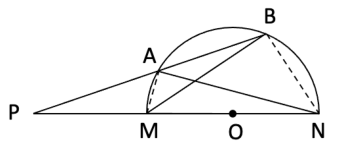
The line $PMN$ passes through the center $O$ of a circle, with $P,M,O,N$ in that order, $M,N$ on the circle and $PM=MN$. A ray from $P$ meets the circle at $A$ then $B$, as shown. Find
$$\frac{AM\cdot BM}{AN\cdot BN}.$$
Give your answer as a decimal to 1 decimal place.
Original source figure, preserving its mathematical labels and arrangement.
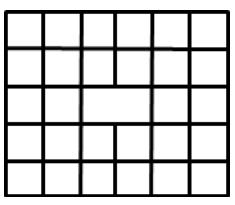
The figure shows a $5\times6$ rectangular board with a missing $1\times2$ rectangle in the center. How many squares are there in the board?
Counting convention: count squares whose complete four-sided outlines consist of printed grid segments, even if they surround the central missing rectangle. Do not count squares requiring an absent boundary segment.
Original source figure, preserving its mathematical labels and arrangement.
In rhombus $ABCD$, the circle through $A,B,C$ has radius 6, while the circle through $A,B,D$ has radius 2. Compute the area of $ABCD$.
Answer entry: use a reduced fraction a/b or a decimal with a dot. The checker recognizes only explicitly listed exact forms; it does not guarantee recognition of all algebraically equivalent forms. An unrecognized equivalent form requires manual checking and must not be treated as wrong or scored zero solely because it is unrecognized.
Suppose $a^2+b^2=2019c^2$, where $a,b,c$ are the sides of a triangle and $\alpha,\beta,\gamma$ are their respective opposite angles. Find
$$\frac{\cot\gamma}{\cot\alpha+\cot\beta}.$$
Let $A=(1,2)$. A line passing through $(5,-2)$ intersects the curve $y^2=4x$ at $B,C$. Triangle $ABC$ is:
Nondegeneracy convention: B and C are distinct real intersections, both different from A, so ABC is an actual triangle. The question asks for the type guaranteed by the hypotheses.