SEAMO self-study edition 2027; not an official 2027 paper. Original source years are retained. 25 questions, 90 minutes; Q1–10: 3 points, Q11–20: 4 points, Q21–25: 6 points, total 100. Original response types and all subparts are preserved. Verified is an editorial convention; source defects, necessary assumptions and unresolved mathematical uncertainty are disclosed.
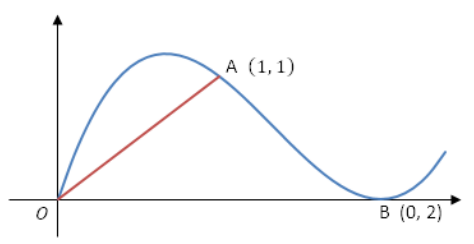
The diagram shows part of the curve $y=x(x-2)^2$, which passes through $A(1,1)$ and touches the $x$-axis at $B(2,0)$. Find the equation of the tangent at $A$.
Source-image correction: use B(2,0), as stated in the printed question and required by the equation. The original image incorrectly labels B(0,2). Its red segment OA is not the tangent being asked for.
Original figure, preserving all printed mathematical labels and the disclosed source-image discrepancy where applicable.
Hexagon $ABCDEF$ is inscribed in a circle, with $AB=CD=EF=2$ and $BC=DE=FA=10$. Compute the area of an equilateral triangle inscribed in the same circle.
Let $x$ be a positive real number. Suppose
$$m=\lfloor\log_{10}x\rfloor,\qquad n=\left\lfloor\log_{10}\frac{100}{x}\right\rfloor.$$
Here $\lfloor z\rfloor$ denotes the largest integer less than or equal to $z$. Find the least possible value of $4m^2-3n^2$.
When 3 new classrooms were opened, the average class size reduced by 10. When 6 new classrooms were opened, the average class size reduced by 16. Find the total number of students.
Interpret both classroom increases relative to the original number of classes, with the same total number of students in each scenario.
Evaluate the infinite series
$$1-\frac16+\frac{1\cdot3}{2!}\left(\frac16\right)^2-\frac{1\cdot3\cdot5}{3!}\left(\frac16\right)^3+\frac{1\cdot3\cdot5\cdot7}{4!}\left(\frac16\right)^4-\cdots.$$
Find the smallest positive integer $n$ that (a) has exactly three distinct prime factors and (b) has exactly eight positive integer factors, whose sum is 3696.
A student sits tests I, II and III. The student is successful if he passes either tests I and II or tests I and III. The passing probabilities are $p,q,1/2$, respectively. If his probability of success is $1/2$, which of the following can be $p,q$?
Conditional self-study version: assume the three passing events are mutually independent. The source does not state independence; without it, more than one listed pair can be possible. Choose under this explicit assumption.
Let $\tan\alpha$ and $\tan\beta$ be the two solutions of $x^2-3x-3=0$. Find
$$\left|\sin^2(\alpha+\beta)-3\sin(\alpha+\beta)\cos(\alpha+\beta)-3\cos^2(\alpha+\beta)\right|.$$
Here $|x|$ denotes absolute value.
A test has 100 questions. A student receives 4, $-1$ or 0 marks for a correct answer, a wrong answer or a blank answer, respectively. How many different total scores are possible? The total may be negative.
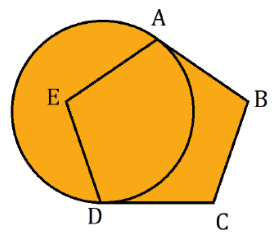
$ABCDE$ is a regular pentagon. A circle is drawn through it, tangent to $CD$ at $D$ and to $AB$ at $A$. What is the angle subtended at the circle's centre by the minor arc $AD$?
Interpret the source phrase “angle formed by the minor arc AD” as the measure of that arc, equivalently its central angle, not an inscribed angle.
Original figure, preserving all printed mathematical labels and the disclosed source-image discrepancy where applicable.
Three towns $X,Y,Z$ have coordinates $(0,0),(200,0),(0,300)$, respectively. They contain 100, 200 and 300 students, respectively. A school is to be built at an integer grid point $(x,y)$ so that the total distance travelled by all students is minimized. Find $x+y$.
Use straight-line Euclidean travel distances in the plane, with every student travelling from their own town to the school.
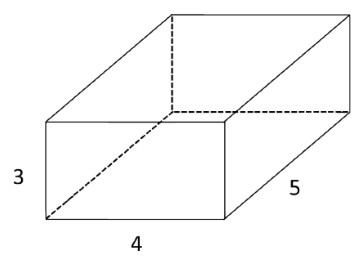
A right rectangular prism has side lengths 3, 4 and 5. The centres of its six faces are joined to form an octahedron. Find the volume of the octahedron.
Original figure, preserving all printed mathematical labels and the disclosed source-image discrepancy where applicable.
If $x=\sin\alpha$, $y=\sin\beta$ and $z=\sin(\alpha+\beta)$, find $\cos(\alpha+\beta)$.
Domain for this self-study question: x and y are both nonzero. Compare the options as identities valid throughout this domain. The source omits this restriction although its options contain denominators x or xy.