SEAMO self-study edition 2027; not an official 2027 paper. Original source years are retained. 25 questions, 90 minutes; Q1–10: 3 points, Q11–20: 4 points, Q21–25: 6 points, total 100. Original response types and all subparts are preserved. Verified is an editorial convention; source defects, necessary assumptions and unresolved mathematical uncertainty are disclosed.
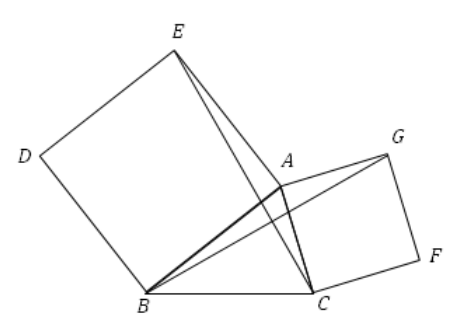
Given triangle $ABC$, squares $ABDE$ and $ACFG$ are drawn outwards from $AB$ and $AC$, respectively. Find $BG:CE$.
Original source figure, with all mathematical labels retained.
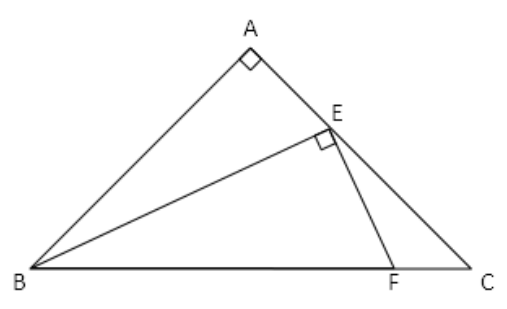
Triangle $ABC$ is isosceles with $AB=1$ and $\angle A=90^\circ$. Points $E$ and $F$ lie on $AC$ and $BC$, respectively, with $FE\perp BE$. Given $AE=2/5$, write the area of triangle $CEF$ as $m/n$, where $m,n$ are relatively prime positive integers. Find $m+n$.
Original source figure, with all mathematical labels retained.
A bag contains nine otherwise identical balls numbered $1,2,\ldots,9$. A draws one at random, notes its number $a$, and replaces it. B then draws a ball at random and notes its number $b$. What is the probability that $a-2b+10>0$?
After simplification, the following value is a proper fraction in lowest terms. Find its denominator minus its numerator.
$$1-\frac2{1(1+2)}-\frac3{(1+2)(1+2+3)}$$
$$-\frac4{(1+2+3)(1+2+3+4)}-\cdots-\frac{100}{(1+\cdots+99)(1+\cdots+100)}.$$
The sum of the squares of 50 consecutive odd integers is 300850. Find the largest odd integer whose square is the last term of this sum.
Interpretation: arrange the consecutive integers in increasing order and find the greatest possible last term across all sequences satisfying the data. The source does not require the integers to be positive.
Let $x_i\in\{\sqrt2-1,\sqrt2+1\}$ for $i=1,2,\ldots,2012$. Define
$$S=x_1x_2+x_3x_4+\cdots+x_{2009}x_{2010}+x_{2011}x_{2012}.$$
How many different positive integer values can $S$ attain?
Andrew and Bob play with a face-down pile of 2022 cards: 1001 black and the rest white. In each round, two cards are drawn consecutively without replacement. If the first is black and the second white, Andrew wins; if the first is white and the second black, Bob wins. If both have the same colour, play continues to the next round. If Andrew's probability of winning is $x$, find $\lfloor2022x\rfloor$.
Probability model: the face-down deck is randomly shuffled, with all card orderings equally likely.
The source states: “In triangle $ABC$, $D$ is the midpoint of $AB$ and $E$ is the midpoint of $BD$. Point $F$ is on $AB$ such that $E$ is on $CF$. If $BF=5$, compute $BA$.” The supplied key gives 15. Analyse this printed configuration and explain whether that answer is consistent.
Source-consistency warning: the printed incidence conditions and the answer key conflict. Retain the segment names exactly as printed; consider whether named points may coincide. Give a reasoned analysis rather than a guessed correction. This question is assessed manually.
How many distinct ways are there to arrange 4 girls and 10 boys to dance in a circle such that there are at least 2 boys between any two adjacent girls?
Counting convention: all dancers are distinct; rotations count as the same arrangement, while reflections count separately.
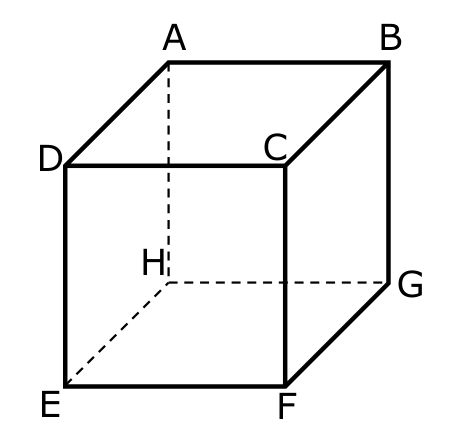
A real number is assigned to each vertex of cube $ABCDEFGH$, labelled as in the diagram. At each vertex, the average of the numbers at its three adjacent vertices is computed. The averages at $A,B,C,D,E,F,G,H$ are respectively $1,2,3,4,5,6,7,8$. What number was assigned to $F$?
Original source figure, with all mathematical labels retained.
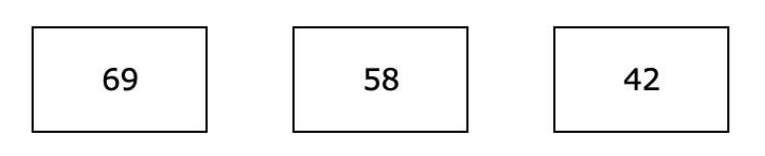
Gary wrote a number on each side of three cards and laid them on a table. The visible numbers are 69, 58 and 42. The sums of the two numbers on each card are equal, and all three hidden numbers are prime. Find the sum of the hidden numbers.
Original source figure, with all mathematical labels retained.
A biased coin is tossed 5 times. There is a nonzero probability of getting heads or tails once. The probability of getting heads exactly once equals the probability of getting heads exactly twice. Find the probability of getting heads exactly three times.
Use independent tosses with the same probability of heads on each toss.
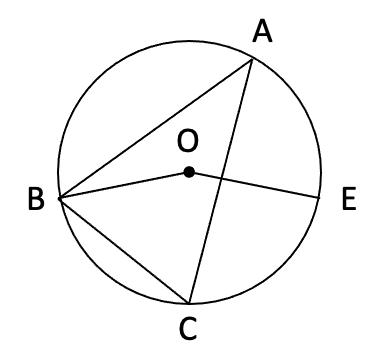
In the circle with centre $O$, $\angle AOB=120^\circ$ and $\angle BOC=72^\circ$, as shown. Point $E$ is on the circle with $OE\perp AC$. Find $\angle OBE$.
Use the position of E shown in the source figure: E is on the minor arc AC not containing B.
Original source figure, with all mathematical labels retained.