**Printed examination instructions.** Answer the following 5 questions. Write down your answer in the space provided after each question. Each question is worth 8 points. Time limit: 60 minutes.
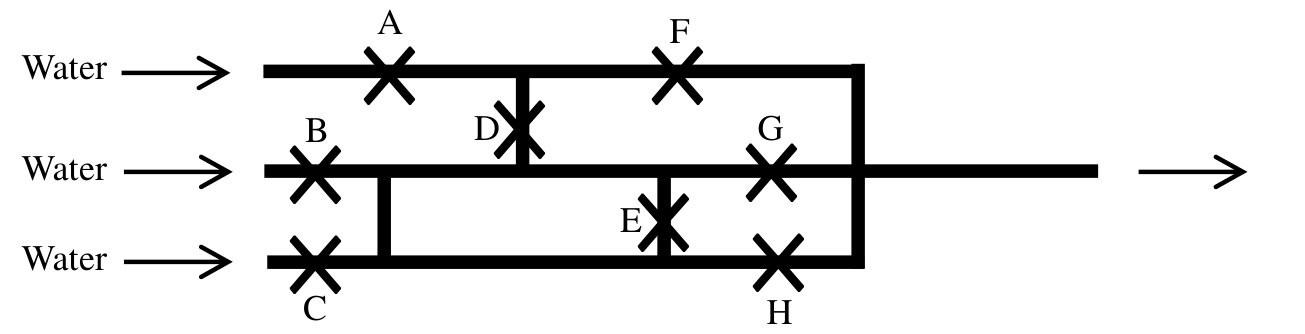
The diagram shows a network of water pipes, with eight taps, each shown by a symbol ×, at positions A, B, C, D, E, F, G and H. Water enters along three pipes at the left, indicated by →, and cannot pass a tap that is “off”. Each tap is either “on” or “off”. How many choices of taps in the “on” position result in water coming out of the pipe at the extreme right, assuming no more than three taps can be “on” at the same time?
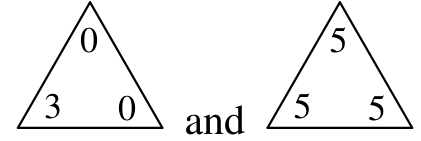
Triominoes is played with a set of tiles, all sides of which are equal in length. Each vertex of every tile is marked with one of the digits from 0 to 5. Different vertices on the same tile may have the same digits, so the two examples below are both included.
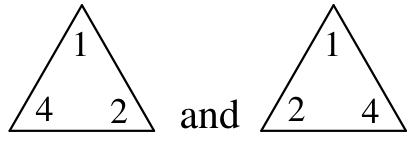
All possible tiles, including those with duplicate or triplicate digits, are in the set. How many possible tiles are there? The following mirror-image tiles are different tiles.
An n-dragon is a set of n consecutive positive integers. The first two-thirds form the tail; the remaining one-third form the head. The sum of the numbers in the tail equals the sum in the head. For example, the nine consecutive integers 2,3,4,5,6,7,8,9,10 form a 9-dragon:
- Its tail is 2,3,4,5,6,7: six numbers with sum 27.
- Its head is 8,9,10: three numbers with sum 27.
(1) Find a 21-dragon. (3 points)
(2) Find the sum of the tail of a 99999-dragon. (5 points)