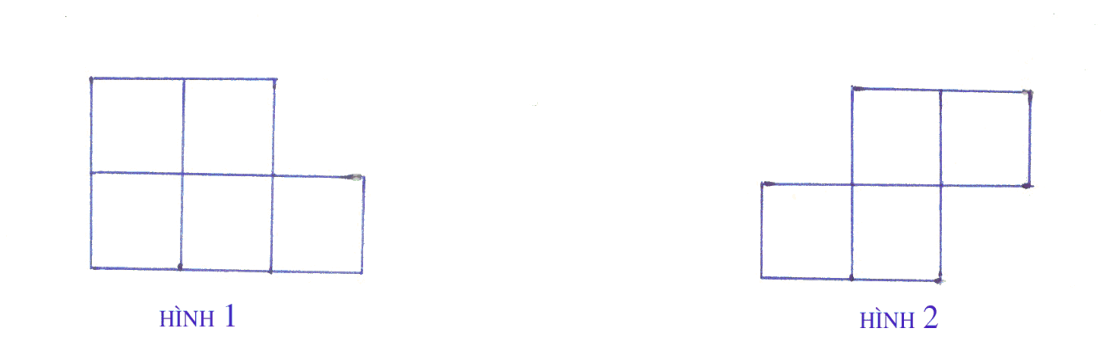
A $2\times3$ (or $3\times2$) rectangle with one unit square removed from a corner is called a singly deficient rectangle (Figure 1). Removing two unit squares at opposite corners gives a doubly deficient rectangle (Figure 2). Tile a $1993\times2000$ rectangle, without overlaps, using $2\times2$ squares and these two kinds of deficient rectangles. Let $s$ be the total number of $2\times2$ squares and doubly deficient rectangles in a tiling. Find the largest possible $s$.
The shapes are understood as unit-grid pieces, as in the source drawing.
The supplied PDF does not state a time limit. This edition uses the user-approved 240 minutes per session, 480 minutes total for both sessions; this is an editorial convention. The supplied source has no question point values. Each problem uses 1 editorial point for import compatibility; this is not an official scoring scale. Essay grading is manual; the rubric is editorial. Importer multipliers: correct 1, incorrect 0, blank 0.
Let $a_1=1$ and $a_{n+1}=a_n+1/\sqrt{a_n}$ for every integer $n\ge1$. Find all real $\alpha$ for which the sequence $u_n=a_n^\alpha/n$ has a finite nonzero limit as $n\to+\infty$.
The supplied PDF does not state a time limit. This edition uses the user-approved 240 minutes per session, 480 minutes total for both sessions; this is an editorial convention. The supplied source has no question point values. Each problem uses 1 editorial point for import compatibility; this is not an official scoring scale. Essay grading is manual; the rubric is editorial. Importer multipliers: correct 1, incorrect 0, blank 0.
Real numbers $x_1,x_2,x_3,x_4$ satisfy $\tfrac12\le x_1^2+x_2^2+x_3^2+x_4^2\le1$. Find the greatest and least values of
$$A=(x_1-2x_2+x_3)^2+(x_2-2x_3+x_4)^2+(x_2-2x_1)^2+(x_3-2x_4)^2.$$
The supplied PDF does not state a time limit. This edition uses the user-approved 240 minutes per session, 480 minutes total for both sessions; this is an editorial convention. The supplied source has no question point values. Each problem uses 1 editorial point for import compatibility; this is not an official scoring scale. Essay grading is manual; the rubric is editorial. Importer multipliers: correct 1, incorrect 0, blank 0.
Let $H,I,O$ be, respectively, the orthocenter, incenter and circumcenter of a triangle. Prove $2IO\ge IH$. Determine exactly when equality holds.
The supplied PDF does not state a time limit. This edition uses the user-approved 240 minutes per session, 480 minutes total for both sessions; this is an editorial convention. The supplied source has no question point values. Each problem uses 1 editorial point for import compatibility; this is not an official scoring scale. Essay grading is manual; the rubric is editorial. Importer multipliers: correct 1, incorrect 0, blank 0.
Let $k>1$ be an integer. For each integer $n>1$, define
$$f(n)=kn\prod_{j=1}^r\left(1-\frac1{p_j}\right),$$
where $p_1,\ldots,p_r$ are all the distinct prime divisors of $n$. Determine all $k$ for which, for every integer $a>1$, the sequence $x_0=a$, $x_{m+1}=f(x_m)$ ($m=0,1,2,\ldots$) is bounded.
The supplied PDF does not state a time limit. This edition uses the user-approved 240 minutes per session, 480 minutes total for both sessions; this is an editorial convention. The supplied source has no question point values. Each problem uses 1 editorial point for import compatibility; this is not an official scoring scale. Essay grading is manual; the rubric is editorial. Importer multipliers: correct 1, incorrect 0, blank 0.
Let $A_1,\ldots,A_n$ be $n>2$ points in space, no four coplanar. Join every pair of distinct points by a segment. Find the largest possible $n$ such that all these segments can be colored blue or red satisfying:
1. Each segment receives exactly one color.
2. At each $A_i$, at most four incident segments are blue.
3. For every red segment $A_iA_j$, there is a point $A_k$, different from both endpoints, for which both $A_kA_i$ and $A_kA_j$ are blue.
The supplied PDF does not state a time limit. This edition uses the user-approved 240 minutes per session, 480 minutes total for both sessions; this is an editorial convention. The supplied source has no question point values. Each problem uses 1 editorial point for import compatibility; this is not an official scoring scale. Essay grading is manual; the rubric is editorial. Importer multipliers: correct 1, incorrect 0, blank 0.