Quadrilateral $ABCD$ has perimeter $60$ cm and $AB$ has length $9$ cm. Sides $AD$ and $BC$ are parallel with distance $7$ cm between them. Points $E$ and $F$ are chosen on sides $BC$ and $AD$ respectively so that the line $EF$ divides $ABCD$ into two quadrilaterals with equal perimeters and equal areas. What is the area of quadrilateral $ABCD$?
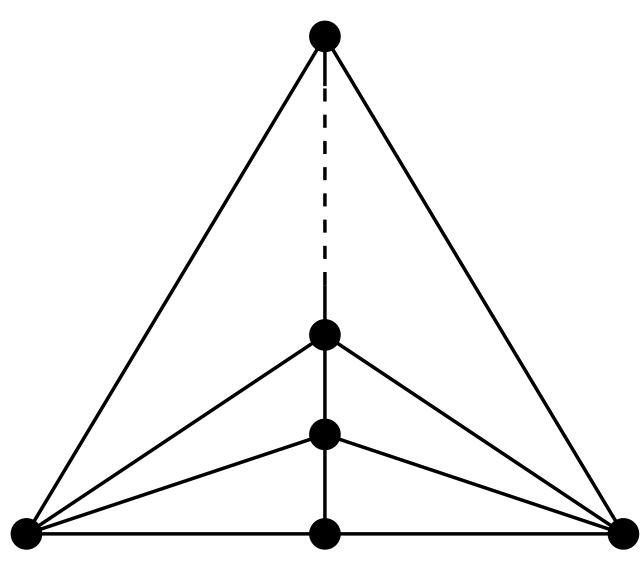
In the following figure, all the central dots are collinear and the bottom three dots are collinear. There are exactly $2024$ triangles that have dots as vertices (no three collinear dots form a triangle). How many dots are there?
A survey of $N$ people was taken to determine which of the different types $A,B,C$ of screen entertainment they used, if any. The survey found:
- $50$ people used $B$;
- $61$ did not use $A$;
- $13$ did not use $C$;
- $74$ used at least two of $A,B,C$.
Find the minimum value of $N$.
A binary sequence is a sequence in which each term is $0$ or $1$. A binary sequence $(a_0,a_1,\ldots,a_{n-1},a_n)$ is dyadic if it has an even number of terms and $a_0+a_n=a_1+a_{n-1}=a_2+a_{n-2}=\cdots=1$. For example, $(1,0,0,1,1,0)$ is a dyadic sequence of length $6$. How many binary sequences are there of length $16$ that are not dyadic, but are composed of $4$ consecutive dyadic sequences each of length $4$?
Denote the number of positive factors of an integer $n$ by $F(n)$. For example, the positive factors of $12$ are $1,2,3,4,6,12$, so $F(12)=6$. In addition, the positive factors of $6$ are $1,2,3,6$, so $F(F(12))=4$. If $F(F(n))=3$ and $F(F(6n))=7$, find $F(n)$.
Suppose that a number of $5\times7$ rectangles are placed on a large grid of unit squares so that each rectangle covers exactly $35$ of the unit squares. The rectangles can be placed either horizontally or vertically and they may overlap. Find the largest integer $N$ for which it is not possible to cover exactly $N$ unit squares in this way. [5 marks]
Investigation. Suppose instead we have rectangles of a single size $3\times n$, for some positive integer $n\ge6$. Placing them on the grid as above, what is the largest integer $N$ for which it is not possible to cover exactly $N$ unit squares? [4 bonus marks]
The original Investigation is assessed separately from the 35 base marks and the five-point main rubric.