Two operations $L$ and $R$ are defined as follows on rational numbers $p/q$, where $p$ and $q$ are positive integers:
$$L\left(\frac pq\right)=\frac p{p+q},\qquad R\left(\frac pq\right)=\frac{p+q}q.$$
Start from 1 and apply the operations $R,L,R,L,R,L,R,L,R,L$ successively. When the result is written as a fraction in simplest form, what is the sum of its numerator and denominator?
Three friends in year 9, Jan, Kate and Lee, sit in that order in the same row at assembly. Each row in the assembly hall has 30 seats numbered 1 to 30.
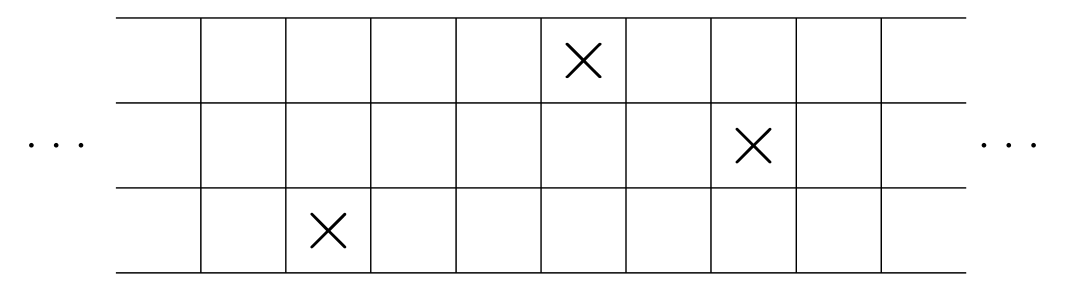
There are $3n$ year 9 lockers. They are arranged in three rows and numbered left to right from 1 to $n$ in the top row, $n+1$ to $2n$ in the middle row, and $2n+1$ to $3n$ in the bottom row.
The three friends' lockers are located like this:
The girls notice that Kate's assembly seat number divides each of their locker numbers. What is Kate's seat number?
$ABCD$ is a square of side 10 cm. $E,F,G,H$ are points on the sides $AB,BC,CD,DA$ respectively. Given that $EB=FC$, $CG=DH$, and $CG-EB=4$ cm, find the area of the quadrilateral $EFGH$ in square centimetres.
Find the largest 3-digit number $N=\overline{abc}$ such that for an integer $d\ge0$ with $d\le b$ and $d\le c$, if $a$ is increased by $d$ and $b$ and $c$ are decreased by $d$, then the result is a number equal to $Nd/2$.
Find the value of $a$ in the solution of the following system of equations:
$$a+b+c=2020\tag{1}$$
$$a^2+ac=b^2+bc\tag{2}$$
$$a^2+ab=c^2+cb-2020.\tag{3}$$
A circle with centre $C$ and radius 36 and a circle with centre $D$ and radius 9 touch externally. They lie above a common horizontal tangent which meets the first circle at $A$ and the second circle at $B$. A circle with centre $E$ is tangent to these two circles and to the segment $AB$. Find the area of triangle $CDE$.
Proceeding through a sequence of numbers term by term, we calculate a running tally as follows. The tally starts at zero. Starting with the first term, a term is subtracted from the running tally if the result is non-negative, otherwise it is added to the tally. When we arrive at the end of the sequence, the resulting tally is called the roman sum of the sequence. For instance, the roman sum of the sequence $2,4,3,3,1,5$ is $0+2+4-3-3+1+5=6$.
For a sequence consisting of the numbers $1,2,3,\ldots,100$ in some order, what is its largest possible roman sum?
If $k,m,n$ are integers such that $2\le k\le m\lt n$, show that
$$\frac{m!}{m^k(m-k)!}\lt \frac{n!}{n^k(n-k)!}.$$
Note that $0!=1$ and $r!=1\times2\times3\times\cdots\times r$ for any positive integer $r$.
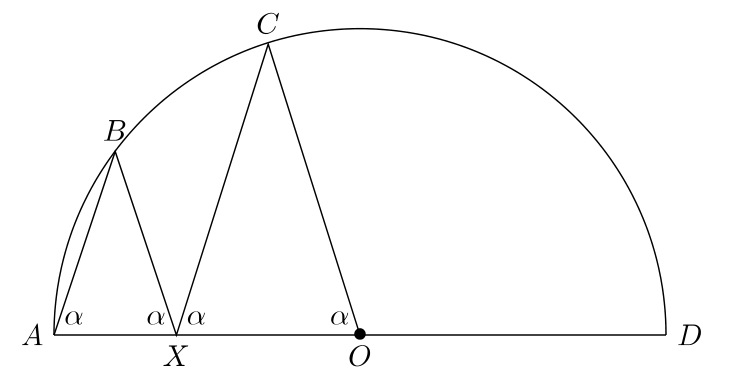
A circle with centre $O$ has diameter $AD$. With $X$ on $AO$ and points $B$ and $C$ on the circle, triangles $ABX$ and $XCO$ are similar isosceles with base angles $\alpha$ as shown. Find, with proof, the value of $\alpha$.
Investigation (separate manual bonus, not part of the 5 base marks). The $1+2=3$ bonus marks are assessed manually and separately from the contest base total of 35.
(a) Find $\alpha$ if, instead of two similar isosceles triangles on $AO$, there are three. [1 bonus mark]
(b) Find $\alpha$ if there are $n$ similar isosceles triangles along $AO$. [2 bonus marks]