Consider the following operation on positive real numbers written on a blackboard: Choose a number $r$ written on the blackboard, erase that number, and then write a pair of positive real numbers $a$ and $b$ satisfying the condition $2r^2=ab$ on the board.
Assume that you start out with just one positive real number $r$ on the blackboard, and apply this operation $k^2-1$ times to end up with $k^2$ positive real numbers, not necessarily distinct. Show that there exists a number on the board which does not exceed $kr$.
Let $a_1,a_2,a_3,a_4,a_5$ be real numbers satisfying
$$\frac{a_1}{k^2+1}+\frac{a_2}{k^2+2}+\frac{a_3}{k^2+3}+\frac{a_4}{k^2+4}+\frac{a_5}{k^2+5}=\frac1{k^2}$$
for $k=1,2,3,4,5$. Find the value of $\frac{a_1}{37}+\frac{a_2}{38}+\frac{a_3}{39}+\frac{a_4}{40}+\frac{a_5}{41}$. Express the value in a single fraction.
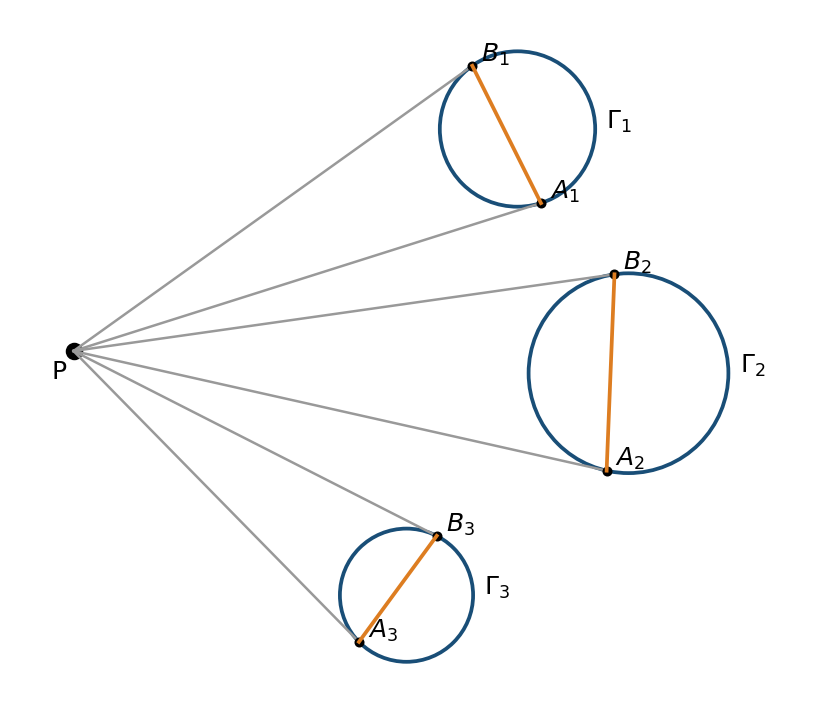
Let three circles $\Gamma_1,\Gamma_2,\Gamma_3$, which are non-overlapping and mutually external, be given in the plane. For each point $P$ in the plane, outside the three circles, construct six points $A_1,B_1,A_2,B_2,A_3,B_3$ as follows: for each $i=1,2,3$, $A_i,B_i$ are distinct points on $\Gamma_i$ such that $PA_i$ and $PB_i$ are both tangents to $\Gamma_i$. Call $P$ exceptional if the three lines $A_1B_1,A_2B_2,A_3B_3$ are concurrent. Show that every exceptional point of the plane, if any exists, lies on the same circle.
Prove that for any positive integer $k$, there exists an arithmetic sequence $a_1/b_1,a_2/b_2,\ldots,a_k/b_k$ of rational numbers, where $a_i,b_i$ are relatively prime positive integers for each $i=1,2,\ldots,k$, such that the positive integers $a_1,b_1,a_2,b_2,\ldots,a_k,b_k$ are all distinct.
Larry and Rob are two robots travelling in one car from Argovia to Zillis. Both robots have control over the steering and steer according to the following algorithm: Larry makes a $90^\circ$ left turn after every $\ell$ kilometer driving from start; Rob makes a $90^\circ$ right turn after every $r$ kilometer driving from start, where $\ell$ and $r$ are relatively prime positive integers. If both turns occur simultaneously, the car keeps going without changing direction. Assume that the ground is flat and the car can move in any direction.
The car starts from Argovia facing towards Zillis. For which pairs $(\ell,r)$ is the car guaranteed to reach Zillis, regardless of how far it is from Argovia?