Let $a,b,c,d,e,f$ be real numbers such that the polynomial
$$p(x)=x^8-4x^7+7x^6+ax^5+bx^4+cx^3+dx^2+ex+f$$
factorises into eight linear factors $x-x_i$, with $x_i\gt 0$ for $i=1,2,\ldots,8$. Determine all possible values of $f$.
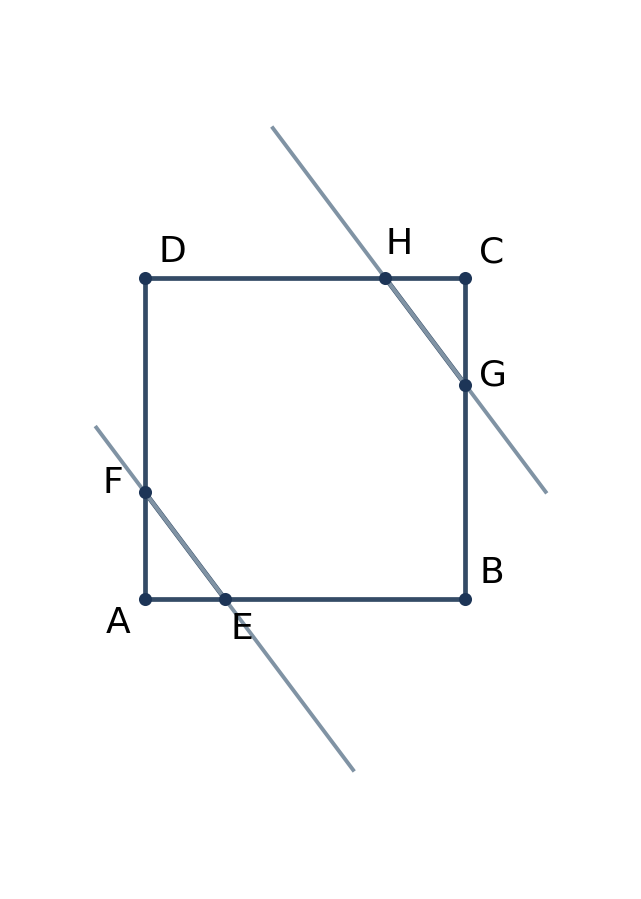
Suppose $ABCD$ is a square piece of cardboard with side length $a$. On a plane are two parallel lines $\ell_1$ and $\ell_2$, which are also $a$ units apart. The square $ABCD$ is placed on the plane so that sides $AB$ and $AD$ intersect $\ell_1$ at $E$ and $F$ respectively. Also, sides $CB$ and $CD$ intersect $\ell_2$ at $G$ and $H$ respectively. Let the perimeters of $\triangle AEF$ and $\triangle CGH$ be $m_1$ and $m_2$ respectively. Prove that no matter how the square was placed, $m_1+m_2$ remains constant.
Let $k\ge14$ be an integer, and let $p_k$ be the largest prime number which is strictly less than $k$. You may assume that $p_k\ge3k/4$. Let $n$ be a composite integer. Prove:
(a) if $n=2p_k$, then $n$ does not divide $(n-k)!$;
(b) if $n\gt 2p_k$, then $n$ divides $(n-k)!$.
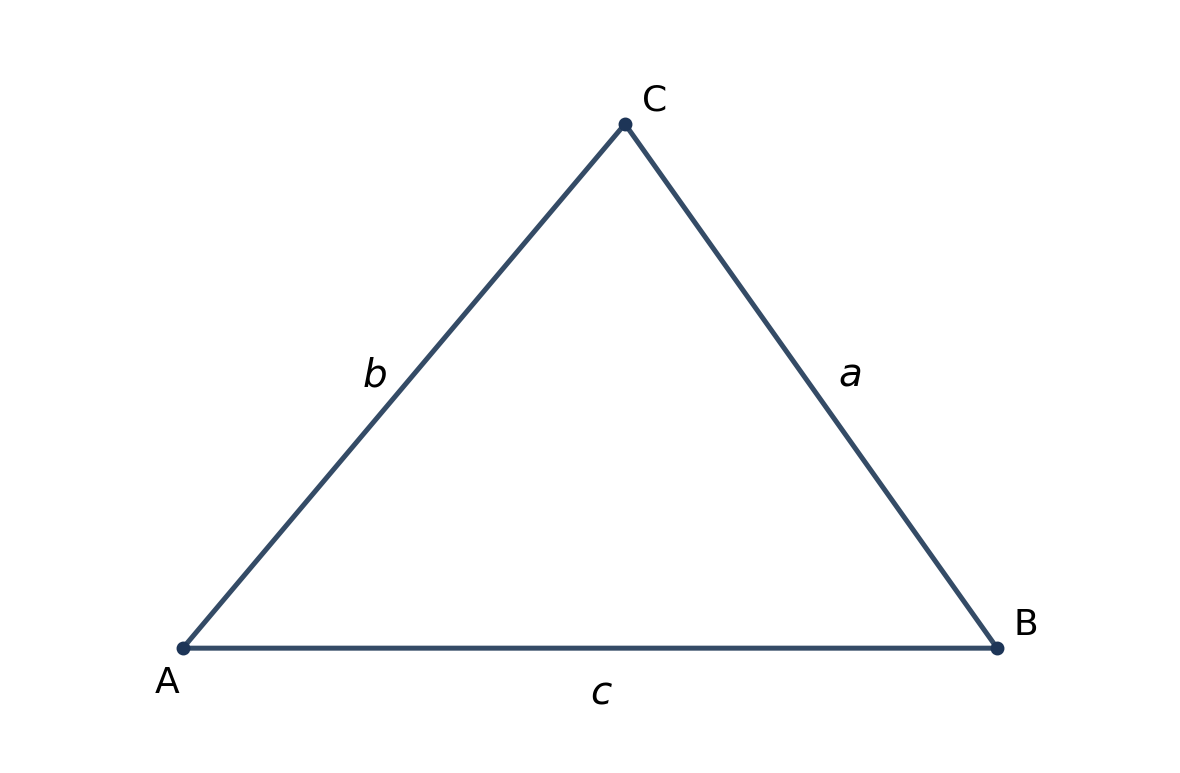
Let $a,b,c$ be the sides of a triangle, with $a+b+c=1$, and let $n\ge2$ be an integer. Show that
$$\sqrt[n]{a^n+b^n}+\sqrt[n]{b^n+c^n}+\sqrt[n]{c^n+a^n}\lt 1+\frac{\sqrt[n]{2}}2.$$
Given two positive integers $m$ and $n$, find the smallest positive integer $k$ such that among any $k$ people, either there are $2m$ of them who form $m$ pairs of mutually acquainted people or there are $2n$ of them forming $n$ pairs of mutually unacquainted people.