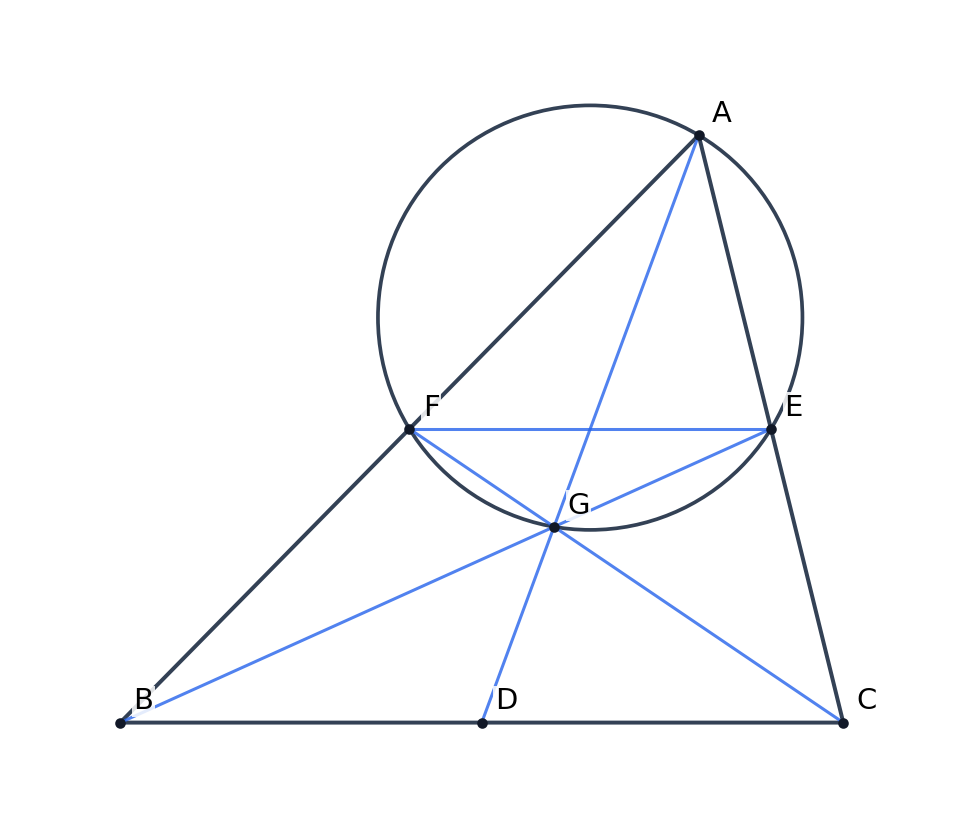
Given triangle $ABC$, let $D,E,F$ be the midpoints of $BC,AC,AB$ respectively and let $G$ be its centroid. For each value of $\angle BAC$, how many non-similar triangles are there in which $AEGF$ is a cyclic quadrilateral?
Let $a_1,a_2,\ldots,a_n$ be positive real numbers, and let $S_k$ be the sum of the products of $a_1,a_2,\ldots,a_n$ taken $k$ at a time. Show that
$$S_kS_{n-k}\ge\binom nk^2a_1a_2\cdots a_n\qquad(k=1,2,\ldots,n-1).$$
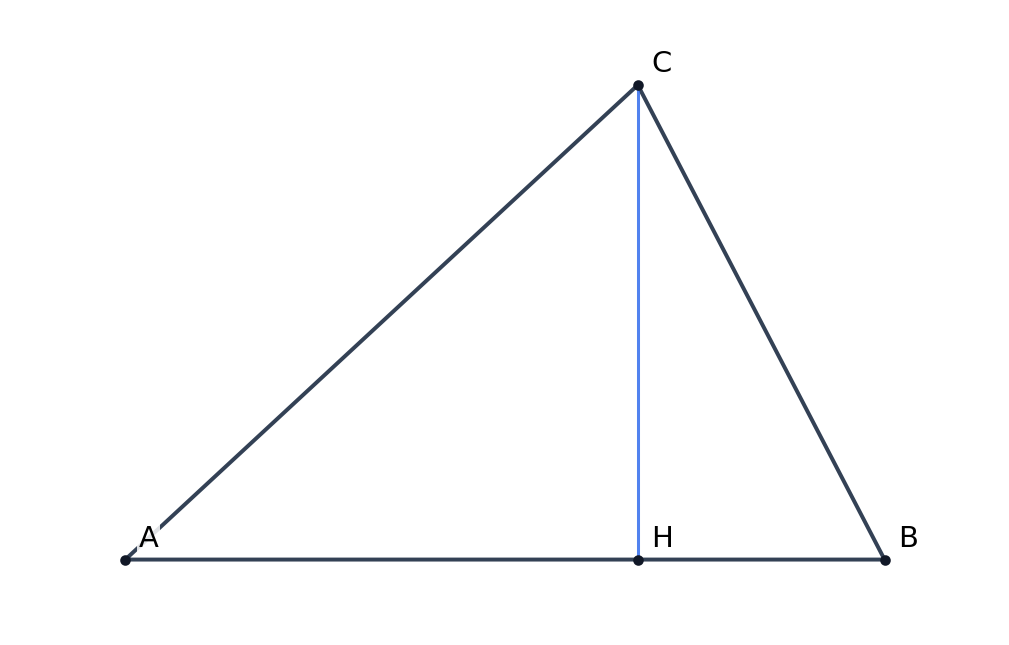
Consider all triangles $ABC$ which have a fixed base $AB$ and whose altitude from $C$ is a constant $h$. For which of these triangles is the product of its altitudes a maximum?
A set of $1990$ persons is divided into non-intersecting subsets so that:
1. No one in a subset knows all the others in the subset.
2. Among any three persons in a subset, at least two do not know each other.
3. For any two persons in a subset who do not know each other, exactly one person in that subset knows both.
(a) Prove that within each subset, every person has the same number of acquaintances.
(b) Determine the maximum possible number of subsets.
Knowing is mutual; an acquaintance is someone who is known. Every person is assumed to know oneself.