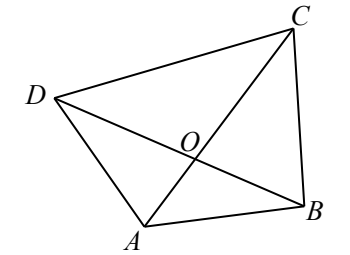
Convex quadrilateral $ABCD$ has diagonals meeting at $O$. Areas $[AOB]=144\ \mathrm{cm}^2$, $[COD]=169\ \mathrm{cm}^2$. Find its minimum possible area in $\mathrm{cm}^2$.
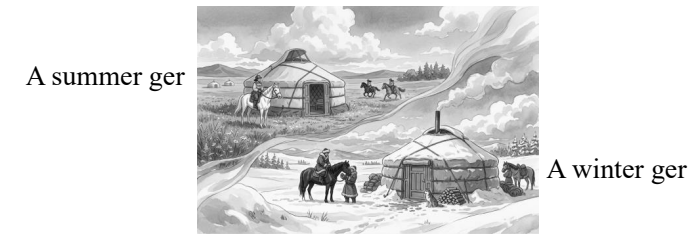
A nomadic family has 31 identical felt rugs. Some or all are distributed between a summer ger and a winter ger, each receiving at least two rugs. How many distributions are possible?
Let $a,b,c$ be non-negative real numbers. Define $X=(2a+b+c)(b+c)+c^2$, $Y=(a+2b+c)(a+c)+a^2$, $Z=(a+b+2c)(a+b)+b^2$. If $X+Y+Z=12$, find $(a^3+b^3+c^3-8)/[(2-a)(2-b)(2-c)]$.
How many ordered pairs of positive integers $(a,b)$ satisfy $ab+57=29\gcd(a,b)+2\operatorname{lcm}(a,b)$? Here gcd and lcm mean greatest common divisor and least common multiple.
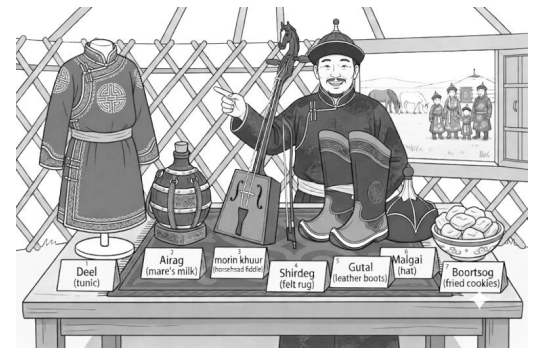
A merchant has seven different items: deel (tunic), airag (mare's milk), morin khuur (horsehead fiddle), shirdeg (felt rug), gutal (leather boots), malgai (hat), boortsog (fried cookies). A small package is any nonempty subset, with no repeated item. A special value deal consists of two disjoint small packages; their order does not matter. How many deals exist?
For example, {(deel, airag, shirdeg), (morin khuur, gutal)} equals the reversed pair, but differs from {(deel, airag, morin khuur), (shirdeg, gutal)}.
Eight medallions numbered 0–7 are arranged on a circular lock. Adjacent medallions must differ by a prime (2,3,5 or 7). Configurations are identical if one can be rotated to match the other. How many configurations unlock the chest?
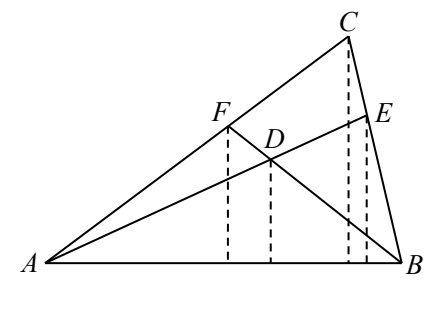
$E\in BC,F\in AC$ in triangle $ABC$, and $AE\cap BF=D$. Perpendicular distances from $E,D,C$ to $AB$ are 7,5,11 cm. Find the perpendicular distance from $F$ to $AB$, in cm.
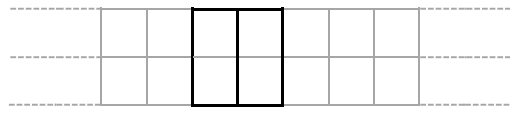
A $2\times2026$ board is tiled by $2\times1$ dominoes. Let $a$ count tilings in which no two vertical dominoes share a side, as illustrated. Find the remainder of $a$ divided by 6.
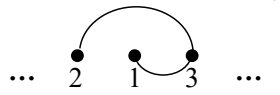
An infinite strip has one ball per square and a periodically repeated permutation $a_1\ldots a_n$ of $1,\ldots,n$, $n\ge3$. Each ball jumps right by the number written in its starting square. A pattern is collision-free if no square receives two balls. The patterns 123,231,312 are collision-free; 213 is not. Cyclic shifts represent the same pattern, so for n = 3 there is one pattern. How many collision-free patterns exist for n = 5? Give a complete explanation; merely listing the patterns is insufficient.
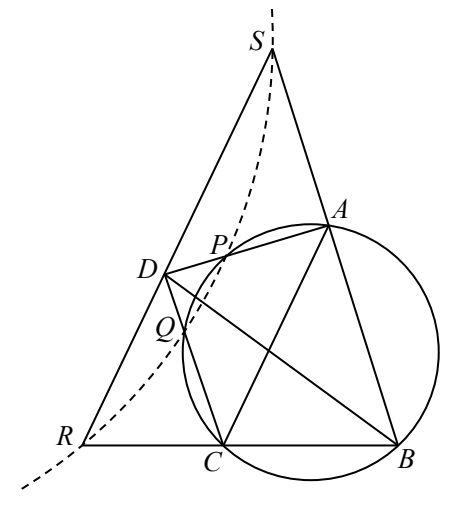
In convex quadrilateral $ABCD$, $BD$ bisects $\angle ABC$. The circumcircle of $ABC$ meets $AD,CD$ again at $P,Q$. The line through $D$ parallel to $AC$ meets the extensions of $BC,AB$ at $R,S$. Prove $P,Q,R,S$ concyclic.