A three-digit number $\overline{abc}$ is said to be remarkable if $\overline{abc}$ is less than $500$ and the last three digits of $\overline{abc}^{\,3}$ are $\overline{abc}$. What is the sum of the largest and smallest possible remarkable numbers?
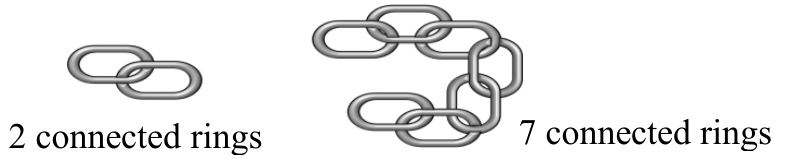
Below, the left diagram shows a chain that has two connected rings and the right diagram shows a chain that has seven connected rings.
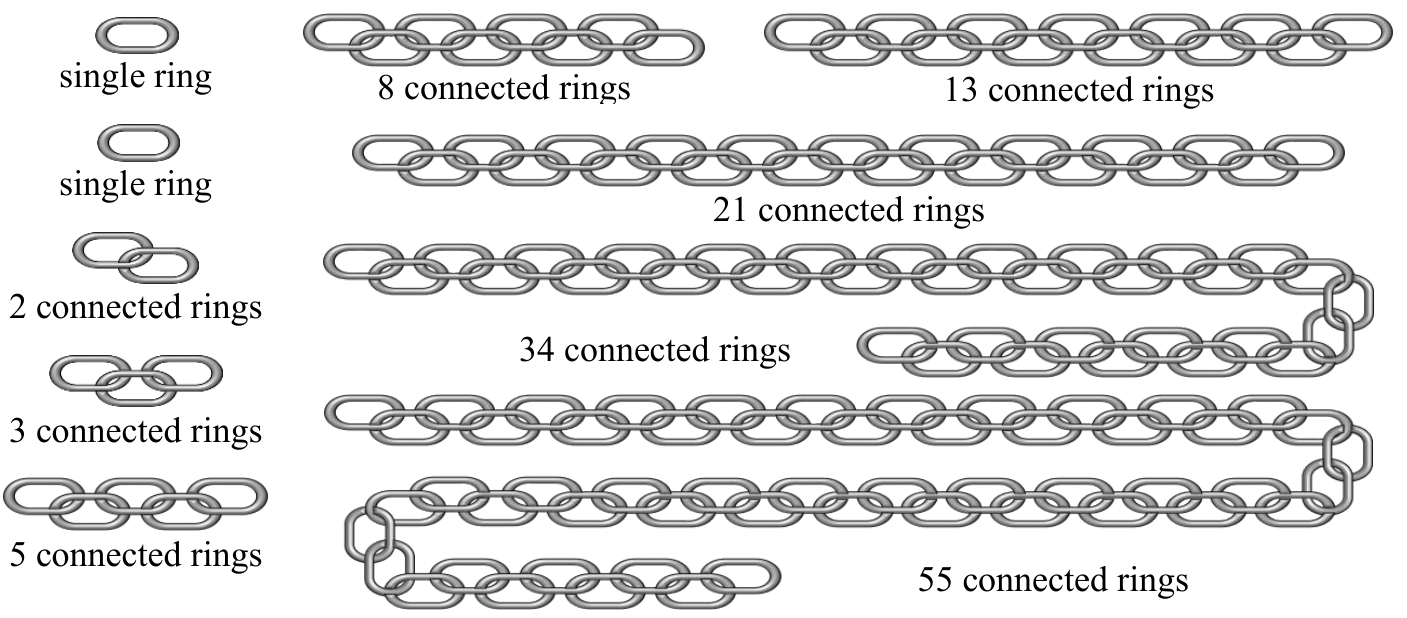
Mr. Metal owns $10$ chains. Two of them are identical, each consisting of a single ring. The remaining eight chains have $2,3,5,8,13,21,34$ and $55$ connected rings, respectively, as shown below.
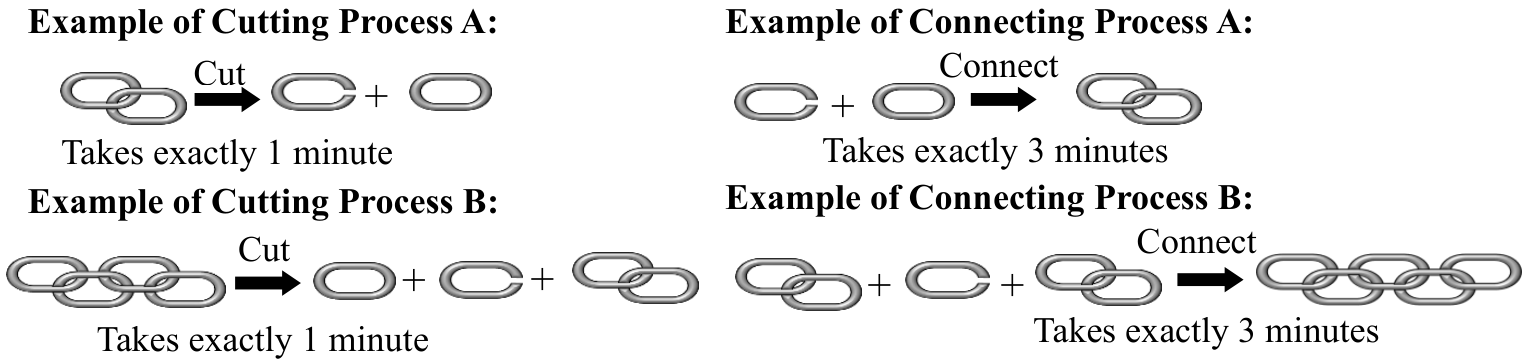
Mr. Metal wants to make two or more chains, all of the same length, with no loops or any opened ring in it. All rings must be used. What is the shortest amount of time, in minutes, to make them if it takes exactly $1$ minute to cut a ring (which disconnects it from other rings) and exactly $3$ minutes to connect rings by welding one open ring (after connecting it to zero or more other rings)?
Examples of Cutting Process A and B: Cut; takes exactly one minute. Examples of Connecting Process A and B: Connect; takes exactly three minutes.
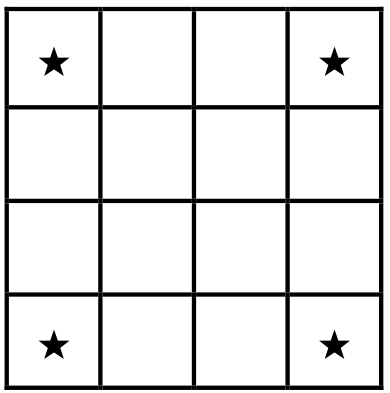
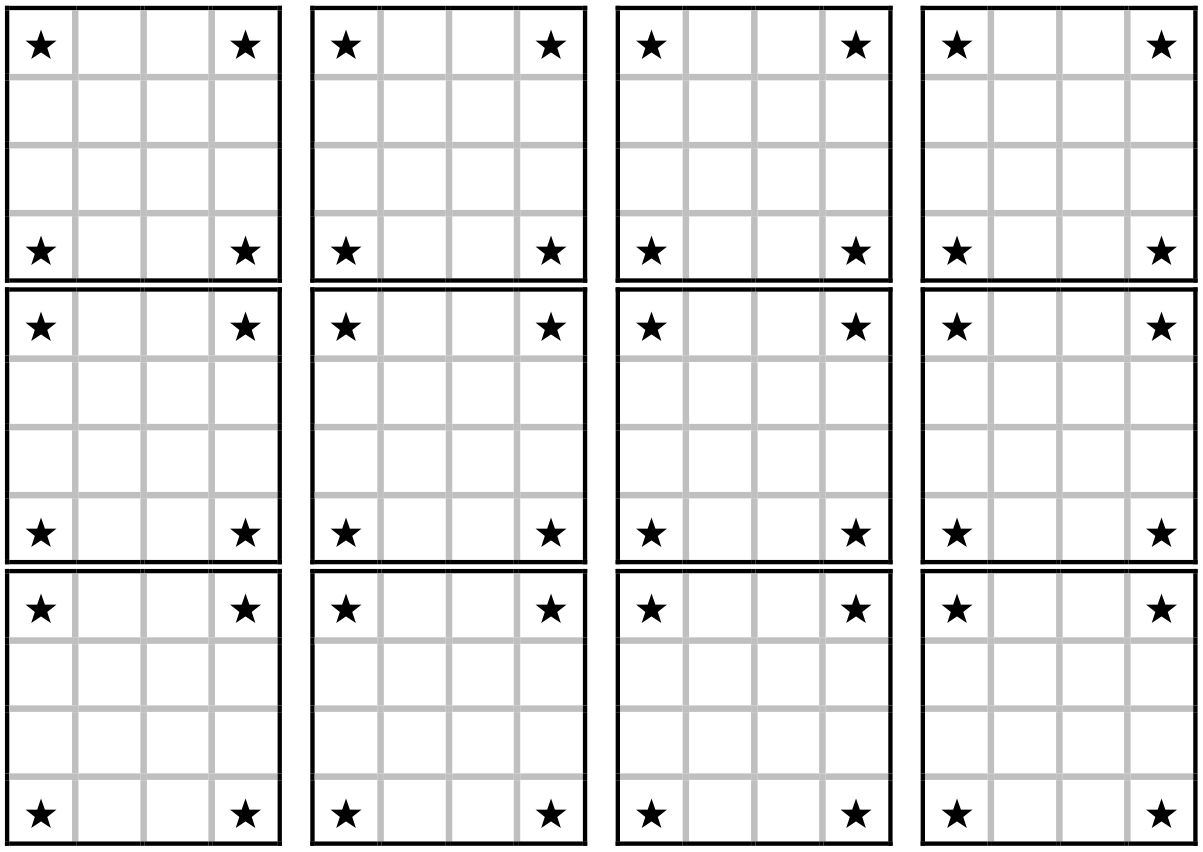
The diagram below shows a $4\times4$ board made of $16$ unit squares, which contains one star in each corner cell. The board is to be partitioned - by cutting along the grid lines - into non-overlapping regions, where each region is connected by sides. A partition is said to be valid if the regions all have the same area and contain exactly one star each. Draw all the valid partitions of the board.
(Note: Two partitions are considered the same if they can be obtained from each other by a finite number of reflections and/or rotations.)
Answer:
(Note: You may not need to fill out all the provided answer diagrams.)
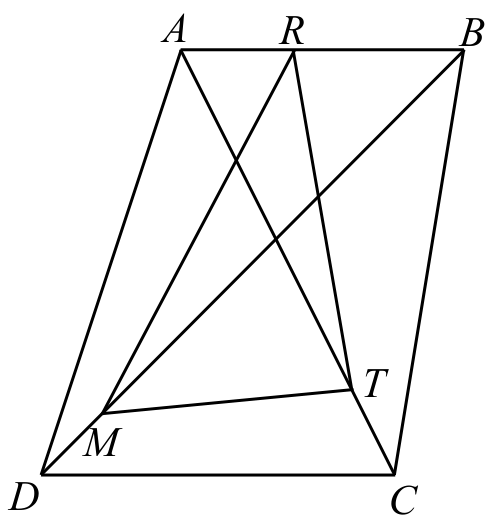
In the diagram below, $ABCD$ is a quadrilateral of area $675$ cm², where $AB$ and $CD$ are parallel and $AB=20$ cm, $CD=25$ cm. Points $M,R$ and $T$ are on segments $BD,AB$ and $AC$, respectively, such that $\frac{MD}{MB}=\frac16$ and $\frac{TC}{TA}=\frac14$.
If the area of the triangle $MRT$ is $216$ cm², what is the length, in cm, of $AR$?
Three boxes, $V,N$ and $M$, initially contain $20,25$ and $60$ identical marbles, respectively. Two players take turns playing a game. On each turn, a player chooses one box and removes a positive number of marbles from it. However, the following conditions must always remain satisfied after each move:
- The number of marbles in box $V$ must never exceed that in box $N$;
- The number of marbles in box $N$ must never exceed that in box $M$.
The player who takes the last marble wins. One of the players has a winning strategy. Formulate a winning strategy for this player and prove that is works.
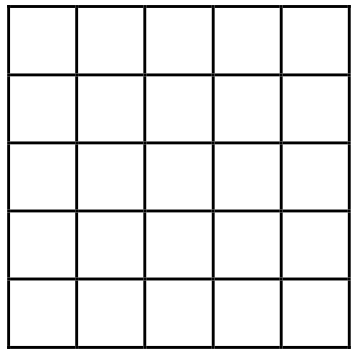
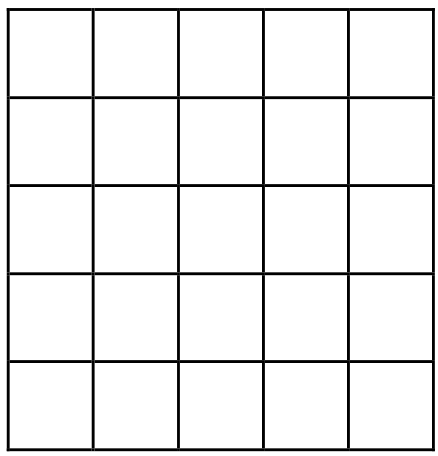
In a $5\times5$ board, each cell is to be painted with one of many colours.
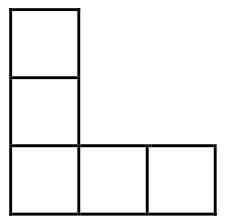
What is the minimum number of distinct colours needed so that no matter how an L-shaped tile (shown below) is placed on the $5\times5$ board along its grid lines, it will always cover $5$ cells of distinct colours? (Note: You must provide a colouring that satisfies your answer, and prove that using fewer colours is impossible.)
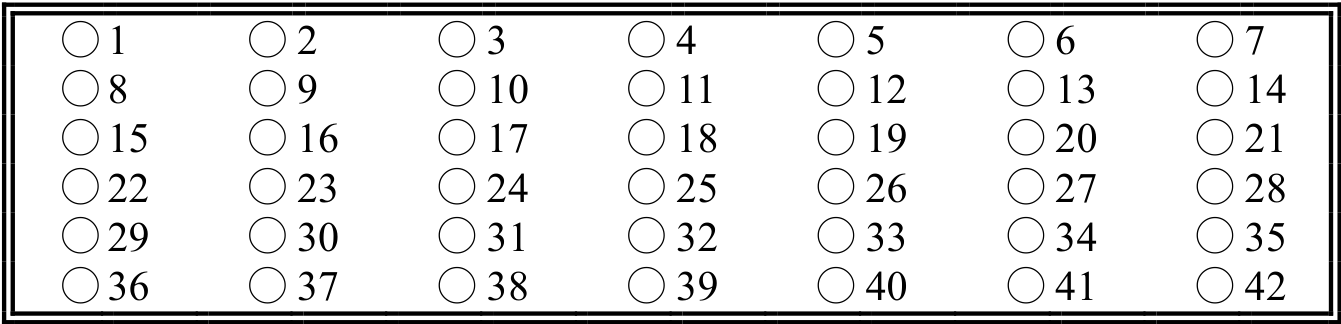
In a lottery game, a player chooses $6$ distinct positive integers from $1$ to $42$.
A sample of the lottery ticket is shown below:
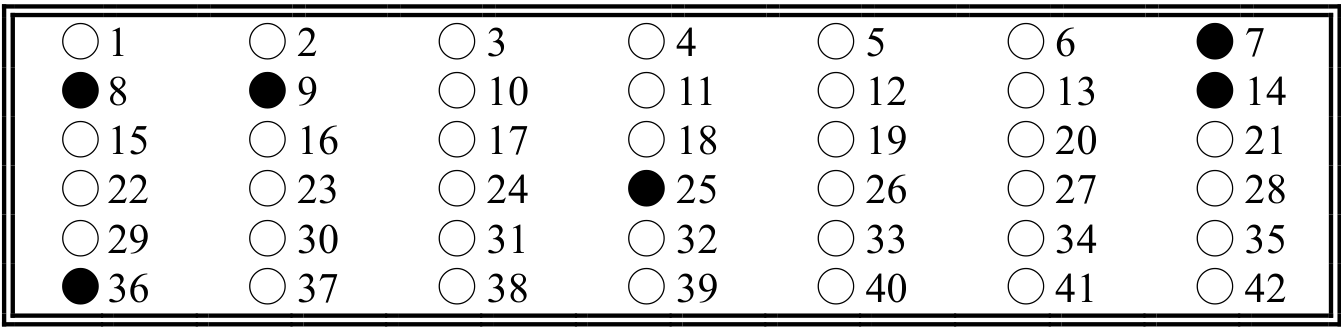
Now, Alex considers a ticket perfect if all the digits from $1$ to $9$ are used exactly once in the selected numbers, and the digit $0$ is not used at all. For example, he can select $7,8,9,14,25$ and $36$, as shown in the diagram below:
In how many ways can he fill out a perfect ticket?
The diagram below shows an evenly spaced $4\times4$ grid with the four central points removed. What is the total number of distinct circles that pass through at least $3$ of the grid points shown?