$N$ integers from $2021$ consecutive positive integers are chosen such that the difference between any two of them is not a prime number. Find the largest value of $N$.
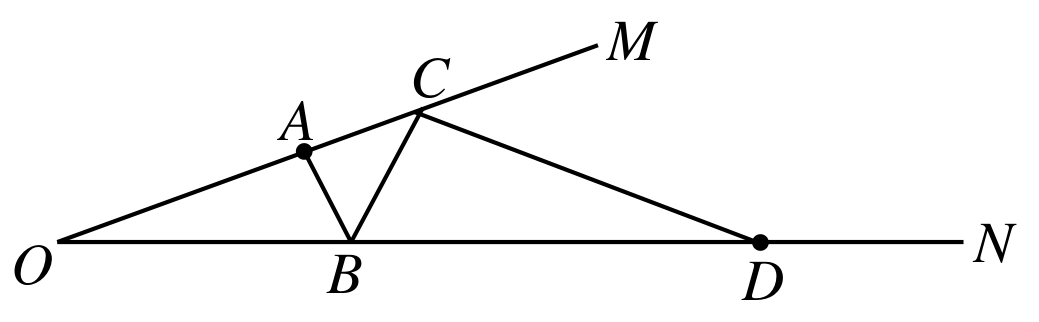
In the figure below, points $A,C$ are on ray $OM$ and $B,D$ are on ray $ON$. It is given that $OA=6$ cm, $OD=16$ cm and $\angle NOM=20^\circ$. What is the minimum length, in cm, of $AB+BC+CD$?
Determine the number of ordered pairs of digits $(a,b)$ such that when the number $\left(\overline{2a1b9}\right)^{2019}$ is divided by $13$, it leaves a remainder of $1$. ($\overline{2a1b9}$ is a five-digit number.)
There are $10$ identical red balls, $15$ identical black balls and $20$ identical white balls. We want to distribute all the balls to $2$ boys and a girl. Each boy must receive at least $2$ balls of each color, and the girl must receive at least $3$ balls of each color. What is the total number of different ways to distribute the balls to those three children?
Point $B$ is an arbitrary point on a circle with centre $O$ and radius $1$ cm. $ABC$ is a triangle with $A$ on the circle such that $AB=BC$ and $\angle ABC=90^\circ$. Determine the maximum length, in cm, of $OC$.
Each of $14$ girls has a different juicy piece of good news, and is eager to share it with all the other girls. In each round, some or all of the girls engage in phone conversations in pairs, telling each other all the pieces they have heard.
**(a)** What is the minimum number of rounds required in order for every girl to have heard all the pieces of good news? (10 points)
**(b)** Show all calls in each round to achieve the minimum number of rounds. (30 points)
On the plane, $5$ points $X_1$, $X_2$, $X_3$, $X_4$ and $X_5$ are chosen, and each pair of these points is connected by a blue line. Suppose no two blue lines are parallel or perpendicular to each other. Now for each point $X_i$ $(1\le i\le5)$ and each blue line $L$ not passing through $X_i$, a red line is drawn passing through $X_i$ and perpendicular to $L$. What is the maximum number of points of intersection formed by the red lines?
A wall with dimensions $2\times7$ squares has to be covered with ceramic tiles. There are two types of ceramic tiles that are available: the $1\times1$ (identical) tile and the $2\times1$ (identical) tile. The $2\times1$ tile can be rotated before being placed on the board. We are provided with as many tiles of each type as we need. In how many ways can we cover the $2\times7$ wall with such tiles?
For any positive integer $x$, let $S(x)$ be the sum of all the digits of $x$ in its decimal representation. Find all solutions of the equation $x=(S(x)+9)^2$.