A two-digit number $x$ is twice another two-digit number $y$. The sum of the digits of $x$ is equal to one of the digits of $y$ and the difference between the digits of $x$ is equal to the other digit of $y$. What is the maximum value of $y$?
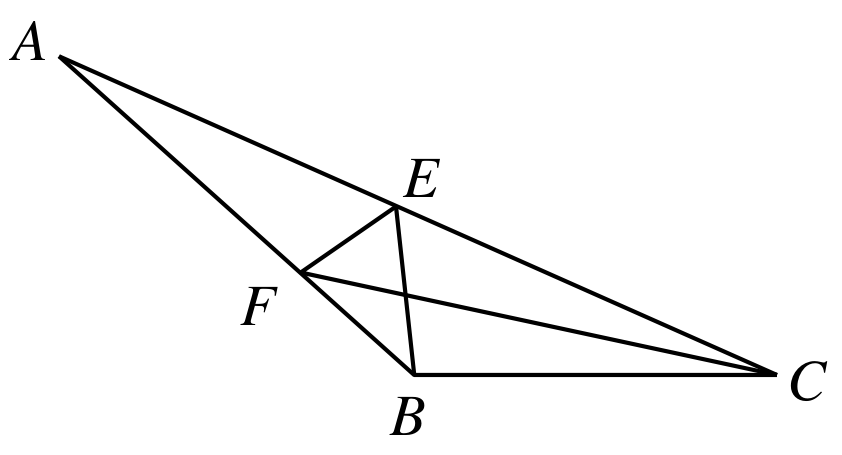
In triangle $ABC$, $\angle CAB=18^\circ$ and $\angle BCA=24^\circ$. $E$ is a point on $CA$ such that $\angle CEB=60^\circ$ and $F$ is a point on $AB$ such that $\angle AEF=60^\circ$. What is the measure, in degrees, of $\angle BFC$?
In triangle $ABC$, $\angle CAB=\angle BCA=45^\circ$. $L$ is the midpoint of $BC$ and $P$ is a point on $CA$ such that $BP$ is perpendicular to $AL$. If $CP=\sqrt2$ cm, what is the length, in cm, of $AB$?
If $x,y$ and $z$ are three consecutive positive integers such that
$$\frac{x}{y}+\frac{y}{z}+\frac{z}{x}+\frac{y}{x}+\frac{x}{z}+\frac{z}{y}$$
is an integer, what is the value of $x+y+z$?
In the parallelogram $ABCD$, $\angle BAD=60^\circ$. $E$ is the midpoint of $BC$ and $F$ is the midpoint of $CD$. $BD$ intersects $AE$ at $M$ and $AF$ at $N$. If $AB=15$ cm and $AD=8$ cm, what is the length, in cm, of $MN$?
In how many different ways can eight children (including Anna, Bert and Cody) be seated at a round table, if Anna must be next to Bert and Anna must not be sitting next to Cody? Seating arrangements in the same clockwise order are not considered to be different.
$A,B,C$ and $D$ are four points on a circle in that cyclic order. If $AD=BD=50\sqrt3$ cm, $AC=106.8$ cm and $\angle CAD=30^\circ$, what is the length, in cm, of $BC$?
On the blackboard are written the reciprocals of the first 2014 positive integers. In a move, we may erase two numbers and replace them by the sum of their sum and their product. Eventually, only one number remains. What is the maximum value of this number?
In triangle $ABC$, $\angle ABC=\angle ACB=30^\circ$. $O$ is a point such that $OA=OC=1$ cm and $OB=2$ cm. Moreover, $\angle CAB=\angle CAO+\angle OAB$. What is the length, in cm, of $BC$?
The Tower of Daejeon consists of 7 disks of different sizes, arranged in increasing order of size from top to bottom on the first of three pegs. The task is to transfer the tower from the first peg to the third peg. In each move, the top disk from a peg may be transferred to the top of an adjacent peg. Thus transfers directly from the first peg to the third peg or vice versa are forbidden. A larger disk may never be on top of a smaller disk. What is the minimum number of moves required?