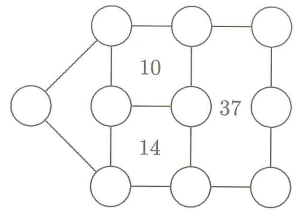
Place the ten digits in the ten circles of the diagram, each once. Consecutive numbers cannot occupy circles joined directly by a segment. The three rectangle perimeter sums are ten, fourteen and thirty-seven as labelled.
A right triangle has relatively prime integral side lengths in centimetres. The line joining its centroid and incentre is perpendicular to one side. Find its minimum perimeter.
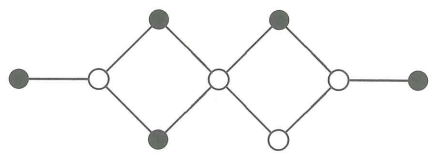
A marker is placed uniformly at random on one of the nine circles in the diagram, then moves uniformly along one incident segment to another circle. What is the probability that it finishes on a black circle?
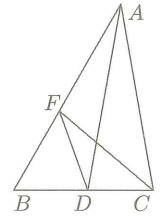
Triangle $ABC$ has $\angle A=40^\circ$, $\angle B=60^\circ$. The bisector of $A$ meets $BC$ at $D$. Point $F$ is on $AB$ with $\angle ADF=30^\circ$. Find $\angle DFC$.
A positive integer has two thousand thirteen digits, its first digit five. Every adjacent digit pair forms a multiple of thirteen or twenty-seven. Find the sum of all distinct possible last digits.
Every pair of tournament participants plays once, with no ties. For any two players, some third player beats both. (a) Prove there cannot be six participants. (b) Exhibit a possible seven-player tournament.
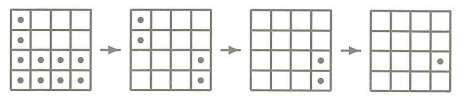
A marker occupies every cell of a $100\times100$ board. Players alternate removing all markers in any nonempty rectangular region containing no vacant cell. Taking the last marker loses. The diagram shows a sample $4\times4$ game lost by the first player. Which player has a winning strategy on the hundred-square-side board?
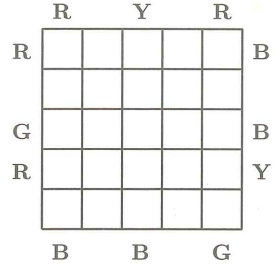
A $5\times5$ case contains five gems each of red, yellow, blue, green. Each row and column has one empty cell and one of each colour. Twelve observers report the first cell colour seen from the indicated edge, or the second if the first is empty. Fill the grid using the edge clues in the diagram; $R,Y,B,G$ denote the colours.
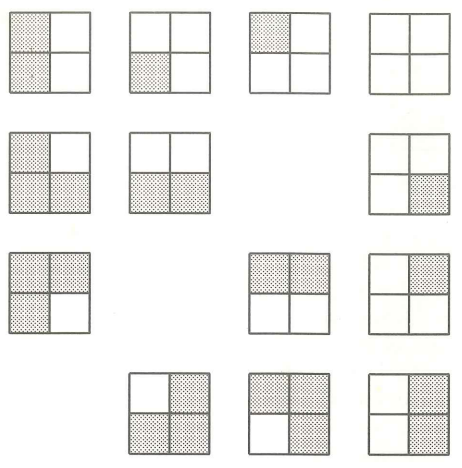
Four distinct stamps in a $2\times2$ block have thirteen nonempty edge-connected subblocks, as shown; shaded cells are removed stamps. How many nonempty connected subblocks are there in a $2\times4$ block of eight distinct stamps?