Children $A,B,C$ collect mangoes. Together $A,B$ collect six fewer than $C$; $B,C$ collect sixteen more than $A$; $C,A$ collect eight more than $B$. Find the product of their individual counts.
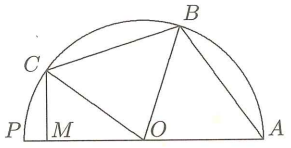
In the shown semicircle with centre $O$, a light ray leaves $M$ perpendicular to diameter $PA$. It reflects at $C$ with $\angle MCO=\angle OCB$, and again similarly at $B$, then hits $A$. Find $\angle COM$ in degrees.
Nineteen children, aged one to nineteen respectively, stand in a circle. Record the positive age difference of every adjacent pair. What is the maximum sum of the nineteen differences?
Quadrilateral $ABCD$ is not cyclic. Points $E,F,G,H$ are circumcentres of $ABD,ADC,BCD,ABC$, respectively. Lines $EG,FH$ meet at $I$, with $AI=4$, $BI=3$ cm. Find $CI$ in cm.
A test requires sixty-five out of one hundred to pass. The class average is sixty-six; passing students average seventy-one, failing students fifty-six. Add five to each score. The new passing average is seventy-five and failing average fifty-nine. If the class has between fifteen and thirty students, how many are there?
A circle has $2009$ blue points and one red point. Jordan counts convex polygons using only blue vertices. Kiril counts those including the red vertex. What is the difference between their counts?
Musa starts with three hundred fifty bottles: water sells at four rands, cold drink at seven. Not all bottles sell; revenue is $2009$ rands. What is the minimum cold-drink count sold?
Ten chess players each play every other exactly once. So far, among any three players at least two have not yet played each other. What is the maximum number of games already played?
Find the smallest positive integer expressible as the sum of four positive squares, allowing repeats, and dividing $2^n+15$ for some positive integer $n$.