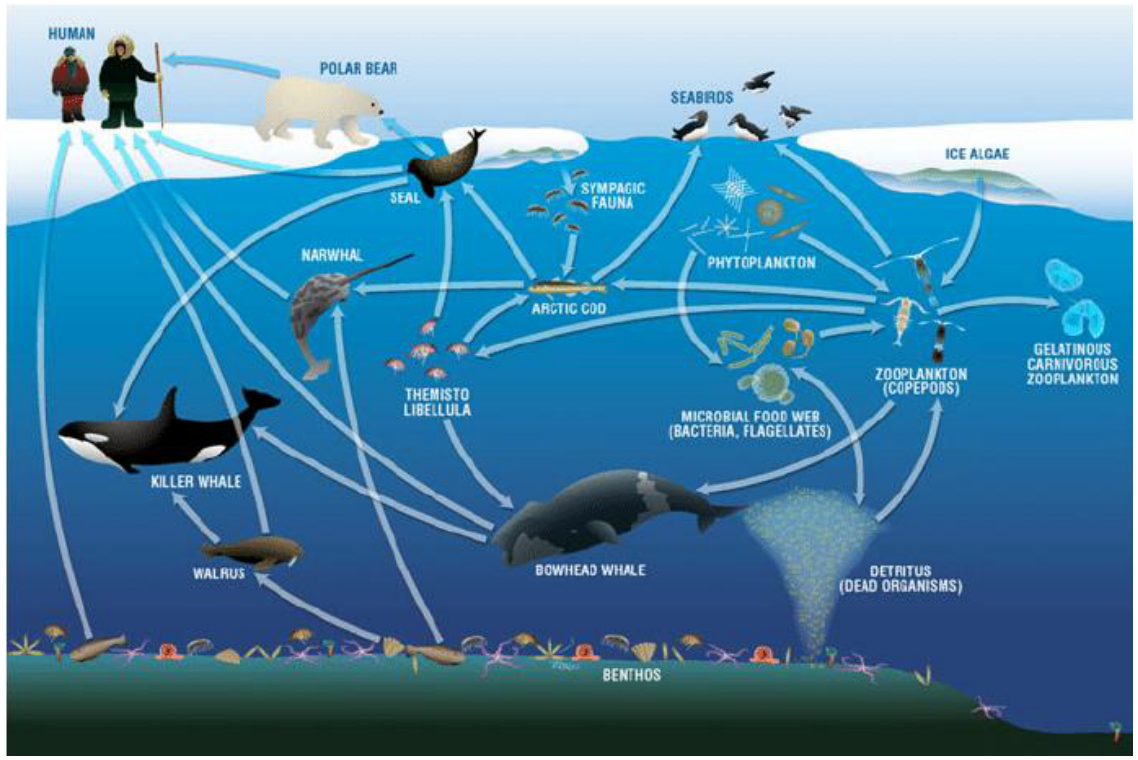
The following image represents a food web in the Arctic Ocean. What would happen if there will be an overfishing of the Arctic cod?
Image reference: Darnis et al. (2012), Climatic Change 115(1):179–205.
Within the tropical rainforests are layers of distinct ecosystems as a consequence of differences in the amount of rainfall and sunlight that can pass through each layer. Which rainforest layer therefore has the richest species diversity?
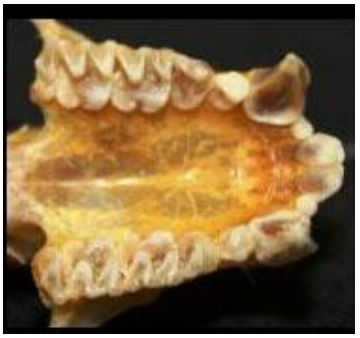
The following image shows the teeth structure of the bat, Phyllostomus hastatus. What is the classification of this bat according to its diet?
Image source: https://insider.si.edu/2011/02/for-chomping-insects-to-fruit-form-follows-function-in-bat-teeth/
One of the symptoms associated with the COVID-19 disease is pneumonia which leads to breathing difficulty among patients. This is due to the SARS-CoV-2, the causative virus of the COVID-19, infecting the alveoli of the respiratory system. How does the viral infection cause the pneumonia?
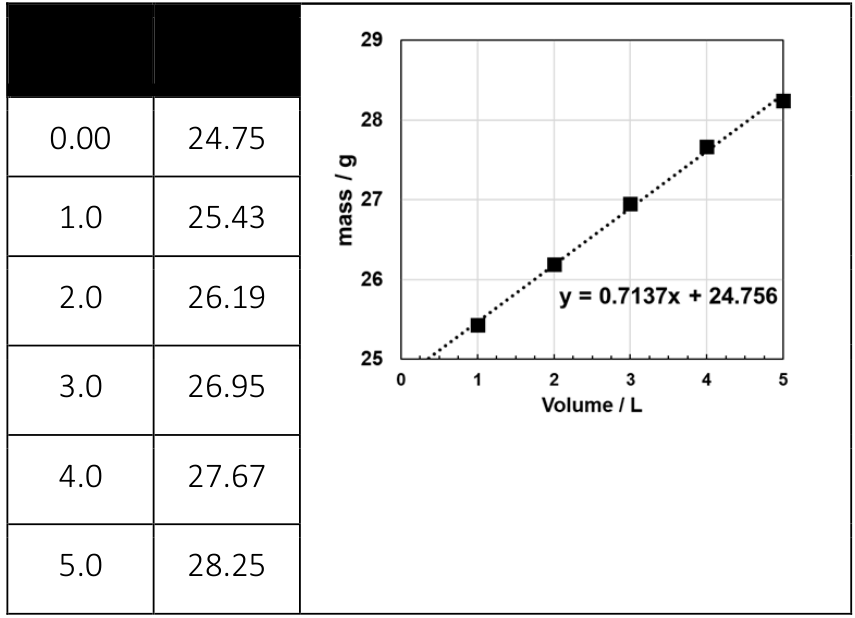
A chemist is determining the density of an unknown liquid. She proceeds by taking the mass of a 10-mL graduated cylinder (24.75 g). Then, she proceeds to add 1mL portions of the liquid while recording the mass. The data is summarized on the table and graphed (best-fit line is also shown) below: From the given data, what is the best measurement of the density?
Editorial unit note: read the horizontal-axis unit consistently with the table and stated additions.
Source-table header transcription: V / mL = added liquid volume; m / g = total mass of cylinder plus liquid. The printed/rendered header cells appear black, so these exact source text-layer headings are supplied here for readability.
Biofuels usually consist of ethanol sourced from fermented biowaste materials. It is a renewable source of energy, as opposed to coal and oil. The demand for such fuels increases every year by at least 3 % as many industries veer away from non- renewable sources of energy. Ethanol ($\mathrm{C_2H_6O}$), like most hydrocarbons, burn in the presence of oxygen gas ($\mathrm{O_2}$) to produce water vapor ($\mathrm{H_2O}$) and gaseous carbon dioxide. It is known that burning 1.00 g of ethanol in a sufficient amount of $\mathrm{O_2}$ results in 1.17 g of water and 1.91 g of carbon dioxide. How much oxygen gas is required for this process?
A small ball filled with air was thrown into a pool of water. The ball was found to float. Which of the following can one deduce from this observation?
Editorial selection convention: choose the most explicit statement identifying the whole observed system.
Air is less dense than water
Air is denser than the ball
The ball is less dense than water
The ball, when filled with air, is less dense than water
Not only is it good for one’s health, but also because it is useless, to open one’s eyes underwater because everything would be blurry. This is because bends a certain way in water, different than that in air, which our eyes are best suited in This bending of waves is called what?
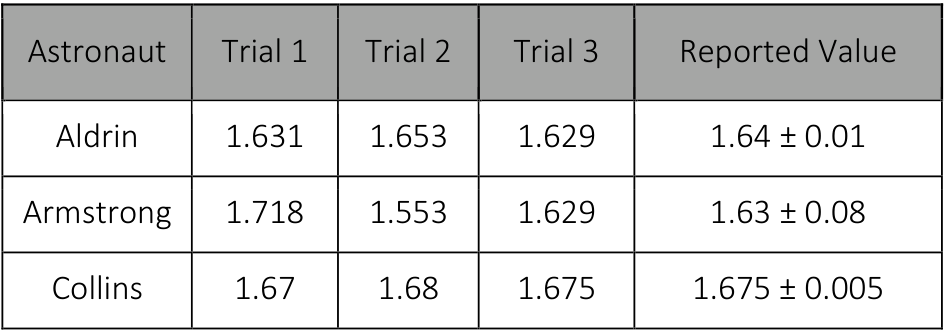
Three astronauts are measuring the acceleration due to gravity on the moon´s surface. Previous studies showed that it is approximately 1.625 $\mathrm{m/s^2}$. Each of them did three trials. Their results are summarized below: Which of them has the most accurate measurement?
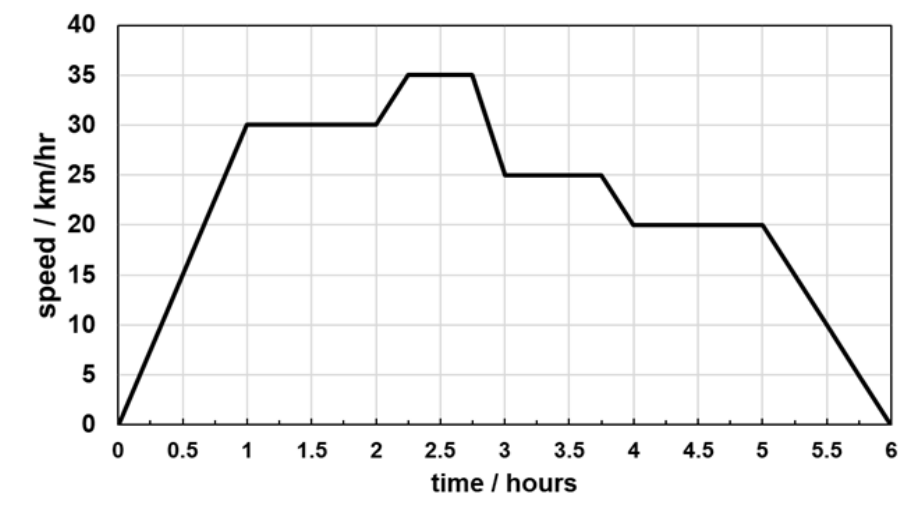
The Tour de France is a 21-day cycling competition that brings professional athletes around France, passing through different cities and villages through the mountains of the Pyrenees and the Alps and finishing at the Champs Elysees in Paris. A typical biker cycles for six hours in a day, logging a speed record as follows: Assuming that the race starts at 8:00 am, what time is the acceleration negative?
9:00 to 10:00, 10:15 to 10:45, 11:00 to 11:45, 12:00 to 13:00
8:00 to 9:00 and 10:00 to 10:15
8:00 to 9:00, 10:00 to 10:15, 10:45 to 11:00, 11:45 to 12:00, and 13:00 to 14:00
10:45 to 11:00, 11:45 to 12:00, and 13:00 to 14:00
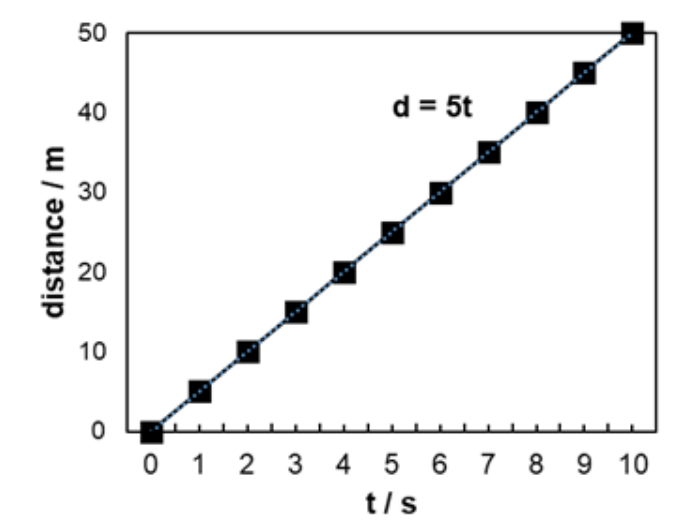
The distance travelled is shown below as a function of time t. Which of the following is true about the data?
Editorial model: straight-line motion in one direction, with constant mass.
The position of the particle changes over time
The acceleration of the particle changes over time
Which of the following rocks could most likely be found in dikes and sills and are characterized by having a composition that is somewhat between a granite and a basalt?
Asia is a region on earth that is usually visited by hurricanes each year. Which among the following is used to measure the wind speed and damage caused by a hurricane?