Let a geometric progression with $n$ terms have first term one, common ratio $r$ and sum $s,$ where $r$ and $s$ are not zero. The sum of the geometric progression formed by replacing each term of the original progression by its reciprocal is
A point in the plane, both of whose rectangular coordinates are integers with absolute value less than or equal to four, is chosen at random, with all such points having an equal probability of being chosen. What is the probability that the distance from the point to the origin is at most two units?
In triangle $ABC,$ $D$ is the midpoint of $AB;$ $E$ is the midpoint of $DB;$ and $F$ is the midpoint of $BC.$ If the area of $\triangle ABC$ is $96,$ then the area of $\triangle AEF$ is
Which of the following statements is (are) equivalent to the statement “If the pink elephant on planet alpha has purple eyes, then the wild pig on planet beta does not have a long nose”?
$\mathrm{I}.$ “If the wild pig on planet beta has a long nose, then the pink elephant on planet alpha has purple eyes.”
$\mathrm{II}.$ “If the pink elephant on planet alpha does not have purple eyes, then the wild pig on planet beta does not have a long nose.”
$\mathrm{III}.$ “If the wild pig on planet beta has a long nose, then the pink elephant on planet alpha does not have purple eyes.”
$\mathrm{IV}.$ “The pink elephant on planet alpha does not have purple eyes, or the wild pig on planet beta does not have a long nose.”
*The word “or” is used here in the inclusive sense (as is customary in mathematical writing).*
A supermarket has $128$ crates of apples. Each crate contains at least $120$ apples and at most $144$ apples. What is the largest integer $n$ such that there must be at least $n$ crates containing the same number of apples?
The measures of the interior angles of a convex polygon are in arithmetic progression. If the smallest angle is $100^\circ$ and the largest angle is $140^\circ,$ then the number of sides the polygon has is
If $r$ is the remainder when each of the numbers $1059,$ $1417$ and $2312$ is divided by $d,$ where $d$ is an integer greater than one, then $d-r$ equals
In triangles $ABC$ and $DEF,$ lengths $AC,$ $BC,$ $DF$ and $EF$ are all equal. Length $AB$ is twice the length of the altitude of $\triangle DEF$ from $F$ to $DE.$ Which of the following statements is (are) true?
$\mathrm{I}.$ $\angle ACB$ and $\angle DFE$ must be complementary.
$\mathrm{II}.$ $\angle ACB$ and $\angle DFE$ must be supplementary.
$\mathrm{III}.$ The area of $\triangle ABC$ must equal the area of $\triangle DEF.$
$\mathrm{IV}.$ The area of $\triangle ABC$ must equal twice the area of $\triangle DEF.$
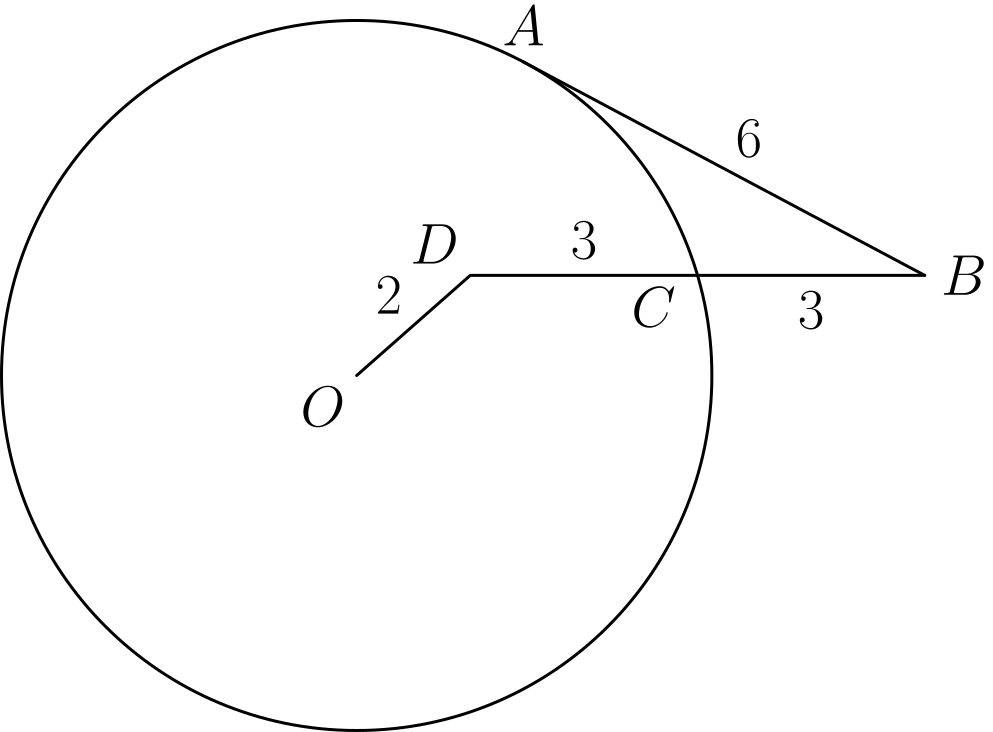
In the adjoining figure, $AB$ is tangent at $A$ to the circle with center $O;$ point $D$ is interior to the circle; and $DB$ intersects the circle at $C.$ If $BC=DC=3,$ $OD=2$ and $AB=6,$ then the radius of the circle is
A polynomial $p(x)$ has remainder three when divided by $x-1$ and remainder five when divided by $x-3.$ The remainder when $p(x)$ is divided by $(x-1)(x-3)$ is
Let $a,$ $b$ and $x$ be positive real numbers distinct from one. Then $$
\begin{aligned} 4(\log_a x)^2&+3(\log_b x)^2\\ &=8(\log_a x)(\log_b x) \end{aligned}
$$