The sum of two natural numbers is equal to three times their difference, and their product is equal to four times their sum. What is the sum of these two natural numbers?
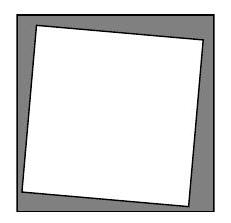
Kristina drew 2 squares whose side lengths in centimetres are natural numbers, and shaded the part of the larger square that lies outside the smaller square (see the figure). The area of the shaded region is $43~\mathrm{cm}^2$. How many square centimetres is the sum of the areas of Kristina's two squares?
(A) 882
(B) 925
(C) 968
(D) 1685
(E) 2022
The second largest divisor of a certain natural number $n$ is 2022. What is the third largest divisor of this natural number $n$?
(A) 337
(B) 674
(C) 1011
(D) 1348
(E) 2021
Find all pairs of natural numbers $k$ and $n$ for which the fraction $\frac{4^{k-1}}{n}$ has, in decimal notation, the form $0. \bar{n}$, where $\bar{n}$ denotes the period. For example, if $n=720$, then $0. \bar{n}=0.720720720 \ldots$
The trapezoid $ABCD$ is inscribed in the circle $\mathcal{K}$. The lines containing the sides $AD$ and $BC$ intersect at the point $M$, and the tangents to the circle $\mathcal{K}$ at the points $B$ and $D$ intersect at the point $N$. Prove that the segments $MN$ and $AB$ are parallel.
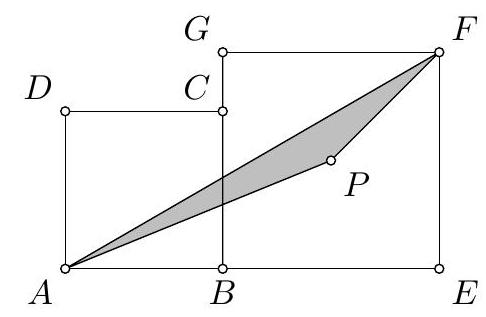
The diagonals of the squares $ABCD$ and $BEFG$ are $8~\mathrm{cm}$ and $11~\mathrm{cm}$ long, respectively. The point $P$ is the intersection of the diagonals of the square $BEFG$ (see the figure). How many square centimetres is the area of the triangle $APF$?
Let $p$ and $q$ be distinct primes. For how many different values of $a$ are both solutions of the quadratic equation $x^{2}+a x+p q=0$ integers?
(A) 4
(B) 3
(C) 2
(D) 1
(E) 0
A jar contains $60 \%$ red and $40 \%$ blue sweets. $30 \%$ of the red and $15 \%$ of the blue sweets are chocolate. What percentage of the sweets are not chocolate?
Tone, Luka and Tine collected waste paper and received a cash prize. Originally the prize was to be divided in the ratio $7:6:5$. Later they changed the agreement and divided the prize in the ratio $6:5:4$. Both ratios are written in the same order as the names are listed.
a. Which division is more favourable for Tine? Justify your answer.
b. In the second division Tone received 216 euros more than Tine. How many euros did each of them receive?
Which expression is equivalent to the given expression
$$
\frac{\sqrt[3]{4 a^{2} \cdot \sqrt[3]{a b} \cdot (a+b)^{0}}}{\left(8 b^{-2} \sqrt{a}\right)^{-\frac{2}{3}}}
$$
where $a, b, a+b \neq 0$?
In the trapezoid $ABCD$ the length of the leg $AD$ is $13~\mathrm{cm}$ and the length of the leg $BC$ is $9~\mathrm{cm}$. The angle $\angle BAD$ measures $37^\circ$. What is the size of the angle $\angle BCD$, rounded to two decimal places, if the angle $\angle CBA$ is acute?
The decreasing linear function $f(x)=k \cdot x+n$ satisfies $f(x+y)=f(x)+f(y)-3$ and $f(k)=2 f(1)$, for all $x, y \in \mathbb{R}$. What is the value of $f(-1)$?
The ratio of the lengths of the leg $a$ and the hypotenuse $c$ in a right triangle is $3:4$.
a) At what angle do the bisectors of the acute angles intersect?
b) At what angle does the bisector of the angle $\alpha$ intersect the opposite leg?
What is the solution of the equation $\sqrt[5]{9^{x-3}}-\frac{1}{\sqrt{3}}=0$?
(A) $x=-\frac{7}{4}$
(B) $x=-\frac{4}{7}$
(C) $x=\frac{4}{7}$
(D) $x=\frac{7}{4}$
(E) $x=-\frac{9}{4}$
What is the exact volume of the solid of revolution obtained by rotating a rectangle with sides $a=2$ cm and $b=3$ cm about the perpendicular bisector of its shorter side?
(A) $2\pi$ cm$^3$
(B) $4\pi$ cm$^3$
(C) $12\pi$ cm$^3$
(D) $\pi$ cm$^3$
(E) $3\pi$ cm$^3$