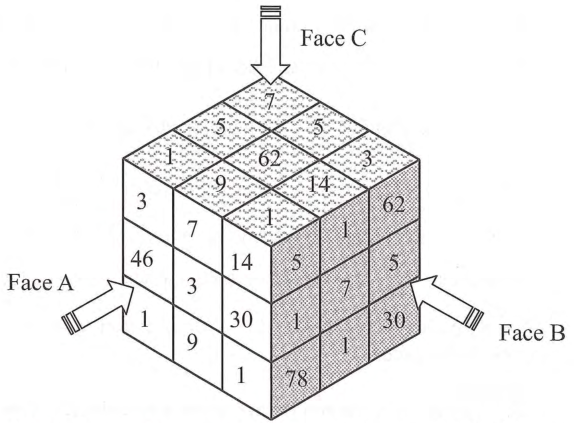
There are 27 unit cubes, each of size $1\times1\times1$, are glued together to form a larger $3\times3\times3$ cube. Each face on each of the $1\times1\times1$ unit cubes contains a positive integer such that:
(i) Two opposite faces of any unit cube must always contain an even number and an odd number. Moreover, the even number must be twice the odd number.
(ii) When any two unit cubes are placed face-to-face, the two touching faces must always contain an even number and an odd number. Moreover, the odd number must be 1 more than the even number.
(a) Place the numbers in the faces of $A'$, $B'$ and $C'$ which are opposite to the faces of $A$, $B$, and $C$, respectively. Find the total sum of the numbers on the faces of $A'$, $B'$ and $C'$. (2 Marks)
(b) Find the total sum of the numbers on the faces of all the unit cubes. (4 Marks)
There are 5 points on the plane, such that no three points lie on one line. Every pair of points is connected by a segment. It is known that it is possible to colour five of these segments in red and the rest in blue, so that all segments of each colour form a simple pentagon. Draw one example.
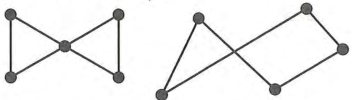
The diagrams below are some examples of a simple pentagon:
The following diagrams below are NOT simple pentagons (because of self intersections):
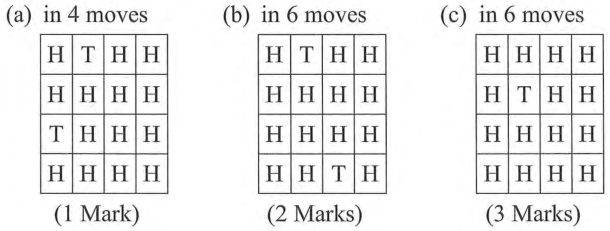
In a $4\times4$ table, we put a coin on each cell. The coins on some cells are tails up (T), while all the other coins are heads up (H). In each move, you are allowed to change all entries in any row, column or diagonal. Diagonals may be of length 1, 2, 3 or 4. Make the entries in the tables below all H using the required number of moves. Show your steps.
(a) in 4 moves (1 Mark)
(b) in 6 moves (2 Marks)
(c) in 6 moves (3 Marks)
(a) In a sequence of positive integers, each term after the first term is the sum of its preceding term and the largest digit of that term. What is the largest possible number of successive odd terms in such a sequence? (3 Marks)
(b) In the following sequence $\{00,01,02,03,\ldots,39\}$, the terms were rearranged so that each term after the first is obtained from the preceding one by increasing or decreasing one of its digits by 1. For example, 29 can be followed by 19, 39 or 28, but not by 30 or 20. What is the largest number of terms that can remain in their original places? (3 Marks)
(a) A chess piece can start anywhere on a $7\times7$ chessboard. It can jump over 4 or 5 vacant squares either vertically or horizontally, but it cannot visit the same square twice. At most how many squares can it visit? (1 Mark)
(b) A chess piece can start anywhere on a $9\times9$ chessboard. It can jump over 5 or 6 vacant squares either vertically or horizontally, but it cannot visit the same square twice. At most how many squares can it visit? (2 Marks)
(c) A chess piece can start anywhere on a $15\times15$ chessboard. It can jump over 8 or 9 vacant squares either vertically or horizontally, but it cannot visit the same square twice. At most how many squares can it visit? (3 Marks)