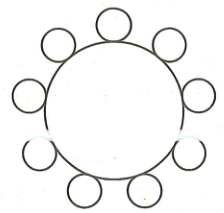
Write the numbers $1,2,3,\ldots,9$ exactly once on the circumference of a circle in such a way that no two neighboring numbers would give a sum that is divisible by either 3 or 5 or 7.
Suppose that the sum of $n$ consecutive integers (which includes positive integers, 0 and negative integers) is 55, find the largest possible value of $n$.
Let $a,b$ and $c$ be distinct digits. The product of the three-digit numbers $\overline{abc}$, $\overline{bca}$ and $\overline{cab}$ is a nine-digit number whose first digit is 2 and last digit is 9. Find this product.
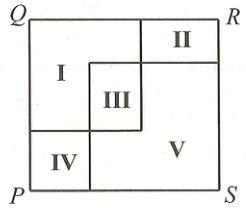
The shape of a factory is a rectangle $PQRS$ with $PS=44$ m and $RS=40$ m. The factory is divided into 5 rooms: I, II, III, IV and V, as shown in the diagram below. The perimeters of rooms II, III and IV are all equal. Also, it is known that rooms I and III as well as rooms V and III form a square, what is the sum of the perimeter, in m, of rooms I and V?
Number $\overline{abcab}$ is a multiple of 7, $\overline{abc}$ is a multiple of 9 and $\overline{cba}$ is a multiple of 4. Find the smallest possible value of $a\times b\times c$.
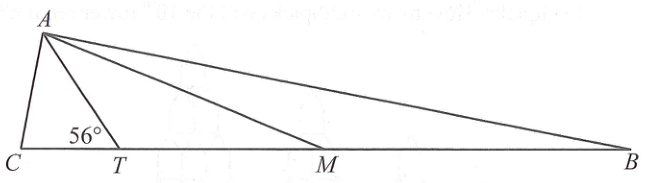
In triangle $ABC$, point $M$ is the midpoint of $BC$, $AM=CM$, $\angle ATC=56^\circ$, and $AT$ bisects $\angle BAC$, as shown in the diagram below. What is the angle measure, in degrees, of $\angle AMB$?
A group of students went on a field trip by bus. Each bus has the same number of students and every seat was occupied. But on the way, one bus broke down. The students were then distributed evenly among the remaining buses and in each bus 4 students had to stand. On the way home, two more buses broke down, and so they finished the trip with 18 students standing in each bus. How many students were on this trip?
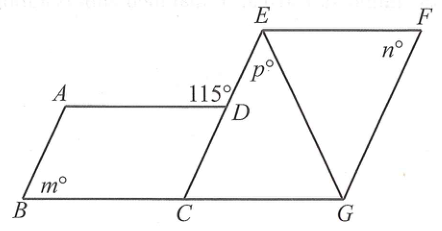
In the diagram below, $ABCD$ and $CEFG$ are parallelograms where $BCG$ is a straight line and $\angle ADE=115^\circ$. If $EG=FG$, find the value of $m+n+p$.
Given 6 different coloured crayons, colour each side of a cube using a different colour. Then write the six numbers on each face so that the numbers 6 and 1; 2 and 5; 3 and 4 are opposite each other. How many different cubes can you make? (Two cubes are considered to be the same if you can rotate one cube into the position of the other.)
The two-digit number $\overline{ab}$ and the number $\overline{ab}+45$ are said to be similar if the sum of the digits of $\overline{ab}$ is the same as the sum of the digits of $\overline{ab}+45$. For example: 15 and $15+45=60$ are similar because the sum of the digits of each number is 6. How many pairs of similar numbers are there?