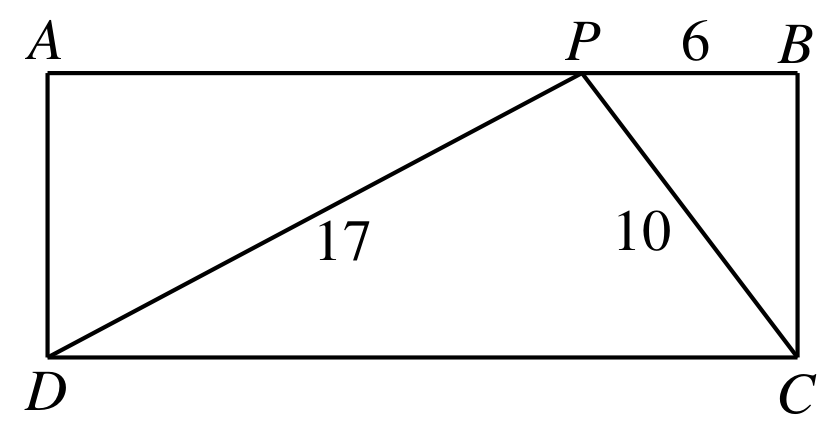
In the figure below, point $P$ lies on rectangle $ABCD$ such that $PB=6$ cm, $PC=10$ cm and $PD=17$ cm. What is the area, in cm$^2$, of rectangle $ABCD$?
If each of the variables $x$, $y$, and $z$ is increased by 1 at the same time, then which one of the following algebraic expressions will remain the same value?
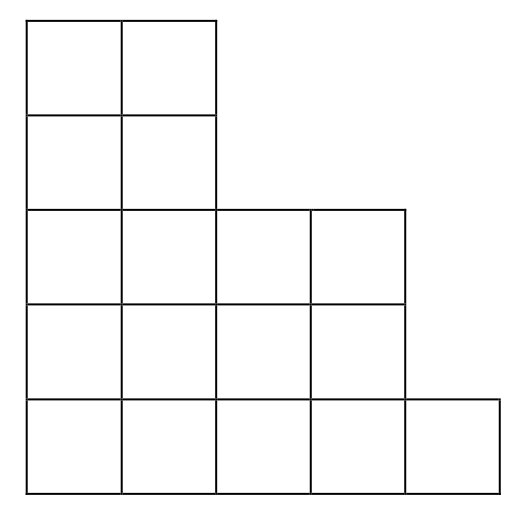
In the figure below, color five unit squares black such that any two black unit squares are not located in the same row or column. How many ways can we color the figure?
There are four rectangular pieces with dimensions of $1\text{ cm}\times2\text{ cm}$, $3\text{ cm}\times4\text{ cm}$, $5\text{ cm}\times6\text{ cm}$ and $7\text{ cm}\times8\text{ cm}$ respectively. They are to be placed on a larger rectangular graphing paper without overlapping. The sides of each piece should be parallel to the edges of the graph paper and that one vertex from each of the four pieces should coincide at a point (that is, this point is also the vertex of four rectangles). What is the smallest possible area, in cm$^2$, of the graphing paper?
Select two different numbers from the set of numbers {1, 2, ..., 10} such that they are not relatively prime. How many different pairs of numbers are there in total? (Note that selecting numbers a and b is the same as selecting b and a.)
The sum of three non-negative integers $a$, $b$, and $c$ is 40, where $a$ is always an odd number. How many ordered triples $(a,b,c)$ will satisfy the condition?
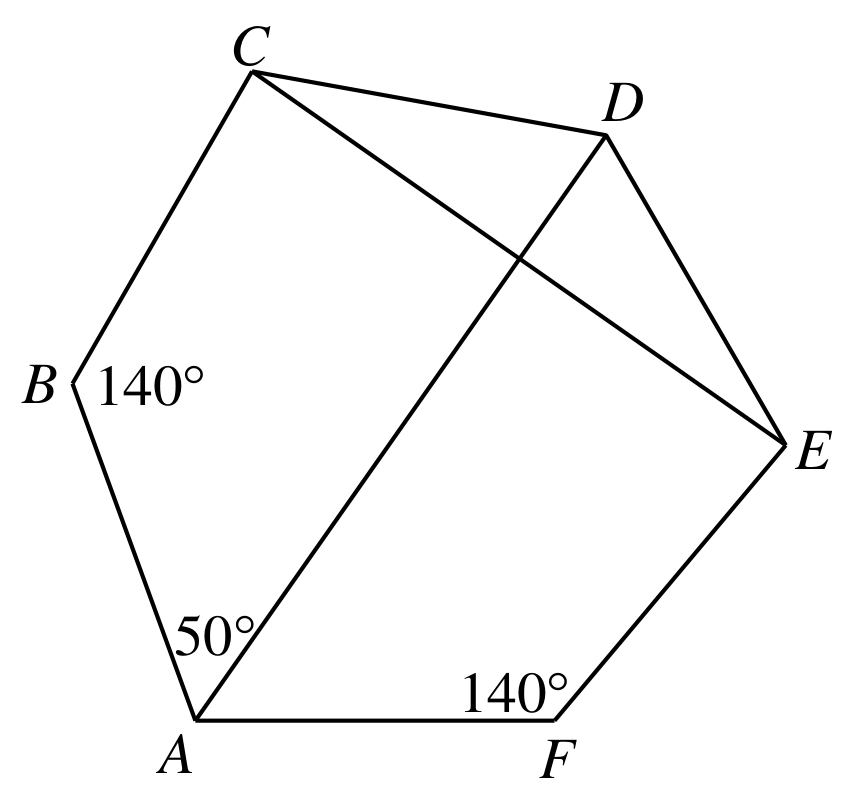
In the figure below, the side lengths of hexagon $ABCDEF$ are all equal, $\angle ABC=\angle AFE=140^\circ$ and $\angle BAD=50^\circ$. Find the measure, in degrees, of $\angle BCE$.
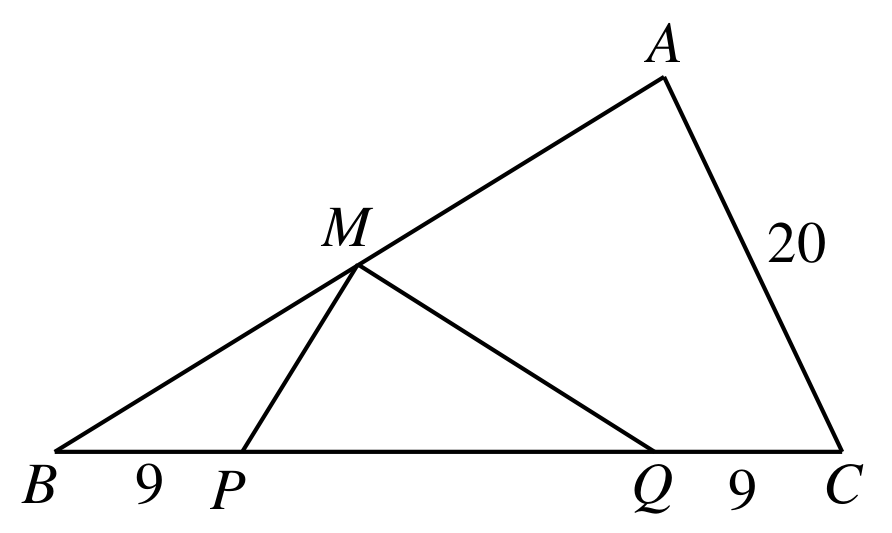
In the figure below, points $P$ and $Q$ lie on side $BC$ of triangle $ABC$ and point $M$ is the midpoint of side $AB$. If $BP=CQ=9$ cm, $AC=20$ cm and $PM\perp MQ$, then what is the length, in cm, of side $BC$?
In the algebraic expression $a^b+c^d+e^f+g^h$, replace each letter with the numbers 1, 2, 3, 4, 5, 6, 7, and 8, such that each letter is represented by a different number. What is the smallest possible value of the said expression?
A three-digit number $\overline{abc}$ is a prime number, such that $a$, $b$ and $c$ represent different digits, and that $a+b+c$ is an odd number. Prove that $a+b+c$ is also a prime number.
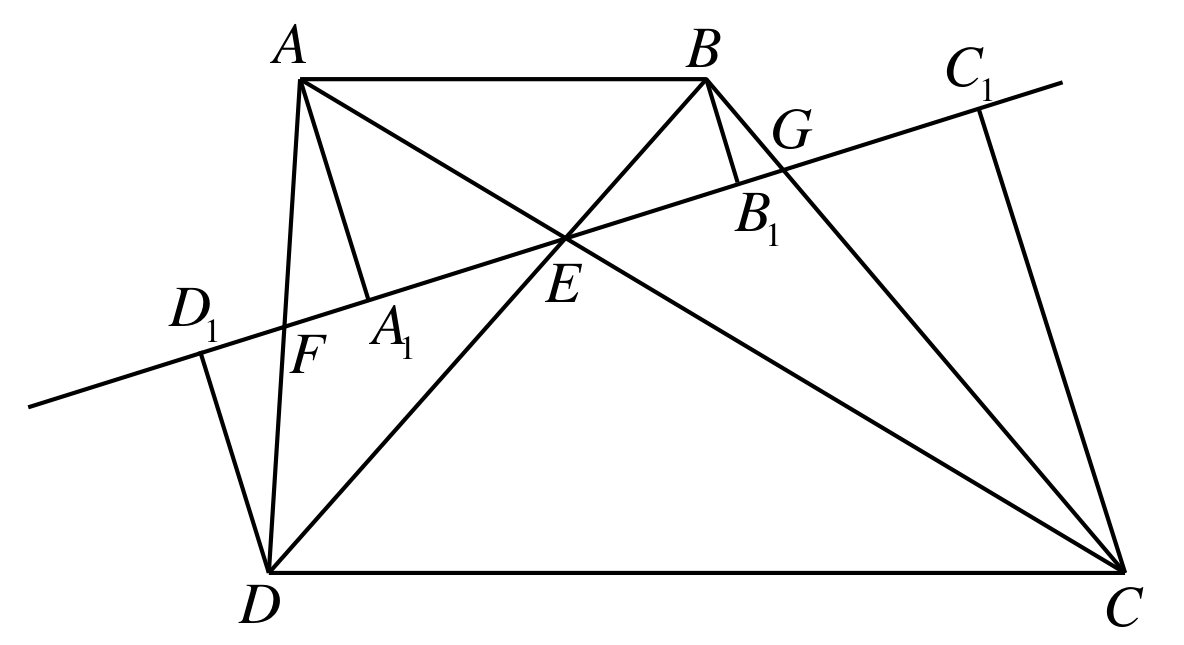
In the quadrilateral $ABCD$, $AB\parallel CD$, point $E$ is the intersection of diagonal lines $AC$ and $BD$, and point $F$ is the midpoint of $AD$. Extend $EF$ to intersect $BC$ at point $G$ and let $A_1$, $B_1$, $C_1$ and $D_1$ be the feet of perpendiculars from $A$, $B$, $C$ and $D$ to line $FG$, respectively.
(1) Prove $\frac{AA_1}{CC_1}=\frac{BB_1}{DD_1}$; (5 marks)
(2) Prove $FE\ge GE$. (15 marks)