Michael bought 6 pens and 3 notebooks while Wallace bought 3 pens and 6 notebooks. The pens are identical and so are the notebooks. Michael’s bill is 6 dollars higher than Wallace’s. How many dollars is the price of a pen higher than the price of a notebook?
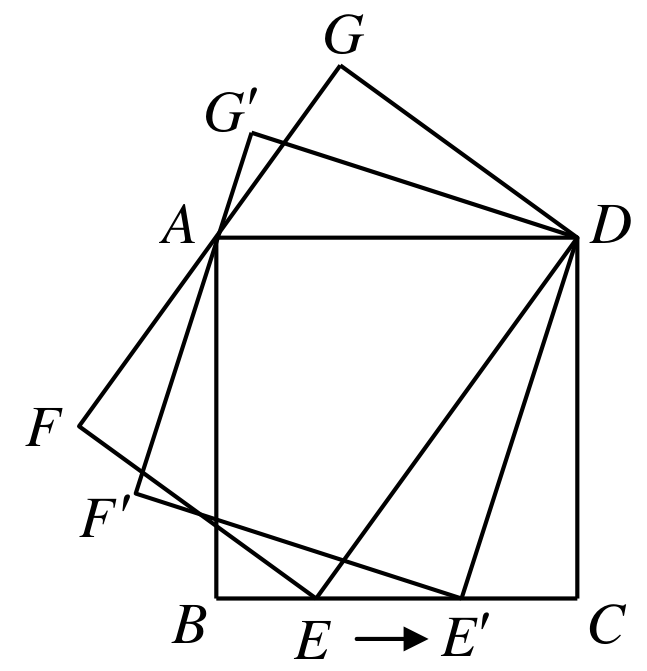
$E$ is a variable point on the side $BC$ of a square $ABCD$. $DEFG$ is a rectangle with $FG$ passing through $A$. As the point $E$ moves from $B$ towards $C$, how does the area of $DEFG$ change?
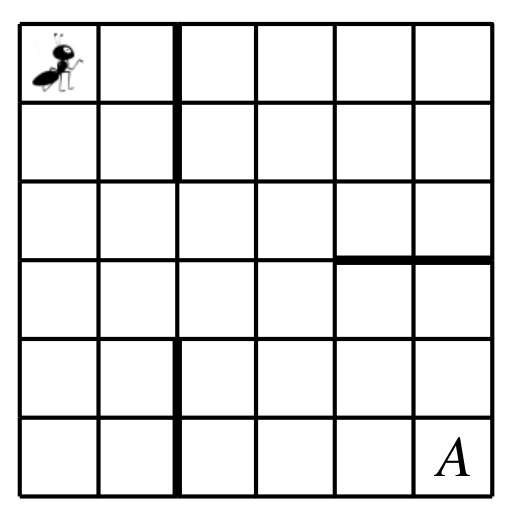
The diagram shows a 6 by 6 board with three barriers. An ant is at the top left corner and wishes to reach the bottom right corner. It may only crawl between squares which share a common side, and only towards the bottom or the right. It cannot pass through any barrier. How many different paths can it follow?
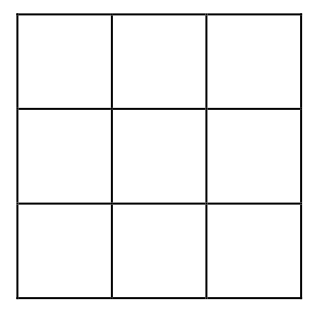
One square in a 3 by 3 board is to be painted black, a second square blue and a third square red. If no two of these three squares are in the same row or in the same column, how many different ways of painting them are there?
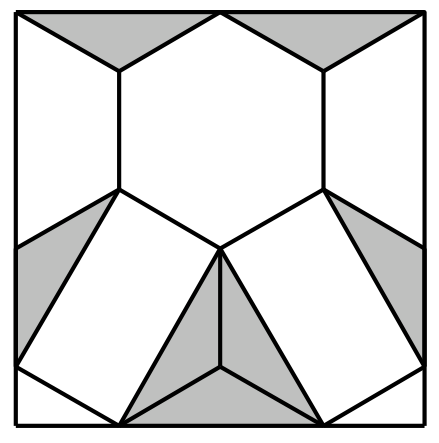
The diagram shows a tile divided into regular hexagons of side length 1 cm. What is the total area, in cm$^2$, of the parts of the tile which are shaded?
Entry format: use sqrt(3) for the square root of 3, * for multiplication, and / for division; omit units.
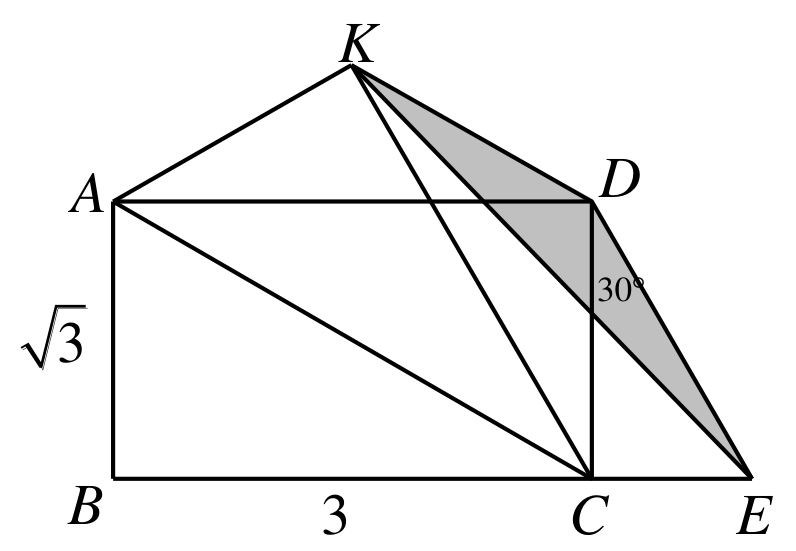
A rectangle $ABCD$ with $BC=3$ cm and $AB=\sqrt3$ cm is folded along $AC$ so that the point $B$ lands on the point $K$ symmetric to it about $AC$. What is the area, in cm$^2$, of triangle $KDE$, where $E$ is the point on the extension of $BC$ such that $\angle CDE=30^\circ$?
Entry format: use sqrt(3) for the square root of 3, * for multiplication, and / for division; omit units.
In the expression $(((10\square2)\square2)\square2)\square2$, each $\square$ is to be replaced by a different one of $+$, $-$, $\times$ and $\div$. How many different values can this expression take?
Let $a,b,c,d$ be four different non-zero digits. The greatest common divisor of the four-digit numbers $\overline{abcd}$ and $\overline{acbd}$ is $n$. What is the largest possible value of $n$?
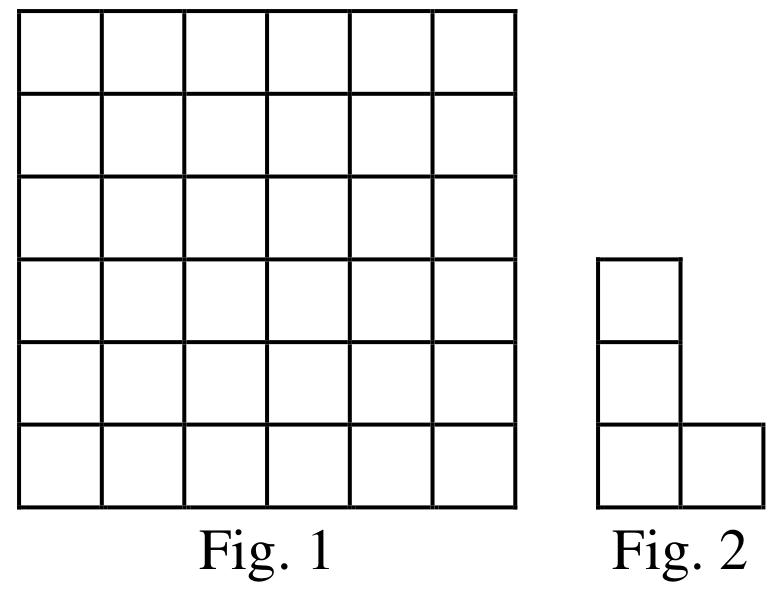
The first diagram shows a 6 by 6 board, and the second diagram shows an L-shaped piece consisting of four 1 by 1 squares. Paint as few of the squares of the 6 by 6 board black so that wherever the L-pieced piece is placed on the board covering four squares, at least one of the squares will be black. The L-shaped piece may be turned about or flipped over.
Detailed solutions are needed. Answer: At least paint ___ squares black.
$P$ and $Q$ are points on the bisector of the exterior angle at $A$ of triangle $ABC$, with $A$ between $P$ and $Q$, such that $BP$ is parallel to $CQ$. $D$ is the point on $BC$ such that $DP=DQ$. Prove that $AB$ is parallel to $DQ$.