a) Determine the sum of the real roots of the equation $$
x^{2}+18 x+30=2 \cdot \sqrt{x^{2}+18 x+45}
$$
b) Solve the equation $\sqrt{5-\sqrt{5-x}}=x$, with $0\lt x\lt 5$.
between $1$ and $2$ - Complete the numerators with positive integers to satisfy the conditions: $\frac{a}{5}$ and $\frac{b}{7}$ are smaller than $1$, and $1 \lt \frac{a}{5} + \frac{b}{7} \lt 2$.
Pedrinho chose 8 different numbers between 1 and 11 and wrote them in a certain order. Joãozinho, seeing the numbers that Pedrinho wrote, noticed the following curious fact: if we average the $n$ first numbers written by Pedrinho, $n=1, \ldots, 8$, we will always have an integer as a result. That is, if we average the first two numbers, the first three, the first four numbers, and so on, all these averages will be integers. What are the possible sequences of numbers that Pedrinho wrote? (Tip: First find out what the possible sums are for the 8 numbers, and then try to find out the chosen numbers backwards.)
A train line is divided into 10 sections by stations $A, B, C, D, E, F, G, H, I, J$ and $K$. The distance from $A$ to $K$ is equal to $56~\mathrm{km}$. The path of two consecutive sections is always less than or equal to $12~\mathrm{km}$ and the path of three consecutive sections is always greater than or equal to $17~\mathrm{km}$. Determine the distances:
a) from $J$ to $K$;
b) from $D$ to $H$;
c) from $B$ to $G$.
The number $119$ is very interesting because it leaves the rest $1$ when divided by $2$, it leaves the rest $2$ when divided by $3$, it leaves Remain $3$ when divided by $4$, leaves rest $4$ when divided by $5$ and finally leaves rest $5$ when divided by $6$. Are there other three-digit numbers with these properties?
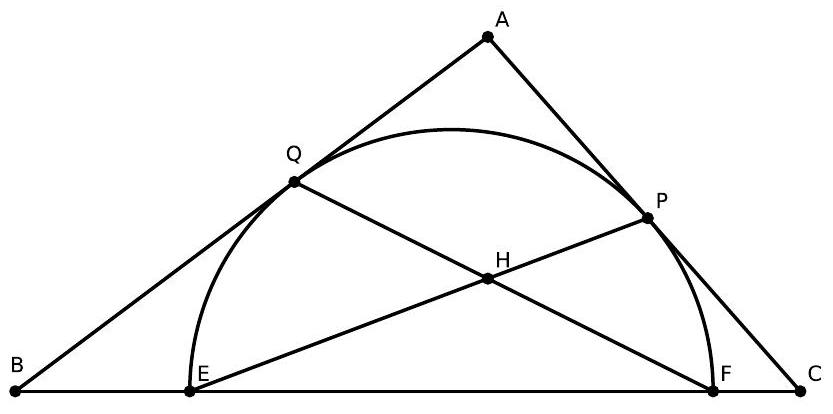
A semicircle of diameter $E F$, located on the side $B C$ of the triangle $A B C$, is tangent to the sides $A B$ and $A C$ in $Q$ and $P$ respectively. The lines $E P$ and $F Q$ are located in $H$. Show that $A H$ is the height of the triangle.
Construímos dois triângulos equiláteros: $ABE$ interno e $BFC$ externo ao quadrado $ABCD$. Prove que os pontos $D$, $E$ e $F$ se localizam na mesma reta.
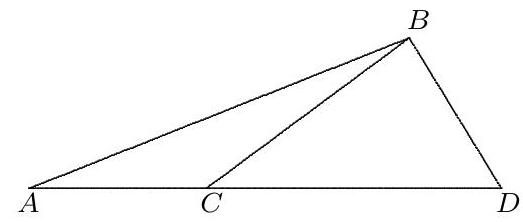
Triangle Area - If $AC = 1{,}5\ \mathrm{cm}$ and $AD = 4\ \mathrm{cm}$, what is the relationship between the areas of triangles $\triangle ABC$ and $\triangle DBC$?
We say that a positive three-digit integer is three stars if it is the result of the product of three distinct prime numbers. For example, $286=2 \cdot 11 \cdot 13$ is a three-star number, but $30=2 \cdot 3 \cdot 5$ and $275=5 \cdot 5 \cdot 13$ are not three-star numbers, as the first only has two digits and the second is not the product of three distinct primes.
a) What is the smallest number three stars?
b) Shows that each number three stars has a common divider with $30$ greater than $1$.
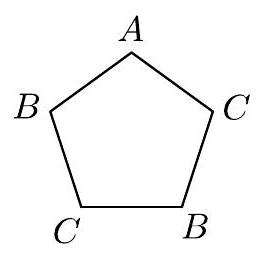
João has three-color buttons: blue, white and gray. We will represent a blue button by $A$, a white button by $B$ and a gray button by $C$. It places five buttons on the vertices of a regular pentagon clockwise: $A, C, B, C$ and $B$, as in the first figure below. He knows he can do some button changes by following a certain rule. When choosing a button, it can exchange it for one of another color as long as there are no two buttons with the same color in neighboring vertices. In order not to change buttons without objective, he decides to adopt as a goal to leave the buttons with the colors $A, B, C, B$ and $C$ clockwise as indicated in the second figure below. After making several changes, João was unable to reach the desired final situation. He then decided to ask his teacher for help from Piraldo. The teacher states that it is not possible to start from the initial configuration and reach the desired final configuration. To prove this, Professor Piraldo took some cards with the numbers $1,-1$ and 0 . Then he told John to put a card on each side of the Pentagon with the following pattern: i) Looking clockwise, if the vertices have $B$ and $A$ or have $A$ and $C$ Place a card with the number 1 . ii) Still looking clockwise, if the vertices have $A$ and $B$ or have $C$ and $A$, place a letter with the number -1 . iii) For other cases, place the letter 0 . Whenever you make an exchange, change the cards using these instructions. After the explanation, Professor Piraldo said that analyzing the behavior of the letters João could now conclude because it is impossible to achieve the initial objective.
a) doing all possible button changes, from $A$ to $B$, from $B$ to $C$ or $C$ for $A$ and reverse exchanges, what happens to the sum of the cards placed on the sides according to Professor Piraldo's instructions?
b) What is the sum of the cards in the initial situation and the desired final situation? Complete that it is not possible to start from the initial configuration and reach the desired final situation.
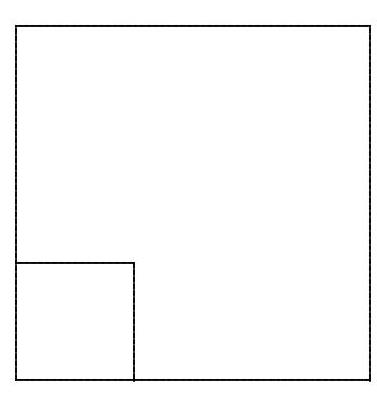
The two squares - The measurements in centimeters of the sides of each of the two squares are whole numbers. If the smallest square had $2001~\mathrm{cm}^2$ more than the area, the two squares would be equal. How much can the side of the largest square measure?
In a triangle $ABC$, the angle $A\hat{BC}$ measures $20^\circ$ and the angle $A\hat{C}B$ measures $40^\circ$. Let $E$ be a dot about $BC$ such that $BE = BA$.
a. Shows that the triangle $CEA$ is isosceles.
b. Knowing that the angle bisector length $B\hat{A}C$ is $2$, determine $BC - AB$.
In the game - Aldo, Bernardo and Carlos play cards. At first, the amount of money they had was in the proportion $7:6:5$. At the end of the game, the ratio was $6:5:4$. One of the players won 1200 reais. How much money did each player get at the end of the match?
Some real numbers are written in the houses of a $n \times n$ board so that the sum total of the written numbers is positive. Show that there is some permutation of the columns of the board, so that the sum of the numbers written in the houses of the main diagonal of the new board is positive.
Determine the closest integer to
a. $\frac{19}{15}+\frac{19}{3}$
b. $\frac{85}{42}+\frac{43}{21}+\frac{29}{14}+\frac{15}{7}$
c. $-\frac{11}{10}-\frac{1}{2}-\frac{7}{5}+\frac{2}{3}$
 After making several changes, João was unable to reach the desired final situation. He then decided to ask his teacher for help from Piraldo. The teacher states that it is not possible to start from the initial configuration and reach the desired final configuration. To prove this, Professor Piraldo took some cards with the numbers $1,-1$ and 0 . Then he told John to put a card on each side of the Pentagon with the following pattern: i) Looking clockwise, if the vertices have $B$ and $A$ or have $A$ and $C$ Place a card with the number 1 . ii) Still looking clockwise, if the vertices have $A$ and $B$ or have $C$ and $A$, place a letter with the number -1 . iii) For other cases, place the letter 0 . Whenever you make an exchange, change the cards using these instructions. After the explanation, Professor Piraldo said that analyzing the behavior of the letters João could now conclude because it is impossible to achieve the initial objective.