The cells of a $3 \times 3$ table were numbered from $1$ to $9$, each number appearing exactly once. For each row the cell with the greatest number is colored red and the cell with the smallest number is colored green. Let $A$ be the smallest of the numbers in the red cells and $B$ the greatest of the numbers in the green cells.
a. Show a distribution of the numbers in the table such that $A - B = 4$.
b. Show a distribution of the numbers in the table such that $A - B = -3$.
Let $ABCD$ be a quadrilateral with $\angle ABC \neq 90^\circ$. Let $M$ and $N$ be the midpoints of $AD$ and $CD$, respectively. Prove that the lines perpendicular to $BC$ passing through $M$ and perpendicular to $AB$ passing through $N$ and $BD$ are concurrent if and only if the diagonals $BD$ and $AC$ are perpendicular.
Determining a sequence - In a certain sequence of 80 numbers, any term, except for both ends, is equal to the product of its neighboring terms. The product of the first 40 terms of the sequence is $8$ and the product of all terms is also $8$. Determine the terms of the sequence.
Place the numbers $663, 664, 665, 666, 667, 668, 669, 670$ and $671$, without repeating, in a table $3 \times 3$, in such a way that the sum in each row, each column and each diagonal is $2001$. If this is not possible, justify your answer.
Sum and invert - using only the two operations "+1=\text{add 1}" and "$-i=\text{minus the reverse}$", we can form several sequences from an initial number. For example, starting with the number $3$, we can form the sequence $$
3 \xrightarrow{+1} 4 \xrightarrow{+1} 5 \xrightarrow{-i}-\frac{1}{5} \xrightarrow{+1} \frac{4}{5} \xrightarrow{-i}-\frac{5}{4} \xrightarrow{+1}-\frac{1}{4} \xrightarrow{+1} \frac{3}{4} \xrightarrow{-i}-\frac{4}{3} .
$$ starting with $0$, with which sequence we will retrieve the $0$, using only these two operations "+1" and "$-i$"?
Circles within the square - Inside a square circles are placed, two by two disjoint, or tangent externally. If the side of the square measures $1~\mathrm{cm}$, will it be possible to place so many of these circles in such a way that the sum of their radii, in centimeters, is greater than $2008$?
Ball of Marble - Three friends play a marble ball game, convicting that the loser of each round folds the balls of the other players, that is, he gives the other two such a number of balls that they are twice as big as they had at the beginning of the round. The first player lost the first round, the second player the second, the third to the third and all finished with 64 balls each. How many balls did each of the three friends start this match with?
Periodic decimal - Knowing that $0,333\ldots=\frac{1}{3}$, which is the irreducible fraction equivalent to $0,1333\ldots$.
(a) $\frac{1}{13}$
(b) $\frac{1}{15}$
(c) $\frac{1}{30}$
(d) $\frac{2}{15}$
(e) $\frac{1333}{10000}$
Ada and Luisa train every day, each of them always with the same speed, for the big race that will take place at the end of the year at school. Training starts at point $A$ and ends at point $B$, distant $3000~\mathrm{m}$. They depart at the same moment, but when Luisa finishes the race, there is still a need for $120~\mathrm{m}$ for ADA to reach point $B$. Yesterday, Luisa gave Ada a chance: "We left at the same time, but I leave a few meters before point A to get together." How many meters before point $A$ should Luisa leave to get along with Ada?
Let $O$ be the intersection point of the diagonals of the cyclic quadrilateral $ABCD$. The circumcircles of triangles $AOB$ and $COD$ meet lines $BC$ and $AD$ again at $M$, $N$, $P$ and $Q$. Prove that the quadrilateral $MNPQ$ is inscribed in a circle with center $O$.
A group of five friends plays Secret Santa: each friend buys a gift for one other friend, and each gives and receives exactly one gift. In how many ways can the recipients be assigned so that nobody gives a gift to themselves?
Sum of squares - Find three numbers, in an arithmetic progression of ratio $2$, such that the sum of its squares is a number formed by four equal digits.
Two tables - The rows of the first table are all arithmetic progressions of the same common difference and the columns of this table are all arithmetic progressions of the same common difference. In the second table given, the same training law was used, but someone deleted some numbers leaving only three. what is the number that was in the indicated position with
Let $ABCD$ be a parallelogram and $\Gamma$ the circumcircle of the triangle $ABD$. Lines $BC$ and $CD$ meet $\Gamma$ at $E \ne B$ and $F \ne D$ respectively. Prove the circumcenter of the triangle $CEF$ lies on $\Gamma$.
certain number leaves the rest $1$ when divided by $3$, leave the rest $2$ when divided by $4$, leave the rest $3$ when divided by $5$ and leave the rest $4$ when divided by $6$. What is the smallest positive integer that satisfies these properties?
An electricity company installed a pole on flat ground. To fix the pole well, cables were attached to the pole, at a height of $1{,}4$ meters from the ground and the $2$ meters away from the pole, one of the cables being measured by $2{,}5$ meters, as shown in the figure. A math teacher, after analyzing these measures, stated that the pole is not perpendicular to the ground. Do you think the teacher is right? Justify your answer.
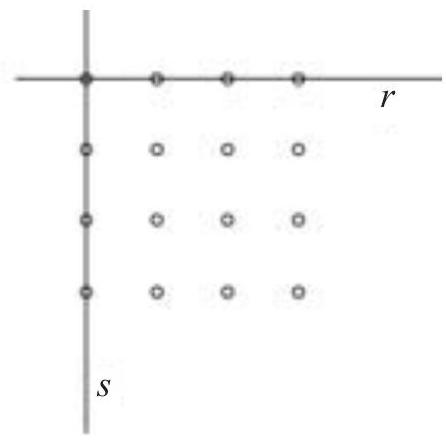
In the figure given, we have 16 points forming a square reticulated and two straight lines, $r$ and $s$, perpendicular to each other.
a) How many squares can we build, in such a way that its vertices belong to the lattice, but none of its sides is parallel, nor to the line $r$, nor to the line $s$ ?
b) How many isosceles right triangles we can build in such a way that their vertices belong to the lattice, but none of its sides are parallel, nor to the line $r$, nor to the straight $s$ ?
A code - In the expression below, each letter corresponds to a digit, with different letters corresponding to different numbers. Determine these digits. $$
6 \times A O B M E P = 7 \times M E P A O B
$$