Let $a,b,c$ be distinct positive integers such that the product of any two of them plus 1 is a perfect square. Write $ab+1=r^2$, $ac+1=s^2$, $bc+1=t^2$, where $r,s,t$ are positive integers. Suppose $0\lt a\lt b\lt c$. Prove that $\dfrac{rs}{t}$ is not a positive integer.
Hoa travels from home at constant speed. At 1 pm the distance traveled is a two-digit number; at 2 pm it has the same digits reversed; at 3 pm it is the original digits with 0 inserted between them. Find her speed in km/h.
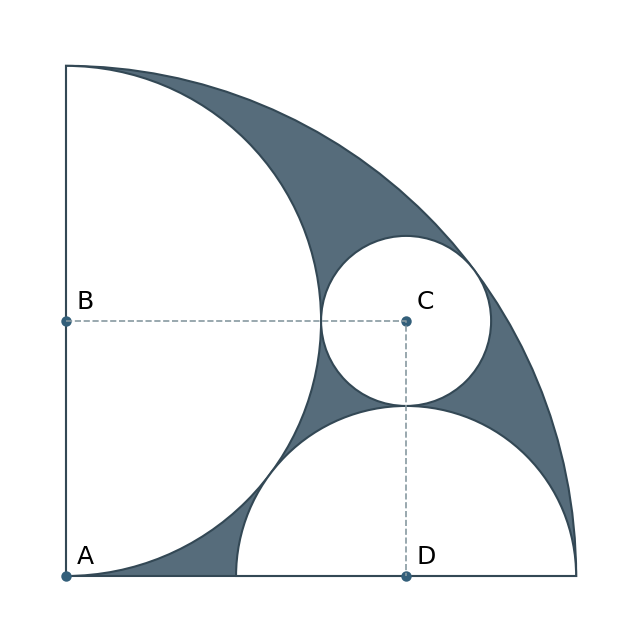
Inside a quarter disk of radius $R$ are two tangent semicircles and a circle tangent to both, arranged as shown. The shaded area is $\pi R^2/x$. Find $x$.
Using the source's indexing, let $S(n+1)$ denote the number of trailing zero digits of $n!$. Find the smallest natural number $n$ such that $S(n+1)-S(n)=5$.
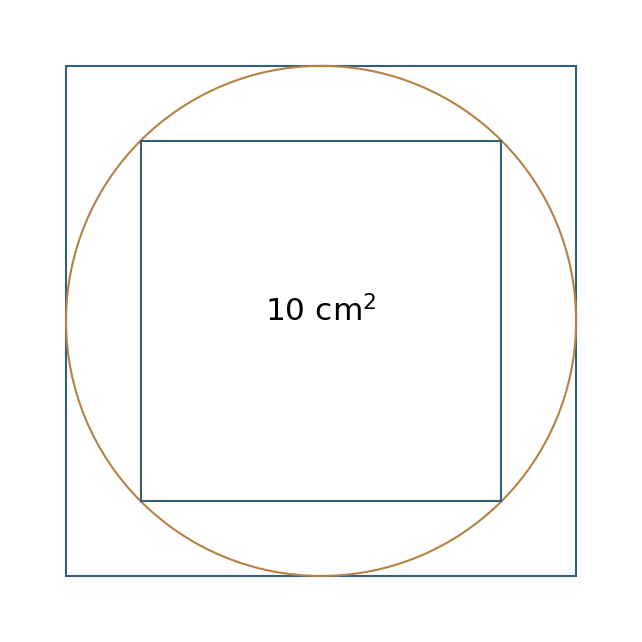
In the figure, the smaller square is inscribed in a circle, which is inscribed in the larger square. The smaller square has area $10\,\mathrm{cm}^2$. Find the larger square's area.
A staircase has 10 steps. A giant climbs from ground level to the top, taking between 1 and 10 steps in each stride. How many climbing sequences are possible?
A circle centered at O has radius 5 cm and perpendicular diameters AB and CD. M is the midpoint of OD, and AM meets the circle again at K. Find the area of triangle KAC in square centimeters.
Positive integers are arranged in the left-aligned triangular array below. The header labels the columns; the labels before the vertical line number the rows.
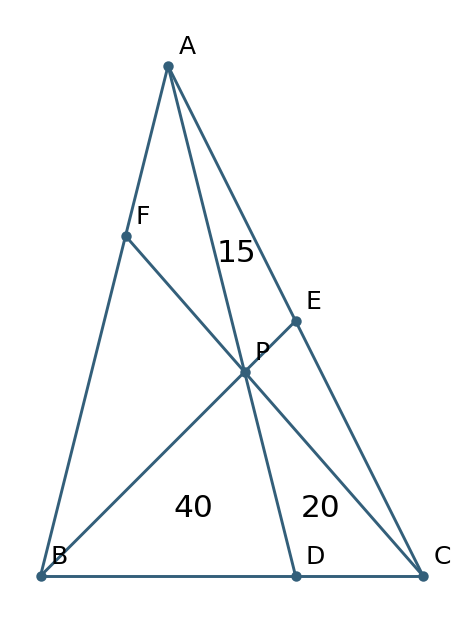
Three cevians of triangle $ABC$ concur at an interior point $P$, meeting opposite sides at $D,E,F$. As shown, the small areas are $[BPD]=40$, $[DPC]=20$, and $[APE]=15$. Find $[ABC]$.
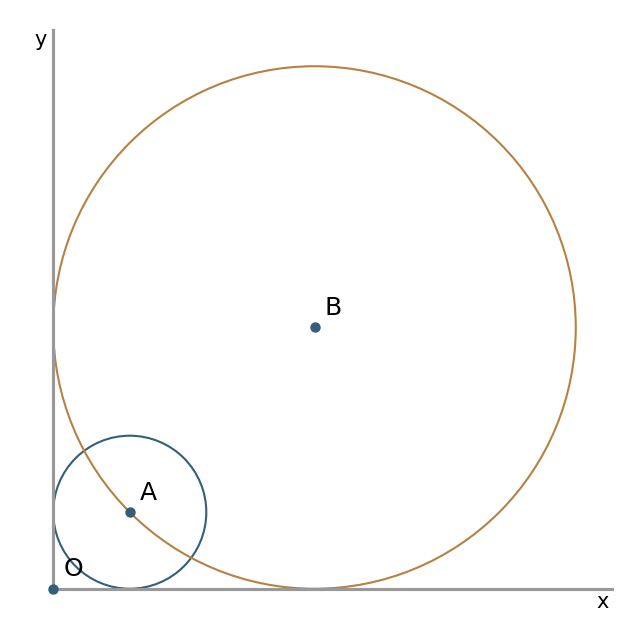
Two circles centered at $A,B$ are tangent to both rays of the right angle $xOy$, and $A$ lies on the circle centered at $B$. As shown, circle $(B)$ is larger. Find its radius divided by that of $(A)$.