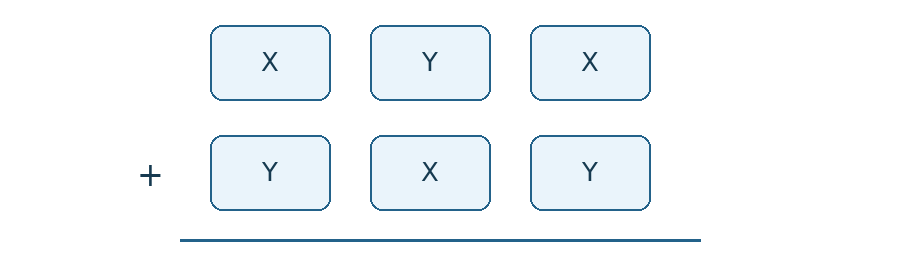
$\overline{XYX}$ and $\overline{YXY}$ are three-digit whole numbers, where $X,Y$ are distinct nonzero digits. Find the sum of the digits of the greatest possible value of $\overline{XYX}+\overline{YXY}$.
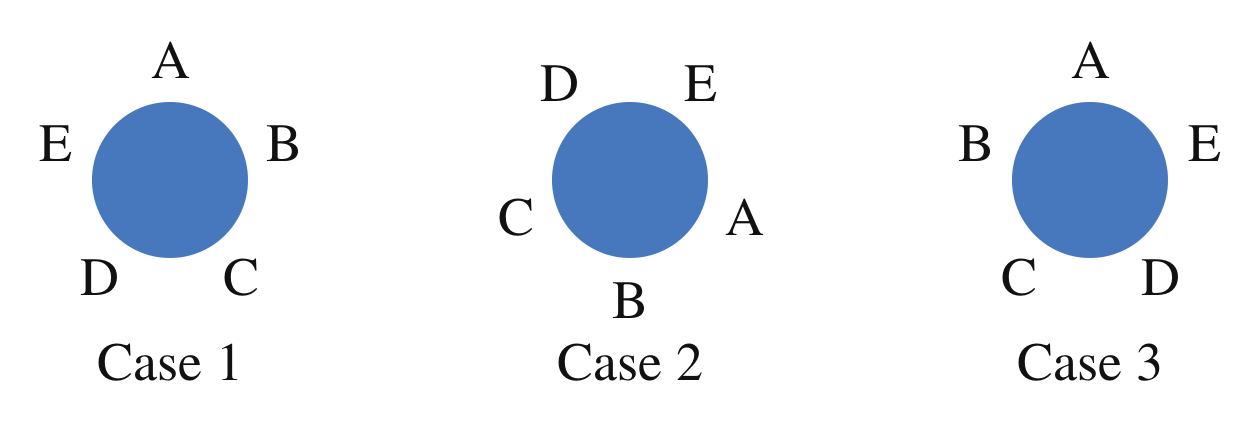
Mr. and Mrs. Hansen and their three children sit around a circular table. In how many ways can they sit if the parents sit next to each other? Rotations count as the same arrangement; reflections count as different arrangements. In the illustration, Cases 1 and 2 are the same, but Case 3 is different.
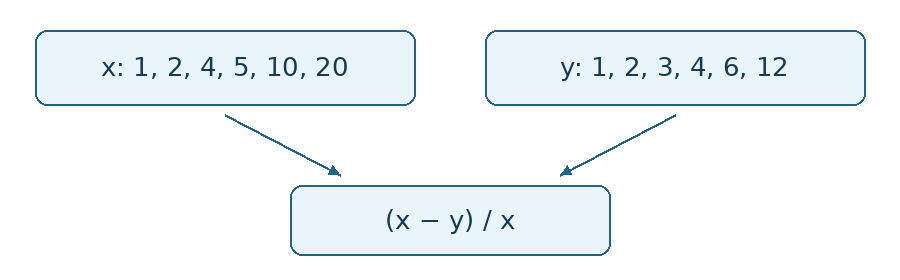
Let $M$ be the greatest value of $\dfrac{x-y}{x}$, where $x$ is a positive integer factor of 20 and $y$ is a positive integer factor of 12. Find $20M$.
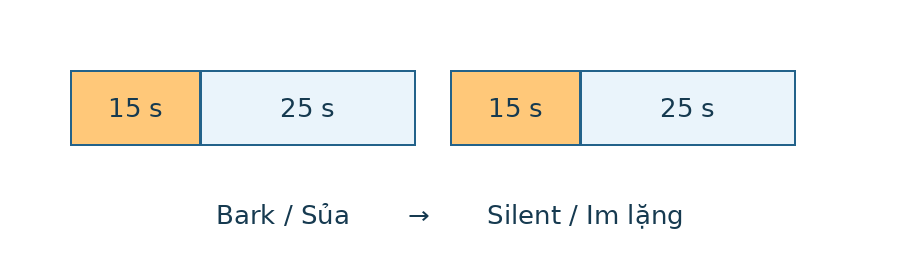
Starting at midnight, Aarf the dog barks for 15 seconds, then is silent for 25 seconds, repeating until 1:01 AM that morning. How many full 15-second barking sessions occur?
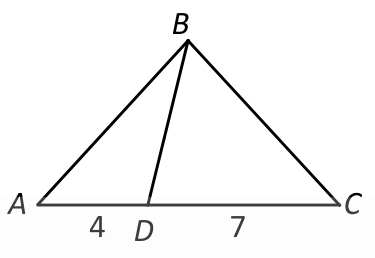
In triangle $ABC$, point $D$ lies on $AC$, with $AD=4$ and $DC=7$. Triangle $ABD$ has area 20 square units. Find the area of triangle $ABC$ in square units.
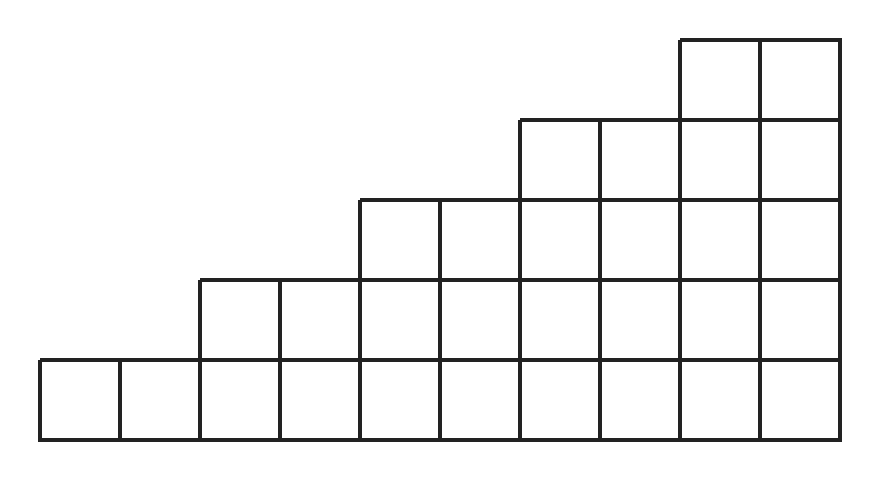
Thirty unit squares share sides and vertices in the step arrangement shown. How many squares with integer side lengths can be found in this arrangement?
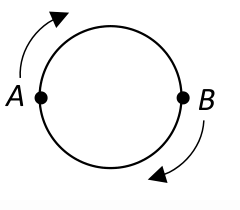
Andy and Brett start at opposite points on a circular track of circumference 300 feet and jog in the directions shown (the same direction around the track). Andy runs at 4.3 feet per second and Brett at 5.5 feet per second. After how many seconds do they first meet?
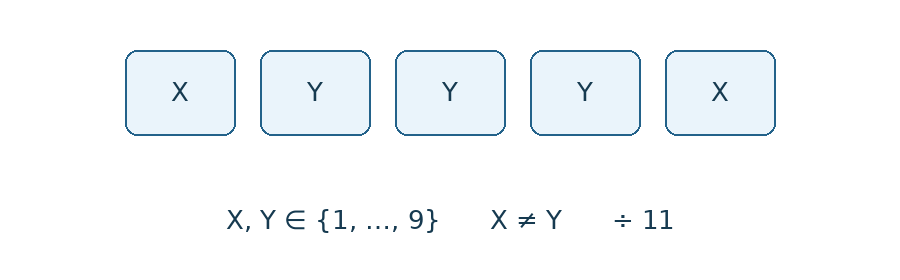
In the five-digit integer $\overline{XYYYX}$, $X,Y$ are different nonzero digits. If the number is divisible by 11, how many different values are possible?
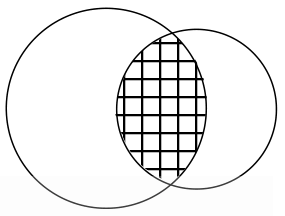
Two circles of radii 14 cm and 21 cm overlap in the crosshatched region shown, whose area is $580\text{ cm}^2$. Find half the combined area of the two unhatched regions, in $\text{cm}^2$. Use $\pi=22/7$.
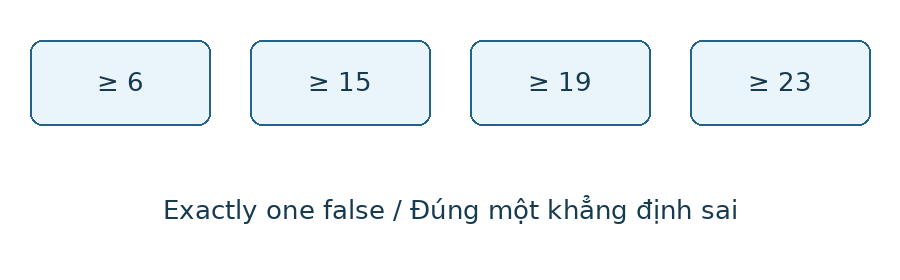
Betsy collects sports posters. Exactly one of these statements is false: she has at least 6 posters; at least 15 posters; at least 19 posters; at least 23 posters. What is the greatest possible number of posters she has?
$\overline{XYX}$ and $\overline{YXY}$ are three-digit integers, where $X,Y$ are distinct nonzero digits. How many different values of $\overline{XYX}+\overline{YXY}$ are possible?