SEAMO self-study edition 2027; not an official 2027 paper. Original source years are retained. 25 questions, 90 minutes; Q1–10: 3 points, Q11–20: 4 points, Q21–25: 6 points, total 100. Original response types and all subparts are preserved. Verified is an editorial convention; source defects, necessary assumptions and unresolved mathematical uncertainty are disclosed.
Find the units digit of $$(2+1)(2^2+1)(2^4+1)(2^8+1)(2^{16}+1)(2^{32}+1)(2^{64}+1).$$
Suppose $a,b,c,d,e$ are consecutive positive integers with $a\lt b\lt c\lt d\lt e$. The sum $b+c+d$ is a perfect square and $a+b+c+d+e$ is a perfect cube. Find the smallest value of $c$.
Enter the exact number only; fractions are allowed.
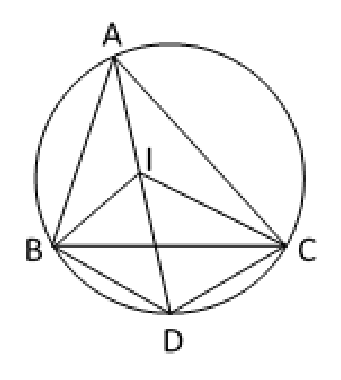
$I$ is the incentre of triangle $ABC$. The ray $AI$ meets the circumcircle again at $D$. Given $AB=3$, $AC=4$, and $[IBC]=[DBC]$, find $BC$. Here $[XYZ]$ denotes triangle area.
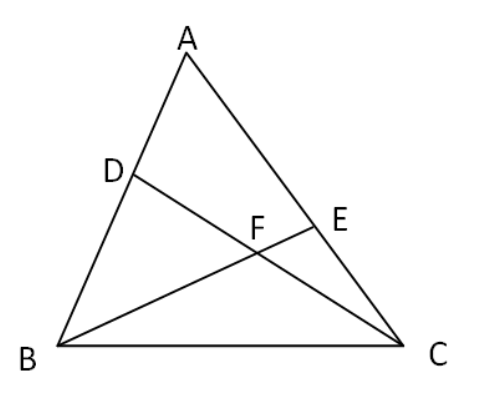
In equilateral triangle $ABC$, points $D,E$ lie on $AB,AC$, respectively. Segments $BE$ and $CD$ meet at $F$, with $\angle BFC=120^\circ$. Which statement about the lengths $AD$ and $CE$ is true?
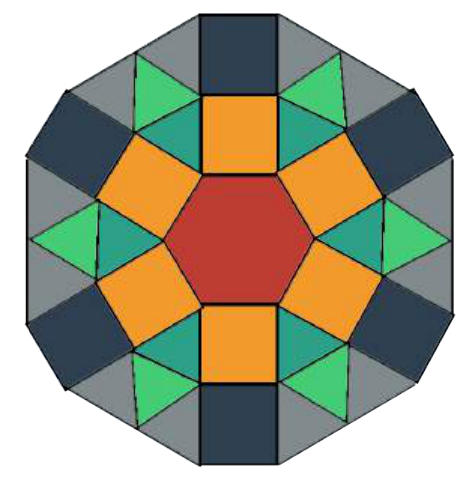
The floor-tile pattern in a mall has a hexagon at its centre. The first ring consists of 6 squares and 6 equilateral triangles. The second ring consists of 6 squares and 18 triangles, and the pattern continues as shown. How many triangles are in the eighth ring?
A positive integer $n$ satisfies all three conditions: (i) $n/5$ is a perfect square; (ii) $n/2$ is a perfect cube; (iii) $n$ is divisible by 27. Find the least possible $n$.
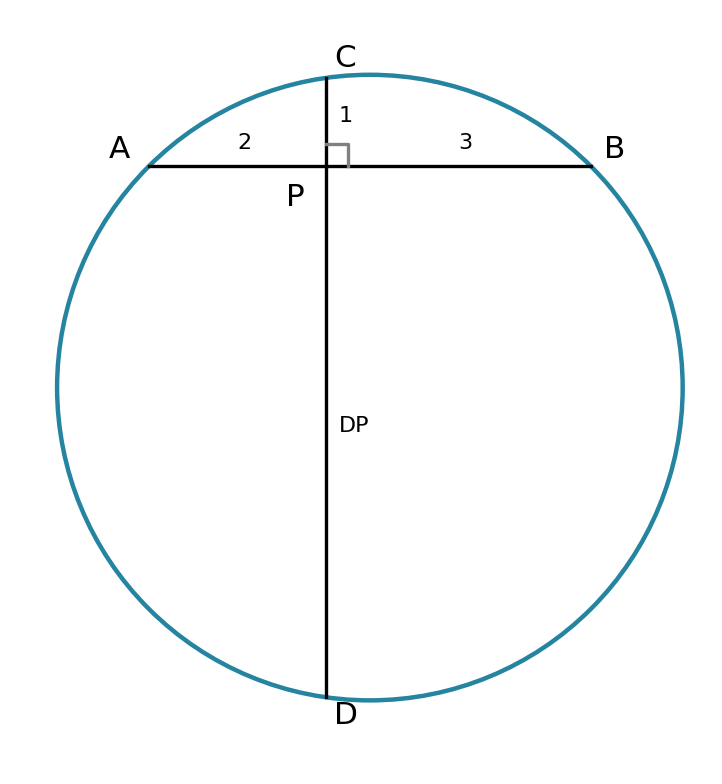
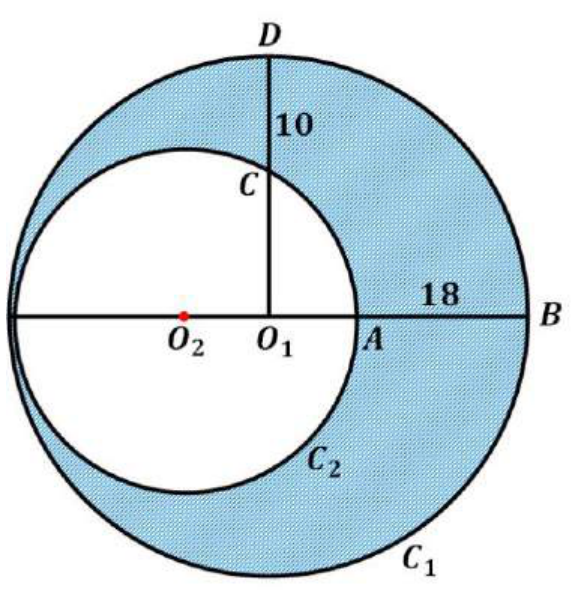
Two circles $C_1,C_2$ of different sizes are internally tangent, as shown. Their centres are $O_1,O_2$. Given $AB=18$ and $CD=10$, find the area of the shaded region.
A jury of 12 people decides whether a defendant is guilty; an absolute majority is needed. Four will vote YES and three NO. Four others each toss a fair coin and vote according to the result. The last person votes with the majority. What is the probability of a guilty verdict?
Use independent fair coin tosses. The last juror follows the majority of the other eleven jurors.
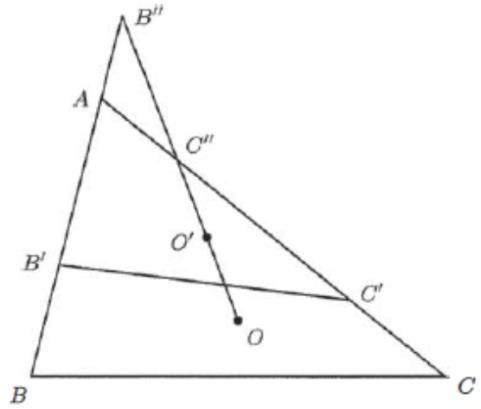
In triangle $ABC$, points $B^{\prime},C^{\prime}$ lie on $AB,AC$ with $BB^{\prime}=CC^{\prime}$. Let $O,O^{\prime}$ be the circumcentres of $ABC$ and $AB^{\prime}C^{\prime}$. The line $OO^{\prime}$ meets the lines $AB^{\prime},AC^{\prime}$ at $B^{\prime\prime},C^{\prime\prime}$, respectively. Given $AB=\tfrac12AC$, which statement is true?
Use the nondegenerate construction shown: the two circumcentres are distinct and the indicated line intersections exist. Lines may be extended.
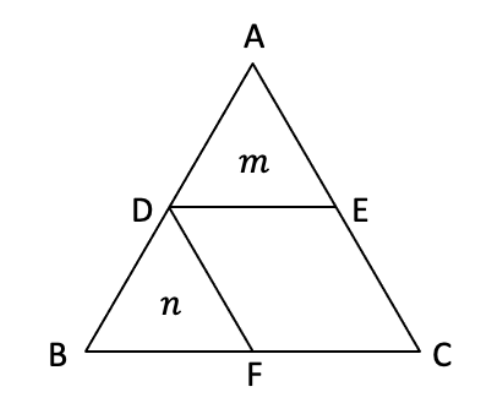
In triangle $ABC$, $D$ lies on $AB$ and $DE\parallel BC$, with $E$ on $AC$. Point $F$ lies on $BC$ and $DF\parallel AC$. The areas of triangles $ADE$ and $DBF$ are $m,n$, respectively. Find the area of quadrilateral $DECF$.
Noppon travels from $A$ to $B$ and back along the same route. His speed is 12 km/h downhill and 4 km/h uphill. The outward trip takes 50 minutes and the return trip takes $1\tfrac12$ hours. Find the distance from $A$ to $B$ in km.
The route consists of uphill and downhill portions only, with the stated speeds throughout each portion.